Microchip _ Nov 25
반도체 AI 보안 인더스트리 4.0 SDV 스마트 IoT 컴퓨터 통신 특수 가스 소재 및 장비 유통 e4ds plus
인공지능(AI) 기반 유니버설로봇 자동화 솔루션
2025-11-13 10:30~12:00
원종호 차장, 심재호 차장 / Universal robots
  AI와 협동로봇의 미래를 만나다   Physical AI로 진화하는 자동화 솔루션의 새로운 패러다임   올해로 설립 20주년을 맞은 유니버설로봇(Universal Robots)은 글로벌 누적 판매 10만 대 이상을 돌파하며 협동로봇 업계를 선도하고 있습니다. 세계 최대 규모의 R&D..

[모빌리티 그랑프리] [Interview] Nam Jun-hee, CEO of Goodbye Car: "Electric and hydrogen vehicle reuse policies are urgently needed."

기사입력2023.08.14 12:20

"Electric and hydrogen vehicle reuse policies are urgently needed."

Recycling policies are needed to recognize and recycle reusable batteries… "The recycling industry has a long way to go."
Hydrogen fuel cell stacks are being used as generators to reduce fuel cell stack performance… "There's no reason why it shouldn't be done."

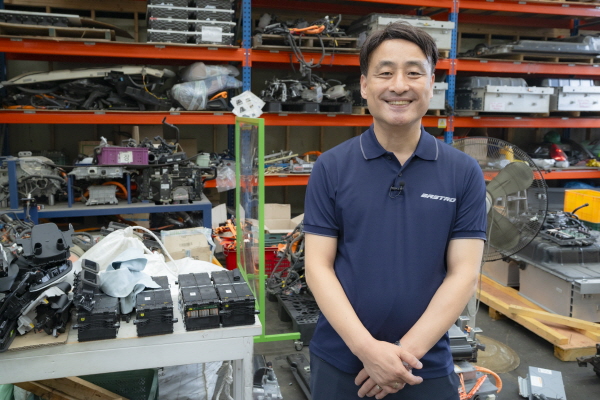
[Editor's Note] GoodbyeCar is an electric vehicle scrapping company that reuses core components, such as batteries, during the scrapping process to manufacture small electric storage devices. This is a prime example of recycling electric vehicle waste batteries, which account for approximately 30% of the carbon footprint of an electric vehicle's entire life cycle, in consideration of environmental friendliness and economic efficiency. GoodbyeCar is also focusing on the reusability of the Nexo's hydrogen electric vehicle fuel cell stack and is actively conducting research and development. Despite these economic feasibility and potential, Nam Jun-hee, CEO of GoodbyeCar, stated at the National Assembly's Future Waste Resources Circulation Forum in July that there are many difficulties due to the policy's focus on recycling and the lack of accurate information about batteries. Accordingly, this magazine met with Nam Jun-hee, CEO of Goodbye Car, to hear about the challenges and prospects of the reuse business.

■ Please tell us about Goodbye Car and the projects you are pursuing.
Goodbye Car is a junkyard that stands for 'Goodbye Car'.
The company's first business is dismantling and recycling automobiles, and it also manufactures and sells various products by reusing key electric vehicle components while focusing on electric vehicles.
We manufacture and sell electric storage devices based on batteries, which are the core of electric vehicles, and we aim to become an energy company.
■ At the previous Future Waste Resources Circulation Forum, it was mentioned that electric vehicle scrapyards were being built in the US and Europe. I am curious to know how the process is progressing.
We are currently in the process of understanding the systems of each country.
GoodbyeCar's business model is to purchase damaged vehicles and reuse them after evaluating their parts. We are currently looking into how damaged electric vehicles are handled in each country.p;
Also, since it takes a lot of time and money to do it alone, I am trying to find a good partner.
We look forward to meeting capable partners at the International Automotive Recycling Conference in Warsaw, Poland in September.
Not all companies are like that, but when I went to a junkyard in the US in June, I saw that they weren't prepared for electric vehicle recycling, so I felt it was difficult to do business with them.
The German junkyard said it had never done any electric car business before, and when asked why, it said it didn't know how.
Although it is not easy to find, we are looking for companies that are interested in electric vehicles and willing to work together based on GoodbyeCar's experience and technology.
■ Are there any difficulties in the business related to electric vehicle scrapping?
All of our country's systems are focused on developing, manufacturing, and distributing new products.
Reuse is a manufacturing area and is a very long part of the value chain.
Electric vehicles must be recovered, the batteries separated, evaluated, and products made from the selected batteries.
It is still more expensive than using a new battery, and customers have a negative perception of used products when selling them. Because of this, there are many times when long persuasion is necessary.
Additionally, there are many related systems that say 'don't do', and the process of overturning these takes a long time.
As a new task, we are trying to make a generator using a fuel cell stack, but there are many things that cannot be done due to laws such as the High Pressure Gas Safety Act.
Although it is difficult for small and medium-sized businesses to change the system, it is clearly necessary and worthwhile.
What is the outlook for battery reuse and recycling?
I think there is hope for the reuse sector, as there are many small and medium-sized enterprises related to the three major battery companies in our country, creating a good environment for cooperation.
Korea's three battery companies are the world's leaders in the ternary battery field.
I felt that if we had automobiles, shipbuilding, and semiconductors, we had batteries that surpassed them all.
Making batteries is not Goodbye Car's role, but recycling them can be.
The 2kW product being sold is the first and first small-capacity electricity storage device that reuses electric vehicle batteries.
Launched ahead of two BMW-backed companies exhibiting at the Hannover Messe in Germany this year It is.
Sungil Hi-Tech, Goodbye Car's shareholder, has world-leading material extraction technology and continues to expand.
I view these achievements very positively.
■ He also said that policy support for hydrogen electric vehicle fuel cell stacks is necessary. What is the current situation and what needs to be improved?
It's unfortunate that there are no policies for the reuse and recycling of hydrogen electric vehicles, but it's no one's fault.
Many people are trying to improve the system for recycling and reusing electric vehicles, but it seems that there is not enough capacity.
The country with the most hydrogen cars per unit area is Korea.
As of the end of June 2023, subsidies for 32,484 Nexos were paid out by the national treasury and local governments, totaling over 1 trillion won.
It is regrettable that a reuse policy has not been established despite the fuel cell stack being installed, worth 40 million won.
Hydrogen fuel cell stacks cannot be repaired, and when performance deteriorates, the vehicle itself is scrapped rather than the stack being replaced.
The Hyundai Nexo has been on the market for a little over five years since March 2018.
After 4-5 years, Hyundai Motor Company's quality warranty will end, and the number of Nexos with deteriorated performance will increase, but there are many regrettable aspects to only extracting materials.
There's no reason why it wouldn't be used as a regular generator with slightly reduced performance, although it's not enough to drive a car. It's well worth a try.
If we succeed in developing a zero-emission power generator using reused fuel cell stacks, it is expected that we will be able to commercialize mobile electric vehicle chargers.
The development stage has been completed with the motor separated, and it will require a lot of development costs until commercialization.
Every time I meet with the Ministry of Trade, Industry and Energy, the Ministry of Environment, and KEPCO, I ask them to create a task for me.
■ Please say a word to e4ds readers.
When I gave a lecture on electric cars, there were many opposing opinions, including concerns that electric cars use a lot of electricity and thus support the need for nuclear power, and concerns about their high price.
From a security perspective and an independent life perspective, I think electricity is the best option.
In the early days of electric vehicles, there were practical issues due to their short driving ranges and problems with chargers, but all of these are being improved.
Likewise, if sufficient research and development is conducted on used batteries for electric vehicles, it is expected to become the cheapest means of storing electricity in human history.
GoodbyeCar will further improve the reusability of various parts, and I believe that this will also contribute to society.