반도체 AI 보안 인더스트리 4.0 SDV 스마트 IoT 컴퓨터 통신 특수 가스 소재 및 장비 유통 e4ds plus

Hyundai Motors Makes Strategic Investment in Startup ‘Code 42’ to Build ‘Future Mobility Integrated Platform’

기사입력2019.04.19 14:10

| Hyundai Motor Company makes strategic investment in Code42, founded by former Naver CTO Song Chang-hyun, to accelerate its transformation into a smart mobility solutions provider

Hyundai Motor Company is joining hands with the country's top engineers to secure capabilities to lead the future mobility era and take the lead in cutting-edge technologies in future innovative growth areas.
Code 42

Hyundai Motor Company announced on the 15th that it will make a strategic investment in the startup 'CODE42 (CODE42.ai)' founded by former Naver CTO Song Chang-hyun and will engage in diverse cooperation with each other.

This is part of a strategic decision to accelerate the transformation into a “smart mobility solution provider” announced by Hyundai Motor Group Executive Vice Chairman Chung Eui-sun last year and to become a “game changer” leading the market landscape.

Song Chang-hyun, CEO of Code 42, said, “While Naver has been solving online problems so far, we are now planning to lead offline innovation through Code 42,” and “With Hyundai Motor Company’s strategic investment as a catalyst, Code 42 will create a guidebook for the coming world of mobility.”

Code 42 is a new startup established by CEO Song Chang-hyun in Pangyo Techno Valley last month, and is a paradigm shift in the future mobility service market.We are focusing on the innovative changes that customers can experience in their daily lives. To this end, we have started developing the Urban Mobility Operating System (UMOS), an integrated mobility platform that covers the entire process of urban mobility services from A to Z.
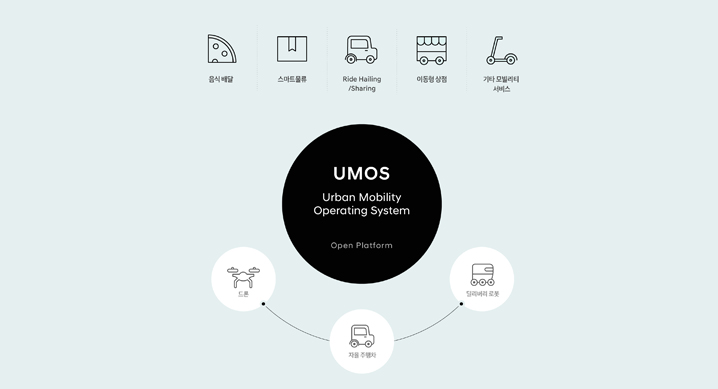
Code 42 UMOS

The future city is expected to be operated with a logistics system and transportation infrastructure that incorporates fully autonomous driving technology. UMOS is a next-generation service platform that will satisfy people’s needs for shopping, fast delivery, and various transportation and mobility methods. In other words, it is a technology that integrates various forms of autonomous transportation such as autonomous vehicles, drones, and automatic delivery robots into one, enabling the provision of individual mobility services such as car calling, car sharing, robo-taxi, smart logistics, and food delivery. It is judged that it will become an essential infrastructure in a smart city where the city is operated as an integrated system.

The biggest feature of the UMOS solution is that it is an open platform in which various mobility service providers can participate jointly, and can develop into various partnership and cooperation models. As the number of players participating in the open platform increases, the synergy effect is maximized and the value returned to consumers increases.

Code 42 plans to not only build the UMOS platform, but also introduce its own mobility service utilizing it. In addition, the company plans to make diversified efforts to secure technologies such as autonomous driving technology for drones, delivery robots, and future pods, which are essential technologies for UMOS, as well as AI automatic dispatching, HD optimized routing, and predictive vehicle management.

Hyundai Motor Company will actively collaborate with Code42 to develop advanced smart mobility solutions through strategic investment.

Hyundai Motor Company has already conducted a car sharing business using the Ioniq EV in Amsterdam, the Netherlands, and is engaging in strategic collaboration with global mobility companies such as Grab in Southeast Asia, Ola in India, Mesh Korea in Korea, and Meego in the US. It is also accelerating the development of its own mobility service platform and operating system to be applied to the global market.

Based on its collaboration with Code 42, Hyundai Motor Company plans to pursue mobility services and technological advancements while realizing various possibilities through integration with UMOS. In addition, it plans to pursue comprehensive cooperation in the fields of future automobiles such as autonomous vehicles and connected cars, as well as robotics, artificial intelligence, and precision maps.

Meanwhile, the industry predicts that the global mobility-as-a-service market size will grow significantly from USD 38.8 billion in 2017 to USD 358.4 billion in 2025 due to the development of autonomous driving technology and the spread of the sharing economy.
이수민 기자
기사 전체보기