마이크로칩7월
Physical AI HBM Smart Factory SDV AIoT Power Semicon 특수 가스 정정·반론보도 모음 e4ds plus

Gwangju Metropolitan City, leaping forward as a representative city of artificial intelligence

Google 우선 소스 기사입력2022.01.25 09:09


Gwangju Integrated Complex Project Budget for this year: 107.6 billion won
Gwangju Key Industry·Artificial Intelligence Convergence Promotion Project

Gwangju Metropolitan City and the Ministry of Science and ICT will invest 107.6 billion won in 2022 to create an integrated complex that combines Gwangju's main industries with AI, thereby leaping forward as a representative city of artificial intelligence.

The Ministry of Science and ICT (MSIT) and Gwangju Metropolitan City held a steering committee meeting for the 'Gwangju Artificial Intelligence Centered Industry Convergence Complex Development Project (hereinafter referred to as the 'Gwangju Complex Project')' consisting of experts from both organizations and industry, academia, and research on the 24th, finalized the 2022 business plan worth 107.6 billion won, and announced the full-scale promotion of the project.

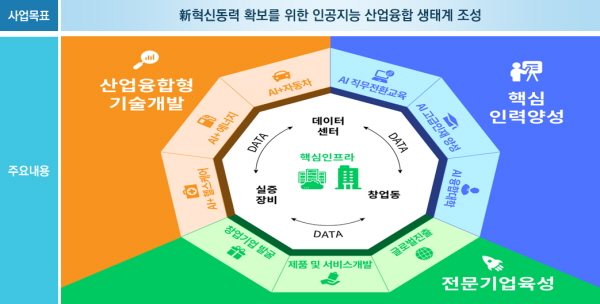
The Gwangju Integrated Complex Project is a core task of the 'National Balanced Development Project' and the 'National AI Strategy'. It is a project that will invest a budget of 411.9 billion won over five years from 2020 to 2024 to promote the convergence of Gwangju's main industries (automobiles, healthcare, energy) and artificial intelligence (AI) and to create an AI convergence ecosystem by concentrating various infrastructures such as data centers, companies, talent, and technology.

This project is largely comprised of 11 projects in 4 major areas: △Establishment of core infrastructure (KRW 254.9 billion), △Fostering AI specialized companies (KRW 54.9 billion), △Training of key personnel (KRW 51.3 billion), and △Industrial convergence R&D (KRW 50.8 billion).

In the third year, 2022, the AI will be worth 107.6 billion won, which is about 5.8 billion won more than last year. The goal is to complete the data center and the integrated complex by 2023.

■ Infrastructure Support for 150 companies

In the 2022 core infrastructure development sector, we will support: △AI-specialized data centers that support high-performance computing; △3 major industry verification equipment. We plan to support a total of 150 companies, including 100 high-performance computing resources and 50 demonstration equipment.

■ AI 99 specialized company training

The AI specialized company fostering sector provides customized support to 99 companies according to the stage of corporate growth, including △startup mentoring, △prototype production, △investment funds, and △overseas expansion.

In order to support prospective entrepreneurs, we promote entrepreneurship competitions, business consulting, and mentoring.

Support for AI-specialized startups includes support for AI startup camp entry and product advancement, while support for AI corporate growth includes support for AI product and service quality improvement tests and overseas expansion.

■ Training 1,260 AI core personnel

The AI core human resource development field provides customized education programs according to the human resource's growth stage, and educates and trains a total of 1,260 people.

To this end, we selected four universities last year to operate an AI convergence undergraduate major program, and plan to educate a total of 760 people this year.

The four major universities and major courses are Chonnam National University (AI + Energy), Chosun University (AI + Healthcare), Honam University (AI + Automobile), and Gwangju Institute of Science and Technology (AI + Core Technology).

In addition, we plan to train a total of 500 people through customized online and offline AI job transition training (200 people) to strengthen the on-site practical skills of employees and job seekers, and an artificial intelligence officer academy (300 people) for young people preparing for employment.

■ Support for 14 industrial convergence R&D projects

Industrial convergence R&D has been supporting 14 R&D projects that integrate AI technology with the three major industries since last year.

In the automotive sector, AI-based intelligent technology based on electric vehicles and customized We are currently supporting four tasks, including autonomous driving software platform.

The healthcare sector is supporting six tasks, including the development of an AI-based next-generation exercise platform and AI-based empathy service technology, while the energy sector is supporting four tasks, including an energy response platform and AI-based eco-friendly energy prediction and forecasting technology.

The Gwangju Integrated Complex Project has already shown visible results, including attracting 92 AI specialized companies, supporting 292 specialized companies, educating and training 1,254 key personnel, creating 436 new jobs, and registering and applying for 192 patents, and Gwangju is quickly transforming into an AI innovation hub.

Ryu Je-myeong, the director of the Ministry of Science and ICT’s Artificial Intelligence-based Policy Bureau, said, “We plan to actively support the Gwangju Artificial Intelligence Complex so that it can develop into a national AI hub that will create new industries and jobs in the post-COVID-19 era.”

Meanwhile, the Ministry of Science and ICT and Gwangju City plan to systematically plan the second phase of the project to be carried out from 2025 to 2029 in accordance with the 'AI Innovation Confidence Promotion Direction' announced last year, and to continuously develop Gwangju into a 'state-of-the-art national AI innovation hub.'