인피니언 6월23일부터
Physical AI HBM Smart Factory SDV AIoT Power Semicon 특수 가스 정정·반론보도 모음 e4ds plus

"Half-baked 5G: Advanced or Alternative?" The National Assembly's first 28GHz policy debate.

Google 우선 소스 기사입력2022.06.22 10:05


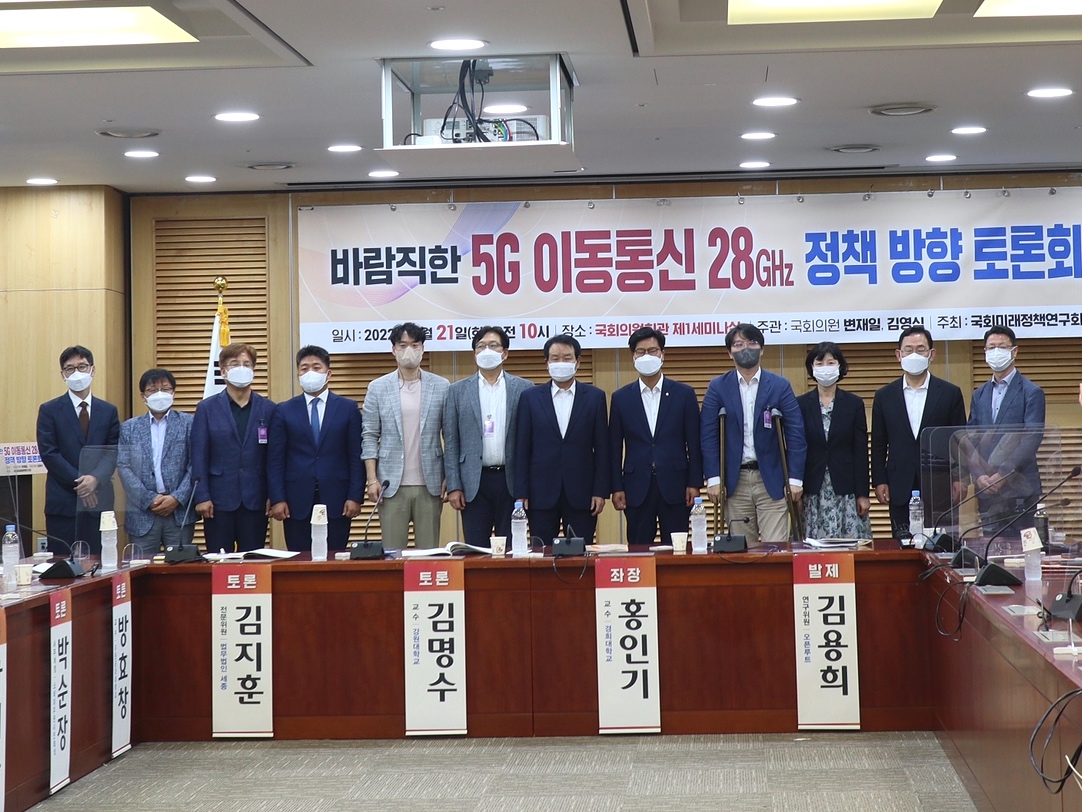
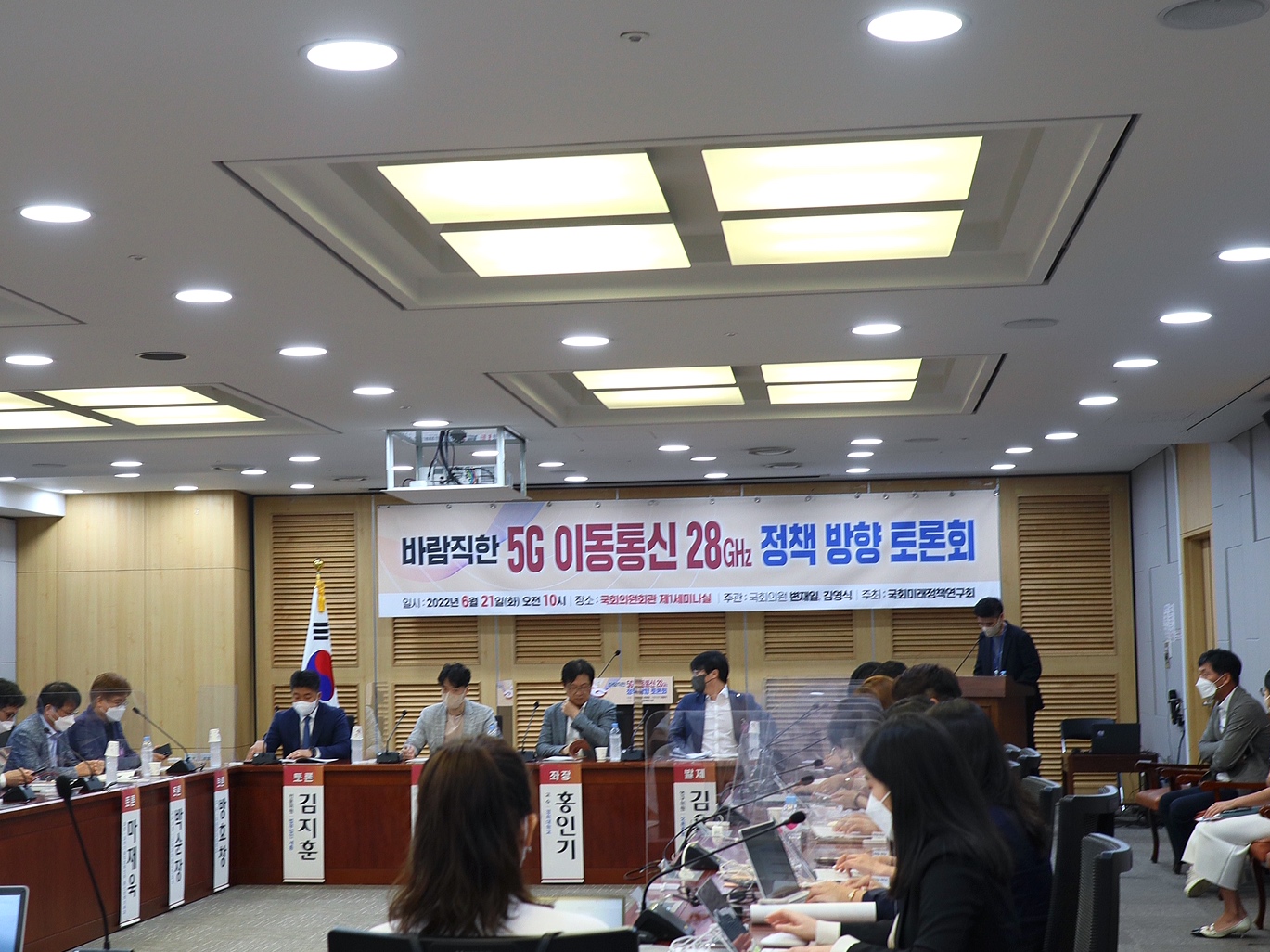
▲The 'Desirable 5G Policy Direction Discussion' was held at the National Assembly Members' Hall on the 21st.


A policy debate will be held at the National Assembly on the 21st to discuss the direction of the 5G ecosystem.
5G, without the 4G distinction... raising questions about its effectiveness.
Continued advancements in autonomy-based technologies, such as Wi-Fi backhaul networks, are needed.
A forum for policy discussion at the National Assembly level was established with various perspectives from the government, businesses, and consumers regarding the commercialization of the 28GHz band of 5G mobile communications.
The 'Desirable 5G Policy Direction Discussion', hosted by the National Assembly Future Policy Research Group and chaired by Representatives Kim Young-sik (People Power Party) and Byeon Jae-il (Democratic Party of Korea) of the Science, Technology, Information, Broadcasting and Communications Committee (STC), was held at the National Assembly Members' Hall on the 21st.
This event began with opening remarks by National Assembly members Kim Young-sik (People Power Party) and Byun Jae-il (Democratic Party of Korea), followed by a presentation by Research Fellow Kim Yong-hee (Open Route), followed by a discussion by Professor Hong In-gi (Kyunghee University) as moderator, Professor Kim Myeong-su (Kangwon National University), and Expert Fellow Kim Ji-hoon (Sejong Law Firm). △Professor Bang Hyo-chang (Doowon University of Technology), △Director Park Soon-jang (Consumer Sovereignty Citizens' Coalition), and △Manager Ma Jae-wook (Ministry of Science and ICT, Telecommunications Policy Planning Division) held a discussion with panelists.
Four years have passed since South Korea became the first country in the world to commercialize 5G, but behind the outward appearance of commercialization and expansion of 5G, the related ecosystem is facing a situation that could be said to be at the level of shutdown, such as a lack of killer content in the 28 GHz band and the absence of a revenue model.
In particular, the three mobile carriers were each allocated 800MHz in the 28GHz band for five years in 2018, and although there are only 1 year and 5 months left until the end of November next year, actual commercialization cases outside of some B2B areas are minimal. According to the Ministry of Land, Infrastructure and Transport, mobile carriers have barely managed to avoid cancellation of their allocations by barely exceeding the 10% of the mandatory base station construction quota, and the reallocation plans appear unclear.

■ Why 28GHz Was Not Commercialized
Experts all agree that 5G services were initially introduced with uncertainty when they were commercialized.
Kim Yong-hee, an expert on open routes, said in his presentation, "From the beginning of the introduction of 5G, 28GHz was considered an unknown area, and because it was different from existing frequencies, relaxed standards were proposed and the auction unit price was also low."
However, even after its introduction, it was difficult to proceed due to lack of profits, although it was first applied to the B2B market in 2020. Efforts continued, such as Wi-Fi backhaul network verification, expansion of subway Wi-Fi, and the establishment of a specialized 5G network, but only network construction was carried out centered on 3.5 GHz.
In the end, we are left with a half-baked 5G.
“The biggest problem is that there is no demand for 28GHz due to a lack of services that fundamentally require wide frequency performance,” said Commissioner Kim.
According to overseas examples, the United States is not seeing any practical use, and is focusing on recommending a transition to sub-6 and expanding the construction of C-band networks. In Japan, too, according to data from mobile carrier NTT Docomo, the actual locations where 28GHz can be used, excluding stores, are limited.
Commissioner Kim said, "It is important to recognize 5G 28GHz differently from other frequencies, limit it to specific service targets, and specialize its use by discovering practical services centered on B2B."
To this end, the plan proposed was to define 5G 28GHz as a spatial network, reorganize specialized network policies, and convert it to an unlicensed band for free use centered on R&D.

■ 28GHz, do you need it?
Professor Kim Myeong-su of Kangwon National University raised questions about whether the current 28GHz 5G network is suitable for people who are accustomed to nationwide networks.
He also said that regarding the level of consumer awareness of the difference in service quality, "4G and 5G 3.5GHz are not differentiated enough for consumers to perceive."
Professor Kim said, "Development that leverages corporate creativity and experimentalism is necessary, and flexible policies that prioritize effectiveness must be supported to provide opportunities."
Park Soon-jang, secretary general of the Citizens' Coalition for Consumer Sovereignty, also argued that from a consumer's perspective, 5G is no different from 4G.
Director Park said, "Speed was important until LTE came along, but now that wireless speeds are faster than wired speeds, speed is meaningless."
Rather, I used an expensive 5G plan but was not able to use it properly. Expressing concerns from a consumer perspective, he added, "There are many places across the country that don't even have 3.5GHz," and "It's also important to consider existing LTE users so that they don't experience any inconvenience."
■ Nevertheless, advancement continues
While challenges were raised regarding the effectiveness of 5G 28GHz, opinions were gathered on the direction toward advancement.
Ma Jae-wook, head of the Ministry of Science and ICT's Telecommunication Policy Planning Division, said, "The government doesn't need to specialize only in B2B," and argued, "We need to find ways to utilize it, whether it's B2C or B2B."
He also added, "Building an ecosystem will be difficult, but no country is giving up on 28GHz," and "I believe that demand for 28GHz will continue to arise, such as in AR and VR technologies."
“It is important to continue to explore 28GHz through continuous investment and verification in a rational direction by gathering wisdom,” said Director Ma.
Professor Bang Hyo-chang of Duwon University of Technology explained the technical characteristics of the 5G 28GHz frequency and emphasized its sophistication.
Professor Bang said, "Where should we start to develop the ecosystem in Korea?He said, "In addition to the ultra-high speeds of 5G, we must also focus on ultra-low latency and large-scale coverage capabilities." He also mentioned the need for continued expansion of pilot base stations and the collection of verified data.
However, he added that rather than mandating it like before, they should grant autonomy. "A realistic solution would be to verify the technology through a pilot service and then provide free Wi-Fi," he said.
Kim Ji-hoon, a member of the Sejong Law Firm, said, "5G 28GHz will be necessary for the industry in the future, and rather than hastily focusing on B2C or B2B, we need to discuss how to prepare users in the future."
He also expressed concern about the existing high allocation requirements, adding, "Let's establish a policy that produces reasonable results by setting the network construction obligation to an appropriate level, such as by designating specific sites or purposes."
Commissioner Kim also mentioned the 5G specialized network, saying, "5G is a service that has been introduced to inject new vitality and develop the mobile carrier market, so it is important to distribute roles to make good use of it."
Professor Hong In-ki of Kyung Hee University, the moderator, concluded the discussion by highlighting the differences in perspectives on 5G 28GHz, which began with uncertainty, and the need for flexible policies to guide it in a positive direction.
Four years after the commercialization of 5G, reflecting on past steps and shifting policy toward realistic alternatives would not be a failure. I hope this National Assembly-level discussion will serve as a new first step toward realistically assessing 5G 28GHz from various perspectives and seeking solutions.
(Photo = Reporter Kim Ye-ji)