“6G to be expanded to all industries by 2030… Leading global leadership”
K-Network 2030, Realizing the Next Generation Network Leading Nation
mmWave Alternative 'Upper Mid Band'... Optimal Frequency Candidate
6G Forum, Entering a 5G heterogeneous industry convergence powerhouse and securing 6G competitiveness
[Editor's Note] In mobile communication systems, a new generation of communication methods has been emerging every 10 years since the 2nd generation. 6G, which is expected to be commercialized between 2028 and 2030, is expected to accelerate the creation of new business markets such as autonomous driving, UAM, smart cities, healthcare, and VR as a core technology of the hyper-connected era. Amid fierce competition for global technological hegemony, the government, industry, academia, and research are making full-fledged efforts to lead 6G technology and standards from various angles. The public-private joint 5G Forum, which celebrated its 10th anniversary this year, was newly launched as the 6G Forum at the end of May. Based on the achievements of supporting the revitalization of the mobile communication industry so far, the 6G Forum aims to secure 5G heterogeneous industry convergence and B5G/6G global competitiveness in the future. Our magazine met with 6G Forum Executive Director Jang Kyung-hee to hear about Korea's telecommunications policy and R&D strategy, as well as the 6G Forum's vision and goals.
▲6G Forum Executive Director Jang Kyung-hee ■
What is 'K-Network 2030'? The 'K-Network 2030 Strategy' was announced last February. The main goal is to become a leading country in the next-generation network that will lead the digital era based on 6G, satellite, and open LAN. The focus of this strategy is on promoting the development of 6G technology. For example, it covers 6G technology, low-orbit satellites, and quantum communications.
The K-Network 2030 policy has two general directions: wireless communication innovation and SW-centered network innovation. In detail, it focuses on expanding the role of communication networks, developing energy-saving technologies, and strengthening supply chain security.
6G will mainly utilize the upper-mid band, and 5G NTN (Non-terrestrial networks) technology is expected to be developed as a technology to expand coverage. In addition, the network will be innovated with SW as the center. This includes the development of open RAN technology, cloud native, and AI native technologies.
In 6G, the role of communication networks expands. The most important thing in utilizing AI is sensing for data acquisition. As the need for high-capacity data transmission processing for sensing increases, the role of data connection in existing communication networks is expanding.
In addition, as a strategy for promoting the development of 6G technology, 6G is developed to support high performance and save energy by linking with the development of energy-saving technology. In addition, as the global technology hegemony competition intensifies with networks at the center, 6G aims to secure technology and core components with domestic technology.
Last week, the ITU finalized the 6G vision framework, aiming for commercialization in 2030. Korea also has a target of 2028-2030 and a goal of demonstrating Pre-6G system technology in 26.
■ Why is the 'Upper-Mid Band' attracting attention as a new frequency for 6G? This question should consider the lessons learned from 5G. Many countries, including ours, have tried to commercialize the 28 GHz band as a mmWave band, but have not achieved great success.
Sub-terahertz (Sub-THz) can also transmit and receive large amounts of data, but as the frequency band increases, the linearity becomes stronger, and there is still a problem that it is difficult to expand coverage due to reflection, scattering, and diffraction caused by various radio wave environments. For this reason, commercialization of the mmWave band is still difficult.
Ultimately, the upper mid-band, which is a lower frequency band than mmWave as an alternative, is expected to be mainly used in 6G, at 7 to 24 GHz.
This does not mean that the sub-terahertz band will not be developed. By applying the spectrum cake concept, the nationwide network will utilize low frequency bands, while services targeting hotspots will utilize high frequency bands to provide services.
Therefore, the upper mid-band is considered the most optimal frequency candidate for 6G to secure a certain level of coverage while simultaneously transmitting and receiving high-capacity data.
■ Please introduce the achievements of the 5G forum so far and the reason for its reorganization into a 6G forum. The 5G Forum was founded in 2013 as a public-private joint effort with the aim of leading the 5G mobile communications technology standards. For 10 years, we have contributed to establishing ITU's 5G vision and have been active in various fields such as promoting international cooperation, fostering industry, and supporting policies.
We have secured global leadership by hosting international events such as the 5G Summit to share domestic and international 5G trends, and by hosting international events such as 'Mobile Korea' every year with seven countries as the main event for information sharing and communication in the communications field.
In addition, we have been making efforts in various fields, such as publishing a total of 59 white papers, including 6G technology, frequency, service, and ecosystem, as well as fields of convergence with other industries such as smart cities, manufacturing, autonomous driving, urban air traffic (UAM), and public convergence.
The 5G Forum has been transformed into the '6G Forum' to further strengthen private sector cooperation on next-generation networks and secure our country's leadership.
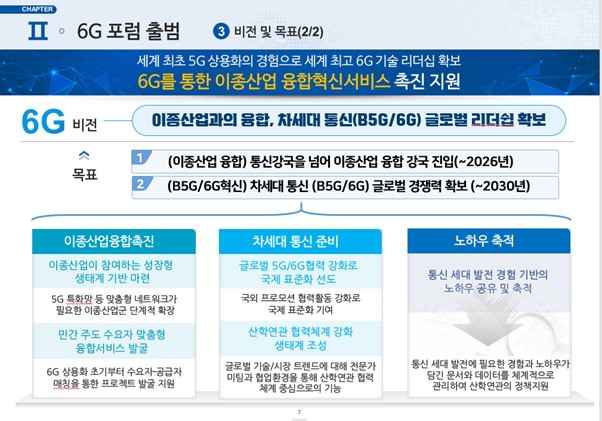
The vision and goals of the 6G Forum are to become a powerhouse in 5G heterogeneous industry convergence and to secure global competitiveness in 6G next-generation communications.
For this purpose, a total of eight expert committees have been established. These include the 6G Technology Service Frequency Ecosystem Strategy Committee for fostering the mobile communications industry, the Next-Generation Mobility Committee for convergence with heterogeneous industries, and the Smart City, Smart Manufacturing, and Public Convergence Committee.
Currently, more than 70% of the 6G forum is focusing on research and development in the 5G convergence field, and it is expected that research and activities on 6G technology and services will gradually increase.
Key tasks include laying the foundation for a growth ecosystem involving heterogeneous industries and discovering private-sector-led, customized convergence services for consumers.
In addition, to secure global competitiveness in 6G communications, we will lead international standardization by strengthening global 6G cooperation and strengthen the industry-academia-research cooperation system to create an ecosystem.
■ At its meeting last June, the ITU established a 6G vision. The updated content is
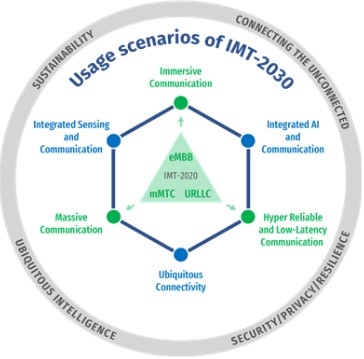
▲ 6G target services (usage scenarios)
The 6G ‘vision’ is now called the ‘framework’. The 6G framework was approved at the meeting last June. This approval is expected to be finalized in November after adoption and approval at the ITU Terrestrial Telecommunications Study Group (SG5) meeting in September of this year, and there are no major changes expected in the framework confirmed this time.
Based on this, our country will define performance, standards, and evaluation methods for about three years from 2024 to 2026. Next, candidate technologies will be proposed from 2027 to 2028, and the proposed candidate technologies will be evaluated and selected starting from 2028.
Through this process, we aim to complete the development and approval of 6G standards by 2030.
The 6G framework derived this time has established 6G target scenarios (Usage Scenarios). Three of them are scenarios that have evolved from 5G, such as △eMBB (Immersive Communication), △mMTC (Massive Communication), and △URLLC (Hyper Reliable and Low-Lataency Communication), and the rest are scenarios specialized for 6G, such as △integrated sensing, △AI, and △ubiquitous.
In addition to the nine 'Enhanced capabilities' key performance indicators, six more items have been added, bringing the total number of key performance indicators for 6G to 15. For example, reliability, latency, and connection density have target values that are up to 10 times higher than 5G.
In addition, the indicators will establish technical performance requirements and set performance targets from 2024 to 2026. When setting these performance metrics, the concepts of sustainability, security/privacy/resilience, connectivity expansion, and intelligence were selected as characteristics that should be applied to all services.
■ A word to the readers When I talk like this in lectures on 6G, I often get asked whether it is okay to start 6G when 5G is not even fully commercialized.
However, as mentioned earlier, mobile communication technology itself is no longer mobile communication technology, but already has the characteristics of an infrastructure industry that is spreading to all industries. That is why our country's 6G research and development is by no means fast.
We plan to carry out various activities centered around the 6G Forum in the future. We ask for your support and encouragement to secure domestic and global leadership.
thank you