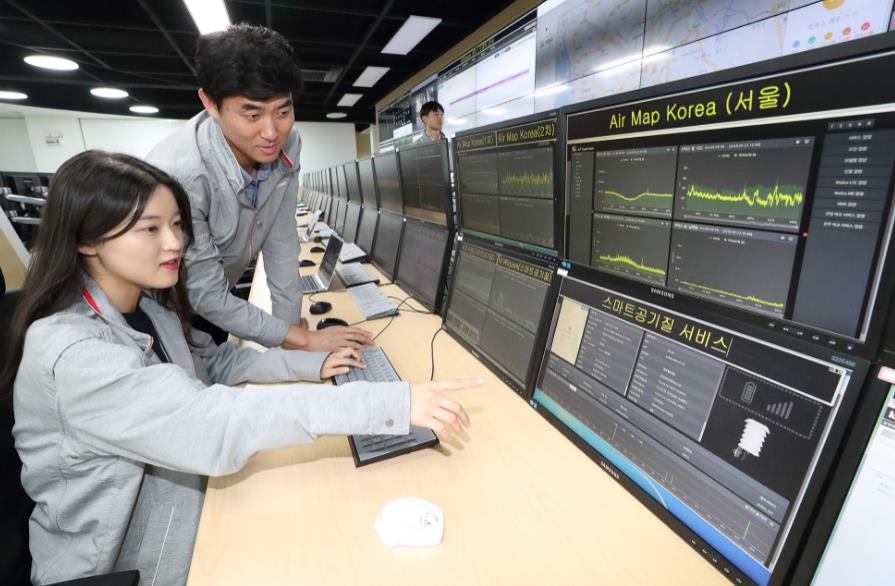
'Air Map Platform' that collects and analyzes air quality data by the minute is released
“The government, local governments, and research institutes will actively cooperate to solve the fine dust problem.” KT announced the progress of the 'KT Air Map Korea' project over the past seven months and its future plans. In September of last year, KT announced that it would be promoting the 'KT Air Map Korea' project to support fine dust policymaking through Internet of Things (IoT) solutions and big data analysis.
KT announced that it has completed the construction of an air quality observation network in 1,500 locations in Seoul and six metropolitan cities using its ICT infrastructure. KT has approximately 5 million ICT infrastructures nationwide, including 4.5 million telecommunications poles, 330,000 base stations, and 60,000 public telephone booths. These facilities are installed primarily in living spaces and are located within 10 meters of the ground where people breathe, making them suitable for practical air quality measurement.
KT installed fine dust measuring equipment in optimal locations through big data analysis of weather observation data, floating population, etc. KT’s air quality observation network is capable of covering more than 50% of the entire nation based on the population, and it is expected to make a substantial contribution to establishing fine dust policies by installing it in areas with many fine dust-sensitive groups such as infants and the elderly, and landmarks with a large floating population.
In addition to building an air quality observation network, KT also unveiled the 'Air Map Platform', an open IoT platform that collects and analyzes air quality data every minute. This platform collects and analyzes real-time data transmitted every minute by fine dust measuring equipment installed in 1,500 locations nationwide. It diagnoses five items including fine dust, ultrafine dust, temperature, humidity, and noise.
The Air Map Platform is based on LTE-M, a global standard network technology specialized for the Internet of Small Things, and is connected to fine dust measuring equipment. In addition, since the Air Map Platform is designed based on the ‘Open API (Open Application Programming Interface)’, fine dust reduction activities can be implemented by linking with air purifiers, air conditioners, artificial rain drones, etc. in addition to the indoor/outdoor air quality measuring networks.

KT established the 'National Air Quality Control Center' at the 'KT INS (Intelligent Network Support) Operation Center' in Gwacheon, Gyeonggi Province to monitor data transmitted from the Air Map Platform and to check and take action on air quality measurement equipment failures in real time. The National Air Quality Control Center, which operates 24 hours a day, 365 days a year, resolves problems by linking with the KT network operation and maintenance system established nationwide in the event of a failure.
In the future, KT plans to provide the government with priority air quality data acquired through the operation of the Air Map platform. It is expected that this data will serve as a supplement to the air quality data collected from the fine dust observation network operated by the government.
In addition, KT plans to develop and launch a ‘fine dust portal’ in the form of a smartphone app within the year after consulting with the government. This app is a service that allows anyone to easily check air quality data that combines the government’s fine dust observation network data and KT’s fine dust measurement values. This app is expected to be a useful service for individuals to respond to fine dust, as it allows them to check fine dust information updated every minute in the search area.
KT released the results of its analysis of fine dust big data collected every minute for two months through air quality observation networks and air map platforms. The analysis results showed that fine dust concentrations differed greatly by region, even in the same city or district, and that fine dust concentrations differed according to time, height, indoor environment, and whether or not there was precipitation. It was emphasized that a more detailed response to fine dust is needed, as fine dust risks differ according to space and time.
According to the analysis results of fine dust big data collected on April 6 by 512 air quality measuring devices installed by KT in Seoul, the difference in fine dust concentration among 25 autonomous districts was up to 44㎍/m³. Even in the same autonomous district or dong, the difference in fine dust concentration was up to 47㎍/m³ depending on terrain, location, etc.
The concentration of fine dust also showed a large difference depending on the time. As a result of analyzing the concentration of fine dust in a specific area of Seoul in April and June, the concentration was 'very bad' (over 150㎍/m³) between 1 and 5 PM, but 'normal' or 'bad' before and after this time period.
Also, as a result of analyzing the air quality of 9 schools in Busan from March 1 to May 7, the indoor fine dust concentration was found to be 77% on average and 90% at most compared to the outdoors on days when the fine dust concentration was 'bad' or 'very bad'. In schools that operated air purifiers and ventilated based on real-time air quality information, the indoor fine dust concentration dropped to an average of 60% compared to the outdoors.
The height of buildings and noise barriers also affected fine dust. As a result of checking the difference in fine dust concentration at KT Gwanghwamun Building West, the 1st floor had an average of 52㎍/m³, and the 4th floor and above had 40~42㎍/m³, a difference of about 10㎍/m³. The soundproof wall had a greater blocking effect as the fine dust concentration was higher, and depending on the presence or absence of the soundproof wall, the concentration difference was up to 97㎍/m³, or about 40%.
The prediction that precipitation would lower the concentration of fine dust was also confirmed through data. On a day when it rained last March, the fine dust reduction effect was analyzed, and the fine dust reduction effect began to appear when the precipitation was 5mm or more, and when it was 10mm or more, the fine dust concentration was reduced by up to 70%. Based on this, when artificial rain was sprayed using an artificial rain machine and sprinkler at Suwon KT Wiz Park in April, the fine dust concentration was reduced by up to 47%.
KT explained that more meaningful data can be derived by conducting big data analysis by combining data collected from 1,500 air quality observation networks with various environmental variables such as traffic volume, floating population, wind speed, and terrain.
In the future, KT plans to actively support fine dust reduction policies promoted by various organizations, including the government, local governments, and public institutions, based on its air quality observation network, air map platform, and big data analysis capabilities.
Kim Hyung-wook, head of KT’s Platform Business Planning Office, said, “KT has launched the Air Map Korea project based on innovative technologies such as IoT solutions and big data analysis to help solve the problem of fine dust, which has emerged as a social issue,” and “KT will actively cooperate with the government, local governments, and research institutes to help the people avoid the dangers of fine dust.”