Techday
Physical AI HBM Smart Factory SDV AIoT Power Semicon 특수 가스 정정·반론보도 모음 e4ds plus

Automotive cameras require ASIL-rated power protection

Google 우선 소스 기사입력2020.04.06 16:10

Automotive Camera Market Size to Reach $7.5 Billion by 2023
With the increase in ADAS and the mandatory installation of rear backup cameras,
Consideration needs to be given to compliance with automotive safety integrity levels


Today’s cars are equipped with multiple cameras that combine advanced sensors such as radar and LiDAR to support safety features such as advanced driver assistance systems (ADAS). These sensors work together to detect blind spots, pedestrians, and lanes, and even assist with automatic parking.

Some current semi-autonomous vehicles have eight to 12 cameras providing a 360-degree surround view for parking assistance, providing a view of up to 250 metres ahead and preventing collisions.

According to a report by Research and Markets, the global automotive camera market is expected to grow at a CAGR of 24.3% from 2018 to 2023, reaching USD 7.5 billion. The report analyzed that ADAS demand and rear backup camera mandates in North America and Europe are the key drivers of growth.

Also, cameras are starting to replace traditional side mirrors in some cars. New driver monitoring systems also use cameras to measure driver conditions such as drowsiness or inattention. Increasingly stricter safety standards are increasing the demand for cameras.

Because automotive cameras play such a critical role in safety, ensuring power and operational reliability for the cameras has become important. Therefore, compliance with the Automotive Safety Integrity Level (ASIL) must be considered.

ASIL, which classifies safety-related risks inherent in automotive systems, is a key requirement for compliance with the international standard ISO 26262 for safety-critical automotive components.
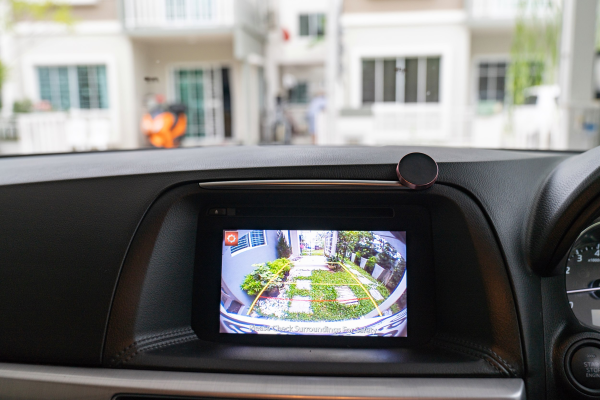
ASIL-compliant automotive camera protection IC provides stable protection of automotive rear-view cameras.
It supports operation. The car rear camera helps the driver to drive safely.
Helps you reverse on the road and navigate parking spaces [Photo = Maxim]


Balancing power and safety
Automotive cameras have a variety of power management systems, ranging from the vehicle battery that supplies power to the remote camera.

Let's say you have a 12V car battery and several cameras that need to be powered via coaxial cables. In this situation, there is a wide voltage variation between the battery and the wiring (8-10V at 0.3A per camera), so you have to consider the various constraints of transmitting multiple voltages via a coaxial power distribution system.

In particular, the buck-boost converter must be adjusted to various voltage environments such as start-stop and cold crank conditions. In addition, damage caused by overcurrent, ground short, and battery short can threaten the safety of the driver and passengers. Solving the problem requires the development of additional hardware and software for system monitoring, as well as multiple individual devices depending on the number of system cameras.

Camera power protection ICs released for automotive camera modules strictly control the maximum current per channel to minimize fault reduction circuits. In addition, if a fault occurs in each camera, the resulting impact can be prevented from spreading to a single power supply or other cameras, and fault diagnostic information is also provided via I 2 C.

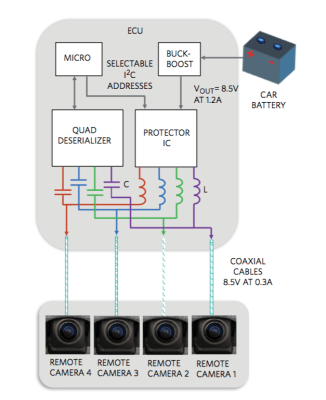
The camera protector can form part of the camera system's integrated electronic control unit (ECU). The buck-boost converter is connected to the vehicle battery and supplies DC power to the remote camera through the camera protector, AC blocking coil, and coaxial cable.

A quad serial-to-parallel converter connects the MCU to the remote cameras via AC-coupling capacitors and coaxial cables. Each remote camera is controlled by an automotive power management IC (PMIC), a serial-to-parallel converter, and an image sensor.
Power management architecture for automotive camera systems.
Automotive camera power protection IC is a power protection IC for the camera system.
It can form part of a fusion ECU.
[Image = Maxim]


Industry's only ASIL rated camera protector
Maxim's MAX20087 is a camera protector IC that can be connected to a remote camera system. It is an ASIL-grade camera protector (compliant with ASIL B to ASIL D standards) with I2C -based diagnostic functions.

This product, which is divided into two types (dual/quad), provides two or four 600mA protection switches in a 4mm × 4mm, 20-pin TQFN size. One MAX20087 device supports four cameras simultaneously, and up to eight cameras can be supported by connecting two of these devices in parallel to one bus.

The device individually protects each output against short-to-battery, short-to-ground, and overcurrent conditions. An integrated 8-bit analog-to-digital converter (ADC) monitors current, voltage, and supply readings to meet ASIL criteria.

The MAX20087 has many built-in features that eliminate the need for additional components. For example, it automatically blocks short-circuit current from flowing into the supply rail, eliminating the need for reverse-blocking diodes on each channel. The MAX20087 evaluation kit can be used to evaluate the performance of the MAX20087 in automotive camera designs, as it can operate as an individual protector and can be connected to a controller via an I 2 C interface for advanced control and diagnostics.

Maxim offers a variety of automotive power ICs that complement the power management architecture of camera systems. Maxim's automotive PMIC supports remote cameras.

The MAX25249 and MAX25249B quad-output mini PMICs integrate three DC-DC converters and a PSRR LDO into a 3.5mm × 3.5mm, 20-pin TQFN.

The MAX20049 is a quad power IC that includes a 500mA buck converter and dual LDOs for automotive camera modules. The two buck converters are designed for fixed-frequency PWM operation from an input voltage of 3.5V to 17V.

Automotive cameras play a critical role in automotive systems, so proper power supply and stable operation are essential. The right automotive PMIC can make a big difference in your design.


This article is a summary of the article titled, “Car Camera Power Protection with ASIL Compliance” by Starry Tsai, General Business Manager, Automotive Business Unit, and Chintan Parikh, Business Director, Automotive Business Unit, Maxim Integrated.
이수민 기자
기사 전체보기