Discovery of phenomenon that cancels elastic interactions between atoms
Presenting the principle of storing data in individual atoms
Memory semiconductors can be miniaturized to 0.5 nm A research team led by Professor Lee Jun-hee of the Department of Energy and Chemical Engineering at Ulsan National Institute of Science and Technology (UNIST) has presented a theory and material that can increase the integration of next-generation memory semiconductors by more than 1,000 times.
The results of this study were published in the American journal Science on the 2nd, local time.
In the semiconductor industry, integration per unit area has been increased through miniaturization to improve device performance. However, domains, which are groups of thousands of elastically connected atoms, are required to store data, so the size could not be reduced below a certain level.
When semiconductor devices become smaller than their limit, a phenomenon called scaling occurs, which causes them to lose their ability to store information. When this phenomenon occurs, the basic operating principles of semiconductors, 0 and 1, cannot be properly implemented.

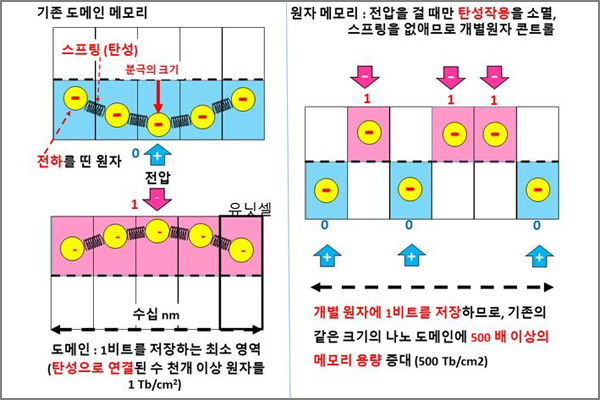
▲ If you utilize the phenomenon suggested by the research team, elasticity between atoms occurs when voltage is applied.
It is possible to store data in individual atoms by annihilating them [Image = UNIST]
Professor Lee Jun-hee's research team discovered a physical phenomenon in which the elasticity between atoms disappears when voltage is applied to oxygen atoms in a semiconductor material called hafnium oxide (HfO
2 ), and successfully applied this to semiconductors to overcome the limits of storage capacity. This phenomenon can be used to control individual atoms and store data (1 bit) in four oxygen atoms.
◇ Memory semiconductors are miniaturized to 0.5 nm, and integration is improved by more than 1,000 times HfO2 is a material commonly used in memory semiconductor processes, and applying this phenomenon can improve the memory performance of various products such as smartphones and tablets.

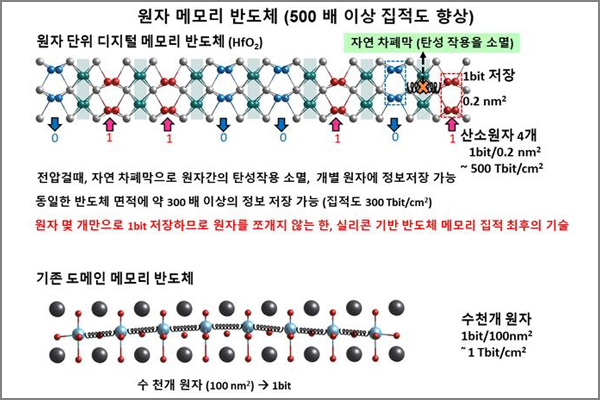
▲ (From top) Memory that stores data in a single atom
Memory that stores data using domains [Image = UNIST]
The research team predicted that if the results of this study are utilized, the problem of losing storage capacity when miniaturizing semiconductors will not occur, and the semiconductor process, which is currently at the 10nm level, can be miniaturized to 0.5nm, which will improve memory integration by about 1,000 times compared to before.
Meanwhile, this study was selected as a Samsung Future Technology Promotion Project project in December of last year and is receiving research support, and was also conducted with support from the Ministry of Science and ICT's Future Materials Discovery Project.