Metal, unsuitable as a shielding material due to its electromagnetic wave reflective properties
Developed Ti 3 CN maxene material has lower conductivity than Ti 3 C 2
116dB electromagnetic shielding possible with the thickness of a hair A new Maxene material technology has been developed that overcomes the limitations of existing shielding materials. Maxene is a 2D nanomaterial that is lightweight, low-cost, and flexible to print compared to metals, and is a ceramic material with electromagnetic shielding performance that surpasses existing metals.
This material is expected to be used not only in future highly integrated mobile electronic devices but also in defense technologies such as electromagnetic shielding and stealth.

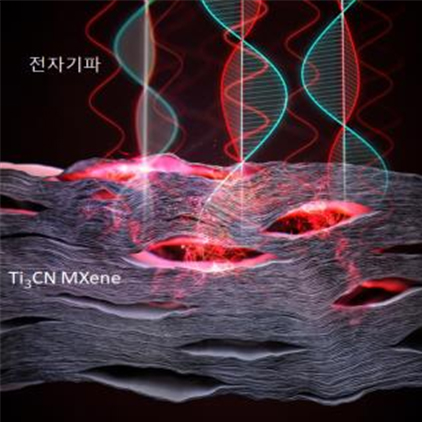
▲ Electromagnetic wave absorption characteristics of Ti 3 CN maxene film [Figure = Ministry of Science and ICT]
A research team led by Director Koo Jong-min of the Korea Institute of Science and Technology (KIST), Professor Kim Myung-ki of the KU-KIST Convergence Graduate School at Korea University, and Professor Yury Gogotsi of Drexel University in the United States has succeeded in developing a Ti
3 CN MXene electromagnetic wave absorbing material that improves the existing electromagnetic wave interference problem.
The Ministry of Science and ICT and the Korea Institute of Science and Technology announced that this achievement was published in Science (IF 41.063) on the 24th (Korean time) under the title, 'Anomalous Absorption of Electromagnetic Waves by 2D Transition Metal Carbonitride Ti
3 CN (MXene)'.
Recently, due to the high performance and integration of electronic devices, the need for the development of lightweight shielding and absorption materials that can absorb a lot of electromagnetic waves is increasing.
Existing electromagnetic shielding technology has been developed primarily using metal materials with excellent electrical conductivity. However, metal materials are heavy and expensive, and the irregular structure makes it difficult to flexibly print and coat, making them unsuitable for use in highly integrated electronic devices. In addition, the strong electromagnetic wave reflection characteristics of electrically conductive metals have the problem of secondary damage caused by reflected harmful electromagnetic waves.
To overcome these problems, the research team developed an electromagnetic shielding technology using Ti
3 C
2 (a compound of titanium transition metal and carbon) MXene material and reported it in Science in 2016, but technology to improve absorption characteristics was needed to reduce secondary damage caused by reflected harmful electromagnetic waves.
.jpg)
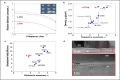
▲ Ti 3 CN maxine structure and electromagnetic shielding performance [Image = Ministry of Science and ICT]
In this study, we developed a Ti
3 CN (titanium, carbon, and nitrogen compound) MXene nanomaterial technology with maximized absorption characteristics that overcomes the limitations of existing MXenes. The Ti
3 CN MXene material has a similar structure to Ti
3 C
2 MXene with a 1 nm thick plate structure, but its electrical conductivity is lower than that of Ti
3 C
2 .
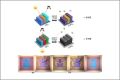
The research team elucidated the metastructure formation mechanism of Ti
3 CN MXene films through simple heat treatment, and through this developed a technology for manufacturing MXene electromagnetic shielding materials that exhibit excellent electromagnetic wave absorption characteristics even with a thin film thickness by controlling the effective permittivity and effective magnetic permeability of the MXene. It has secured a high electromagnetic shielding performance of over 116dB at a thickness of approximately 40μm (micrometers), which is similar to the thickness of a hair.
The newly developed Maxene material is a new nanomaterial created by humans that does not exist in nature, and securing a supply chain linking materials, parts, and equipment will likely be important for future commercialization.