Physical AI HBM Smart Factory SDV AIoT Power Semicon 특수 가스 정정·반론보도 모음 e4ds plus

Electronic signal errors can be measured in the order of one quadrillionth of a second?

기사입력2020.07.27 10:55

KAIST Department of Mechanical Engineering Professor Jeongwon Kim's research team,
Electronic signal timing error with ultrafast pulse lasers
Development of technology to measure at less than 1/100th of a second


A technology that will enhance the performance of next-generation data converters and ultra-high-speed communications and integrated circuits that require precise timing performance has been developed by domestic researchers.

On the 24th, a research team led by Professor Jeong-Won Kim of the Department of Mechanical Engineering at the Korea Advanced Institute of Science and Technology (KAIST) developed a technology to measure and control the time error of electronic signals to less than 1 quadrillionth of a second (100 attoseconds = 10 -16 seconds) using an ultra-fast pulse laser.
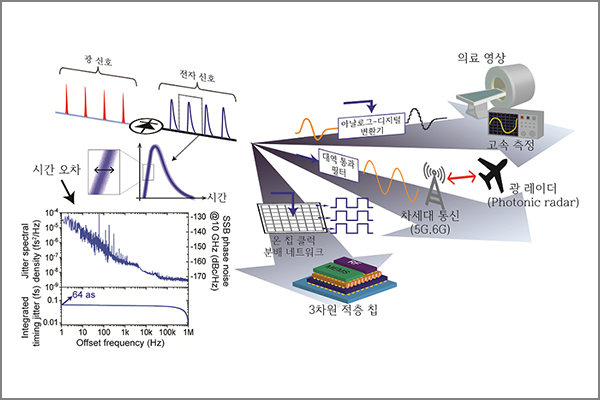
▲ The extremely high electronic signal presented by the research team
Application examples using time error performance [Figure = KAIST]

This study, conducted in collaboration with the research team of Professor Ha-yeon Jeong of the Department of Electronic and Information Engineering at Korea University, in which PhD student Min-ji Hyun participated as the first author, was published in the July 22nd issue of the international academic journal Nature Communications under the title, 'Attosecond electronic timing with rising edges of photocurrent pulses.'

Ultrafast pulse lasers can achieve temporal stability that was difficult to achieve with conventional technologies. Over the past decade, research has been conducted worldwide to extract a single microwave frequency component from these lasers and generate a sinusoidal electronic signal with low phase noise.

However, many digital and information communication systems often use clock signals in the form of pulses or square waves rather than sine waves. There has been no research on generating electronic clock signals in the form of pulses or square waves from ultrafast lasers and measuring their noise characteristics.

The research team was able to measure the time error of a current pulse signal generated from an ultra-fast laser with a resolution of 50 attoseconds using a time error measurement technology they independently developed. Through this, they were able to determine for the first time in the world that the time error at the rising edge of a current pulse can be as small as 100 attoseconds.

The research team also revealed that this timing error is limited by the process by which the amplitude noise of the optical signal is converted into noise in the time domain, and by controlling the amplitude noise of the optical signal, the timing error at the rising edge of the current pulse could be controlled to the level of 64 attoseconds.

Recently, as electronic systems and data speeds have rapidly increased, it has become important to reduce the timing error of electronic clock signals in the form of pulses or square waves. High-speed data transmission and data conversion, high-speed inter-chip communication, and 5G communication already require timing errors of tens of femtoseconds (femtoseconds = 10 -15 seconds, one quadrillionth of a second).

The results of this study imply that using ultrafast lasers, the timing error of electronic clock signals can be controlled to the level of 100 attoseconds or less, which is better than recent requirements. Therefore, it is expected that the use of ultrafast lasers in the ICT field will become more widespread in the future.
이수민 기자
기사 전체보기