Intelligent sensors produce high value-added information with low power
Emerging as a key component of smart IT convergence services
We need to integrate hardware and software capabilities such as materials and algorithms. As AI, IoT, and big data are gaining attention as growth engines in almost all industries, the value of data collection and utilization is increasing. Accordingly, the demand for sensors that convert physical quantities such as pressure, temperature, and humidity, and acceleration into electrical signals or data is increasing.
According to the Korea Institute of Industrial Technology Evaluation and Planning, it is expected that 1 trillion sensors will be produced this year alone. However, as the number of sensors increases, there is a disadvantage in that the power consumption of the application processor (AP) increases because wide-bandwidth communication is required to centrally process large amounts of data.

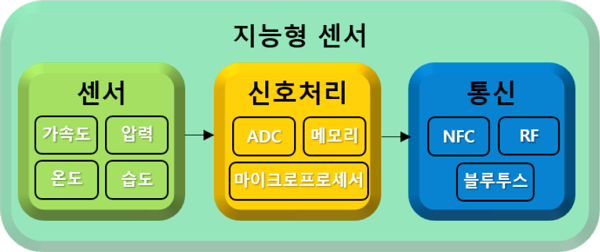
▲ Integrated sensor, signal processing, and communication functions
Intelligent Sensor Architecture [Figure = ETRI]
However, by utilizing an intelligent sensor that combines control, judgment, storage, and communication functions with existing sensors, a fully distributed method is possible that reduces noise in raw data within the sensor, extracts meaningful information, and transmits the data to the center as needed.
Intelligent sensors have the advantage of reducing power consumption of the central processing unit and increasing the number and types of available sensors with the same performance processor, making them advantageous for utilizing AI, IoT, and big data technologies. Therefore, it is emerging as a key component applied to smart IT convergence services.
◇ Intelligent sensor encompassing hardware and software The Intelligent Sensor Research Lab of the Electronics and Telecommunications Research Institute (ETRI) published a report titled ‘Intelligent Sensor Technology Trends for Smart IT Convergence Platforms’ and analyzed research trends in intelligent sensor technology by dividing them into four fields.
Intelligent sensor technology is a complex solution technology that brings together hardware and software ranging from ▲intelligent sensor elements ▲intelligent algorithms ▲signal processing circuits and modularization ▲integrated platforms.
Movements to secure these technologies are taking place both domestically and internationally, and the development of a smart IT convergence platform to provide intelligent convergence services in all areas of society is also progressing rapidly.
Intelligent sensor device including AI processor Existing sensor technologies have formed a market centered on low-cost, small-variety sensor items that depend on materials and process technologies such as semiconductor and MEMS technologies and flexible process technologies.
Recently, with the development of AI, IoT, and big data technologies, the demand for sensors has skyrocketed, and convergence sensors that integrate multiple sensor functions while reducing the burden of rising sensor costs are emerging. In addition, they are rapidly developing into intelligent modules that include AI processors and signal processing to produce new, high value-added information through AI and big data technologies.
Intelligent sensor technology applied to smart IT convergence services is a key component of the IoT era that produces new information through the processes of recognition, inference, and judgment, surpassing existing high-performance sensor technology. Accordingly, intelligent sensor devices are being developed with strategies for miniaturization, low power consumption, convergence, new flexible and elastic form factors, and high-resolution sensor array integration.
Intelligent sensor algorithms that create sensors beyond sensors Intelligent sensors combine MCU embedded technology with SoC technology to detect objects and make objects react like humans, with functions such as intelligent algorithm-based data processing, storage, automatic correction, as well as control, judgment, self-diagnosis, and decision-making.
.png)
▲ Intelligent sensors with intelligent algorithms applied to the installed devices
Enables equipment to perceive and judge like humans
While existing sensors were limited to detecting specific conditions and providing data for the central processing unit to make decisions, intelligent sensors with intelligent algorithms have sensing functions as well as communication, data processing, and AI functions.
AI algorithms capable of situational awareness, analysis, and inference have been added, allowing data generated from sensors to be processed in real time and immediately reflected on-site, rather than in a cloud-based manner. Intelligent sensor technology equipped with these intelligent algorithms is expected to be applied to various smart IT convergence platforms, enabling the implementation of intelligent IoT and AI services in the era of the 4th industrial revolution.
Intelligent sensors are evolving into modules with their own computing power As networks develop, devices such as smartphones, AI speakers, and IoT devices become widespread, and many new applications using sensors are emerging. Early sensor-based information terminals only performed the function of collecting sensor signals and transmitting them to the cloud.
Recently, edge computing technology is spreading to improve power efficiency through data load reduction, quick response to collected data, and distribute computing functions from the cloud to terminals. In particular, sensor modules are changing from the level of only collecting and transmitting signals to intelligent sensor modules with computing power based on digital signal processing to improve energy efficiency of terminals and increase the accuracy of sensor signals.
Intelligent sensor modules have the characteristics of integrating computing power within the module for miniaturization, low power, and multi-functionality of terminal devices. While existing sensor modules were at the level of integrating sensor elements and analog circuits (OP AMP, ADC, etc.) into a single package, intelligent sensor modules integrate digital signal processing circuits into a single package, reducing data transmission to the terminal device and increasing the power efficiency of the terminal.
Additionally, it has a built-in means to measure and correct sensor errors, thereby increasing the precision of sensor element signals with its own computing power. For example, the temperature sensor module has a built-in self-calibration circuit that compensates for sensor signal errors due to temperature in the digital domain, thereby compensating for performance degradation of the sensor due to aging and soldering in the digital domain.
Intelligent sensor platform that creates new business models An intelligent sensor platform can be defined as a set of common technical elements required to integrate measurement data from a variety of intelligent sensors and provide data visualization, model building, and prediction services in various fields.
That is, when individual intelligent sensors are utilized as IoT devices, the intelligent sensor platform can be defined as a subset of the IoT service platform. However, the IoT service platform is being defined with a focus on data standardization and API standardization for IoT communication and services, led by existing Internet communication service companies.

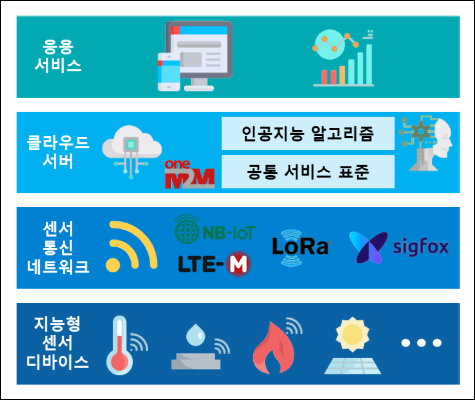
▲ Intelligent sensor platform structure [Figure = ETRI]
The intelligent sensor platform consists of four technological elements: △intelligent sensor module, △communication network, △cloud server, and △application service.
Intelligent sensor modules are responsible for collecting the necessary data, and a variety of sensor modules are installed and distributed throughout the service provision area. Measurement data from the intelligent sensor module is transmitted to the cloud server through a communication network consisting of various communication means.
The cloud server integrates the received measurement data into big data, and then uses AI technology to perform data visualization, model building, and prediction data calculation. Finally, the application service provides services using the cloud server's calculation results to various terminals such as mobile devices.
Competitiveness in the 4th Industrial Revolution Era: Intelligent Sensors Are the Key The report predicted that intelligent sensor technology, which will be applied to numerous smart IT convergence services, will become a key component leading the era of the 4th Industrial Revolution, producing new information based on AI that goes beyond existing high-performance sensor technology.
Intelligent sensors are expected to become the cornerstone of smart IT convergence services such as smart homes, smart cities, and smart factories, while also bringing about explosive growth in the sensor industry.
Last September, the government launched the 'Next-Generation Intelligent Semiconductor Business Unit' and is currently carrying out the 'Next-Generation Intelligent Semiconductor Technology Development Project' with a total investment of 1 trillion won by 2029.
Companies and institutions involved in this business should not simply create high-performance semiconductors, but should consider where and what semiconductors will be used and create semiconductors that can produce useful information in specific environments. The use of sensors will determine the success or failure of intelligent semiconductors.