Physical AI HBM Smart Factory SDV AIoT Power Semicon 특수 가스 정정·반론보도 모음 e4ds plus

ETRI develops LED haptic technology that creates various vibration stimuli

Google 우선 소스 기사입력2021.03.06 21:00

ETRI develops LED-based film-type haptic technology
Create various vibration stimuli with LED light signals
Ability to implement regional vibrations rather than full board vibrations


A domestic research team has developed a technology that creates various vibration stimuli using LED light signals. It is expected that it can be applied to various fields such as automobiles and electronic devices, as it can create different tactile sensations depending on the location and reduce the price and size of the light source.

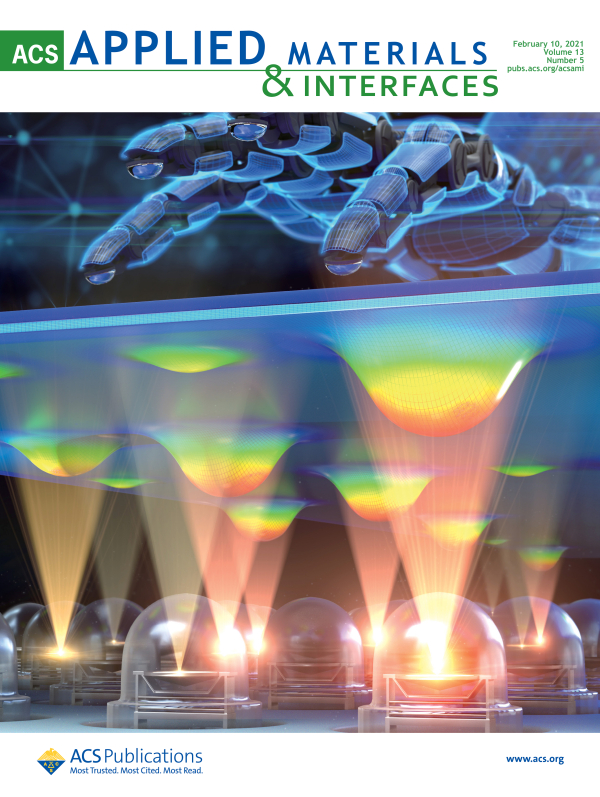
The Electronics and Telecommunications Research Institute (ETRI) announced on the 3rd that it has developed a technology to implement various vibrations using LEDs. This technology was published as the cover paper in the 'AMI (ACS Applied Materials and Interfaces)' journal published by the American Chemical Society (ACS) on February 10th of this year.
▲ Published on the cover of the American Chemical Society (ACS) AMI paper
ETRI's LED-based film-type haptic technology [provided by ETRI]

Haptic technology is an interface technology that can communicate with users through touch.

A typical application case is the vibration function of a smartphone or tablet display. The current commercialized technology creates vibration by moving a weight attached to a motor, so the entire device shakes together. Even if you place multiple fingers in different positions on the screen, you will all feel the same vibration. It is also impossible to implement detailed tactile sensations for each part.

Recently, a technology has been developed to create vibrations using shock waves resulting from instantaneous temperature changes using a nanosecond pulse laser, but the price of the laser light source reaches tens of millions of won and miniaturization is difficult, so it has not been commercialized.

The newly developed technology converts low-power optical signals into vibrations. Using this technology, it is possible to create displays that independently generate vibrations using multiple small LEDs that cost only 1/10,000th the price of a laser light source. This means that each finger can feel a different vibration depending on its location.

The technology uses the principle of absorbing light energy and converting it into heat energy. When light is shone on a special film coated with a light-to-heat conversion layer (PEDOT-Tos), a conductive polymer material that absorbs near-infrared light, the film deforms and recovers according to the material's thermal expansion rate along with heating and cooling, creating vibrations.
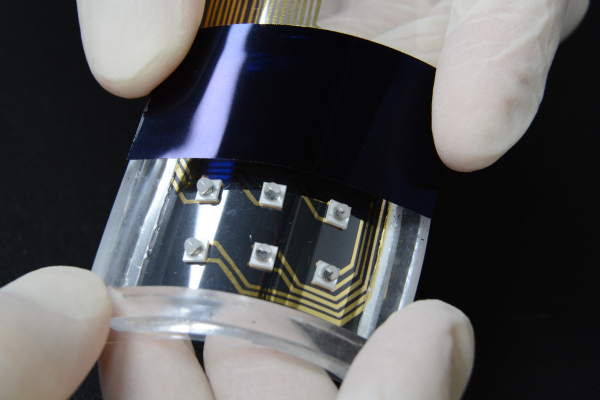
▲ LED film-type haptic technology on flexible displays
Applied prototype [Photo = ETRI]

Using the technology, the research team created a 3x3 LED array with nine 1㎠ zones, and technically demonstrated that each zone can express precise vibrations over a wide frequency band (125~300Hz). It is easy to scale up to a large area, and since the film layer does not contain an electrical structure, it is highly durable and suitable for application to flexible displays.

ETRI’s Shin Hyeong-cheol, head of the Human Augmentation Research Lab, said of this technology, “It is a fundamental technology that can convey a lot of information through touch,” and explained, “For example, if it is applied to information transmission devices for the visually impaired, it can be used as an alternative technology to supplement Braille.”

The researchers are planning follow-up research to increase the efficiency of converting light energy into vibrations, creating vibrations strong enough for humans to feel, while reducing power consumption.
이수민 기자
기사 전체보기