100x reduction in memory footprint for sparse volume data Bringing AI and GPU optimizations to OpenVDB
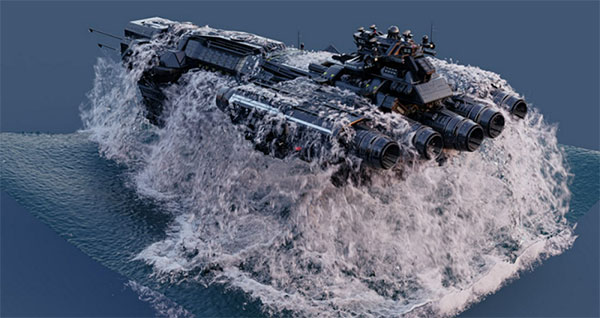
NVIDIA announces NeuralVDB, bringing the power of AI to OpenVDB, an industry-standard library for simulating and rendering sparse volumetric data such as water, fire, smoke, and clouds.
NVIDIA announced on the 10th that it has released NeuralVDB.
Announced at SIGGRAPH, NeuralVDB builds on the past decade of OpenVDB development. With applications in scientific computing and visualization, medical imaging, rocket science, and visual effects, NeuralVDB reduces the memory footprint by up to 100x, enabling creators, developers, and researchers to interact with extremely large and complex data sets in real time.
OpenVDB has been an Academy Award-winning technology used across the visual effects industry for the past decade. Since then, it has been used in industries and sciences where sparse volumetric data is widely used, such as industrial design and robotics, beyond entertainment.
Last year, NVIDIA introduced NanoVDB, which added GPU support to OpenVDB. Performance improvements enable real-time simulation and rendering.
NeuralVDB builds on the GPU acceleration of NanoVDB by adding machine learning to introduce a compact neural representation that significantly reduces memory space. NeuralVDB represents 3D data at a much higher resolution and larger scale than OpenVDB, allowing users to easily process large volume data sets on devices such as individual workstations and laptops.
NeuralVDB provides significant efficiency improvements to OpenVDB by compressing the memory space of a volume by up to 100x compared to NanoVDB, enabling users to efficiently transfer and share large and complex volumetric data sets.
NeuralVDB allows frame weights to be used in subsequent frames to accelerate training by up to 2x. It also allows users to use network results from previous frames for temporal consistency or smooth encoding.
NeuralVDB dramatically reduces memory requirements, accelerates training, and enables temporal consistency. It can be used for large-scale complex volume data sets for AI-assisted medical imaging and large-scale digital twin simulations.
These three effects of dramatically reducing memory requirements, accelerating training, and enabling temporal consistency enable NeuralVDB to open up new possibilities for scientific and industrial use cases, including large-scale complex volumetric datasets for AI-assisted medical imaging and large-scale digital twin simulations.