Yoon government invests 340 trillion won in AI semiconductors and trains 150,000 professionals
Ministry of Science and ICT, Graphcore, SKT, KT, etc. Start Development of Korean AI Semiconductor
As demand for AI semiconductors has been rapidly increasing across industries, the government and companies are accelerating the development of AI semiconductors to enhance competitiveness.
AI is being applied to various applications, businesses are expanding, and interest in AI semiconductor development is growing due to issues such as the surge in GPU prices and the burden of operating costs due to power usage.
AI semiconductors are non-memory semiconductors that perform large-scale calculations required to implement AI services at ultra-high speeds and low power. AI semiconductors implement artificial intelligence computational power efficiency approximately 1,000 times higher than existing ones, allowing them to learn and process information on their own like the brain and perform simultaneous calculations at once.
According to Gartner and others, the global AI semiconductor market size was $26.7 billion last year, and is expected to grow by about four times over the next 10 years to $117.9 billion in 2030.
The Yoon administration has been actively leading the national competitiveness of AI semiconductors, and not only global big tech companies such as Nvidia, Google, and Samsung, but also telecommunications companies such as SKT and KT have begun developing AI semiconductors.
■ Establishment of government-led support measures such as ‘Strategy to achieve semiconductor superpower’ On the 21st, the government announced the 'Strategy to Achieve Semiconductor Superpower', stating that it will invest 340 trillion won by 2026 through cooperation between industry, academia, and research institutes, and train more than 150,000 AI semiconductor experts by 2031.
AI semiconductors will be supported with 1.25 trillion won, and will be applied to major domestic industries such as data centers, future cars, bio, home appliances, machinery, and robots to verify performance.
Last June, the Ministry of Science and ICT announced ‘AI Semiconductor Industry Growth Support Measures’ at the ‘1st AI Semiconductor High-Level Strategy Dialogue’ comprised of industry, academia, and research, including Samsung Electronics and SK Hynix.
The discussions that day included: △Securing AI semiconductor super-gap technology, △Creating initial market demand for domestically produced AI semiconductors, △Using domestically produced AI semiconductors when developing AI products and services, △Promoting new performance verification projects, △Application and expansion to public projects such as intelligent CCTV and smart cities, △Creating an industry-academia-research cooperation ecosystem with the participation of large corporations, etc.
ong>■ Graphcore IPU records 31% faster training time than NVIDIA in MLPerf test
As full-scale support at the national level is promoted, competition among companies to develop AI semiconductors is also intensifying.
Graphcore's 'Bow Pod16' has achieved 31% faster training time than NVIDIA's 'DGX-A100 640GB' in the natural language processing category of the latest MLPerf 2.0 benchmark test.
MLPerf is a consortium of AI leaders from academia, industry, and research that standards-based assessment of training and inference performance of hardware, software, and services to “build fair and useful benchmarks.” We have the authority to regularly run new tests and add new workloads that represent cutting-edge AI technologies to stay on the cutting edge.
MLPerf benchmark tests include image classification, object detection, biological, medical, image segmentation, automatic speech recognition (ASR), natural language processing (NLP), recommendation, and reinforcement learning. MLPerf benchmarks provide IT organizations and developers with the right solutions through relevant performance data.
Graphcore, an AI semiconductor IPU development company, signed an agreement with ETRI on the 6th to develop a new SW approach for high-efficiency AI computing, thereby making a full-fledged entry into the domestic market.
■ SKT, KT…Telecommunications companies begin developing AI semiconductors SKT's self-developed AI semiconductor brand 'Sapion' launched Korea's first data center semiconductor 'SAPEON X220' in November 2020 after four years of research and development since 2017.
SAPEON said that the 'SAPEON X220' is 1.5 times faster than GPUs in deep learning calculations, uses 80% of the power, and costs half the price of GPUs. It also said that it plans to release the successor model X330 next year, which adds real-time learning capabilities to the X220, which is optimized for inference.
In addition, SKT will implement the 'SK ICT Curriculum' with SK Hynix on the 12th to foster AI and semiconductor talent. He added that he plans to help overcome the shortage of AI and semiconductor talent and to foster capable human resources with practical capabilities.
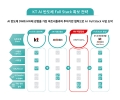
On the 6th, KT announced that it will make a strategic investment of 30 billion won and business cooperation with domestic AI semiconductor startup ‘Rebellion (CEO Park Sung-hyun)’, aiming to become an AI full-stack operator.
Korea is overwhelmingly number one in memory semiconductor production and ranks second in the world in foundry (semiconductor consignment manufacturing) market share, but its market share in the fabless (semiconductor design) sector is only around 1%, highlighting the importance of cooperation between domestic large corporations and fabless startups.
Rebellion is an AI fabless startup that has been discovering development personnel in the AI semiconductor field and establishing a position in AISC design competitiveness, and KT expects that cooperation with these companies will be an opportunity to fully enter the AI semiconductor field and drive the competitiveness of the fabless domestic and international markets.
As it is expected that the country and industry will be able to secure a market advantage by taking the lead in developing AI semiconductor technology, which is expected to increase industrial value in line with the digital transformation trend, attention is being paid to the future direction of the country and industry.