▲(From left) Senior Researcher Yong-Hoon Kim of the Korea Institute of Materials Science, Principal Researcher Jeong-Dae Kwon, Professor Je-In Lee of Pusan National University, and Student Researcher Byeong-Jin Park of the Korea Institute of Materials Science who led this research
Simultaneous information processing and storage, expected to be applied to various AI devices
Handwriting pattern image learning results recognition rate accuracy 97% recorded
The Korea Institute of Materials Science (KIMS, President Lee Jung-hwan), a government-funded research institute under the Ministry of Science and ICT, has implemented the world's first neuromorphic semiconductor device that can simultaneously process and store information, and perform image learning and recognition, such as handwriting patterns. Expectations are high that this device will be applied to various artificial intelligence devices in the future.
The Korea Institute of Materials Science announced on the 8th that the research team led by Dr. Yonghoon Kim and Dr. Jeongdae Kwon of the Nano-Surface Materials Research Division succeeded in implementing the world's first next-generation neuromorphic semiconductor device with high integration and high reliability by thinning lithium ions, a key material for lithium ion batteries.
This technology is a next-generation artificial intelligence semiconductor core component manufacturing technology that enables high integration and high reliability by ultra-thinly filming lithium ions, the core material of lithium ion batteries that has recently been attracting attention, and grafting them onto two-dimensional nano-materials.
Neuromorphic semiconductor devices are composed of synapses and neurons, similar to the human brain. At this time, the development of synaptic elements that simultaneously perform information processing and storage functions is essential.
Synaptic elements have the characteristic of simultaneously processing and memorizing information by receiving signals from neurons and modulating synaptic weights (connection strengths) in a variety of ways, similar to the human brain.
In particular, if the linearity and symmetry of the synaptic weights are satisfied, there is an advantage in that various pattern recognition can be easily implemented with low power.
Previous studies have mainly used charge traps between the interfaces of different materials or used oxygen ions to control synaptic weights.
On the other hand, in this case, there was a disadvantage in that it was difficult to control the movement of ions as desired depending on the external electric field.
The research team solved this problem by developing a highly integrated artificial intelligence semiconductor device through a thin film process development while maintaining the mobility of lithium ions according to an external electric field.
It has the advantage of being suitable for existing semiconductor processes, as it allows for wafer-scale thickness control and micro-patterning processes by thinning the film to a thickness of tens of nanometers.
The research team succeeded in forming a thin film of lithium ions using the vacuum sputtering deposition method used in general semiconductor processes.
The thickness of the lithium ion thin film deposited at this time is less than 100 nanometers. Afterwards, a transistor-shaped element is created on a silicon wafer substrate through a semiconductor process, and when an electric field is applied from the outside, the lithium ions inside the charged lithium thin film move reversibly, allowing the conductivity of the channel to be finely controlled.
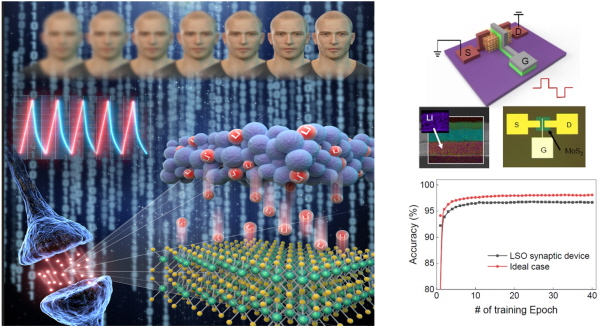
The research team implemented an artificial neural network learning pattern using the synaptic elements developed in this way, and learned handwriting image pattern recognition based on this. The fabricated artificial intelligence semiconductor device showed a high handwriting pattern recognition rate of approximately 96.77% by maintaining finely tuned synaptic weight characteristics even after repeated electric fields of more than 500 times.
The research team led by Dr. Yonghoon Kim and Dr. Jeongdae Kwon stated, “The next-generation neuromorphic semiconductor device developed this time does not require a CPU, which is an information processing device in the existing von Neumann method, and a memory, which is an information storage device, separately. It performs information processing and storage simultaneously and can perform image learning and recognition, such as handwriting patterns.” They added, “It is expected to be widely applied to various low-power artificial intelligence devices, such as world-class neuromorphic hardware systems, haptic devices, and vision sensors in the future.”
Meanwhile, this research result was carried out with the support of the Ministry of Science and ICT through the major projects of the Korea Institute of Materials Science and the Materials Innovation Leading Project of the National Research Foundation of Korea.
In addition, the research results were published in 'ACS AMI (ACS Applied Materials & Interfaces, IF: 10.383)' published by ACS, a world-renowned academic journal, on November 17, 2022. (First author: Student researcher Park Byeong-jin, Co-corresponding author: Professor Lee Je-in of Pusan National University)
Currently, the research team is conducting follow-up research in the field of intelligent wearable devices by applying the results of this study to low-power artificial intelligence devices and wearable edge devices.

▲Schematic diagram of next-generation neuromorphic semiconductor devices with high integration and high reliability using battery materials (left), photo of a highly integrated 3-terminal-based device using thin-film lithium-ion materials and handwriting pattern accuracy (right)