Physical AI HBM Smart Factory SDV AIoT Power Semicon 특수 가스 정정·반론보도 모음 e4ds plus

[Monthly Planning - Developer Reality ③] Population Cliff Era, Globalization of Developers Required

Google 우선 소스 기사입력2023.02.13 15:44

“No to overseas personnel permit system, demand change to reporting system”
Developers are worth their weight in gold, simple development work goes to Southeast Asia
Semiconductor industry also faces manpower drought, “concentration in large companies and globalization”

As cutting-edge industries gradually expand, demand for development jobs increases and supply becomes insufficient, and voices in the industry are growing louder that it is not easy to fill IT manpower with only domestic talent. We followed the human resource difficulties scattered throughout the software (SW) and hardware (HW) industries, such as the rising salaries of development jobs and the phenomenon of large corporations flocking to them, and the perspectives of HR and management who are suffering from this and turning their eyes to global talent.

■ Startups, Globalization of IT Talents YES


“Although there is a developer boom in the job market and the supply has increased, it is not easy to find developers from beginners to those with five years of experience.”

Mr. A, who is developing an HR platform app to be used locally in the Philippines, lamented that it is difficult to find mid-level developers with less than 5 years of experience in small and medium-sized companies and startups. Mr. A said, “Developers with 5 years of experience want a salary of around 5 million won per month, but the labor cost of developers in the Philippines is about 1/3 of that for similar performance, so we are hiring local developers.”

According to Jobplanet, the average annual salary for mobile app developers in 2022 is 49.91 million won. When looking at it by year, the value starts to rise significantly from the 5th year. The average annual salary in the 5th year is 43.06 million won, with the lower tier earning 37 million won and the upper tier earning 68.2 million won. From the 6th year, the average annual salary is 48.22 million won, and from the 7th year, it is 56.42 million won, showing a rapid increase.

Even in this case, the black hole of human resources is so severe that small and medium-sized companies and startups are having difficulty recruiting employees, as they quickly change jobs even if they are offered a salary level that matches the offered salary. As a result, they are looking to Southeast Asia, such as the Philippines, Vietnam, and Malaysia. Developers are forming teams by appointing domestic senior developers as team leaders for project management and planning, and creating local corporations to form junior developers such as simple coders as overseas personnel. It is also due to this background that 'accidentally global management' has become common in the development industry.

However, this does not mean that there are no disadvantages to using overseas personnel. △ Feedback and communication issues with overseas corporations and overseas outsourced personnel △ Difficulties in dispatching domestic personnel overseas, etc., are increasing the demand for domestic employment of overseas personnel.

However, hiring foreign developers in Korea is blocked by various regulations, making it difficult to fill the desired workforce. The industry raised its voice, saying that while the foreign employment quota system is a necessary system to protect domestic workers, it could hinder industrial development itself in the current situation where the total workforce is insufficient. It is difficult to cover the decrease in the youth population in the era of low birth rates and the increase in the demand for talent in various cutting-edge industries such as AI, semiconductors, and mobility with a limited population.

The speed of project development is slowing down due to a lack of human resources. In a market that requires rapid trend changes and development cycles, the timely supply of human resources for timely development is one of the important factors in corporate management. Person A said, “In this situation, the startup, SME, and mid-sized business ecosystem is collapsing, and only large corporations will remain,” emphasizing the importance of supplying talent to secure self-reliance.

The current government is limiting the employment of professional foreign workers to 20% for each workplace, along with the quota system. Small and medium-sized businesses are demanding the abolition of the limit and a transition to an employment reporting system, pointing out that they are being forced into illegal and expedient means to run their businesses, such as hiring illegal immigrants, splitting up workplaces, and hiring short-term workers on tourist visas.

■ Semiconductor industry, denounces bias toward large corporations and escapes borders for talent

“To attract global talent, national boundaries must now disappear for domestic companies.”

Mr. B, the CEO of a fabless company that designs and develops short-range wireless communication chips, argued that the domestic semiconductor labor market should open up rather than remain trapped within the country like a Galapagos trap.


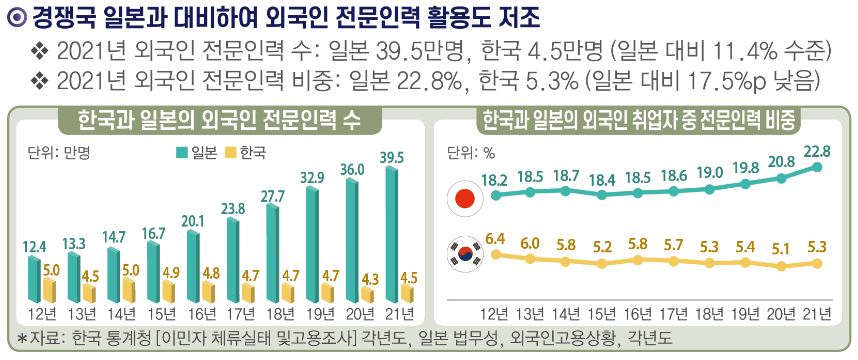
▲Comparison of the number and proportion of foreign professionals in Korea and Japan (Source: Federation of Korean Industries)

According to the 'Trends in Attracting Foreign Professionals in Major Countries and Korea's Challenges' announced by the Federation of Korean Industries in December, "Like Europe, which overcame the shortage of professional manpower in IT and other areas through policies to open up its market to foreign workers, Korea also needs to improve its response to the chronic shortage of industrial technology manpower by increasing the use of foreign professional manpower."

As of 2021, the number of foreign professionals in Japan has increased by 197% compared to 2013, reaching 395,000, and the proportion of professionals among all foreign workers reached 22.8%. On the other hand, the number of foreign professionals in Korea has been below 50,000 every year, accounting for only 5% of foreign workers.

Although there has been a recent active movement to foster semiconductor professionals, such as semiconductor contract departments within universities, a university official pointed out that compared to Taiwan’s semiconductor professional training, it is somewhat conservative. In addition, the industry feels that there is a greater shortage of advanced personnel with a master’s degree or higher than general bachelor’s degree personnel, so they all agreed that a clever way to foster related personnel is needed.

In addition, while the government and educational institutions are working hard to foster specialized development personnel such as SW, AI, and semiconductor personnel, the industry is continuously demanding the legislative and administrative branches for policy solutions to resolve the immediate personnel shortage, as it will take at least 10 more years for the personnel currently being trained to become mid-level skilled workers who can play their roles in the field.

Although there are small and medium-sized companies that offer salaries comparable to those of large corporations, an industry insider said that talent prefers large corporations such as Samsung and SK Hynix, adding that “continuous exposure through the media is also necessary to make the technological prowess and future vision of small and medium-sized companies widely known to job seekers and the general public.”