반도체 AI 인더스트리 4.0 SDV 스마트 IoT 컴퓨터 통신 특수 가스 소재 및 장비 e4ds plus

Car display 'OLED' life or death

기사입력2023.08.04 09:44


▲Hyundai Motor Company’s Ioniq 6 display (Photo: e4ds news)

LCD China and Taiwan take the lead, OLED share to increase to 17.2% by 2027
Market demand changes, premium line, large OLED adoption expansion

It was analyzed that in order for Korean companies to survive in the rapidly growing automotive display market, they will have to maintain their lead in the OLED market, which they currently dominate.

The Korea Display Industry Association announced the 'Vehicle Display Value Chain Analysis Report' containing data on the vehicle display value chain and global competitiveness on the 2nd.

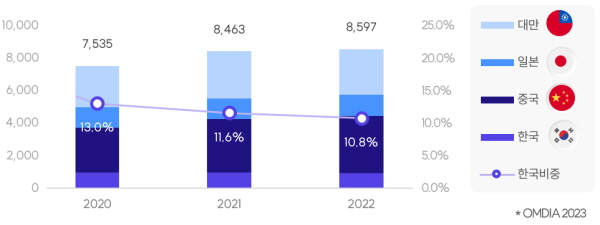
According to this, as of 2022, the automotive LCD market will be worth 8.6 billion dollars. China, which has rapidly expanded its market share based on its huge domestic market, will account for 38.4%, Taiwan, which entered the automotive display market early, will account for 33.7%, and Japan and Korea, which are continuously decreasing their LCD production, will account for 14.8% and 13.1%, respectively. It was revealed that all four Northeast Asian countries are participating in the production of automotive LCDs.

▲Vehicle Display LCD Market Size by Country (Million USD)

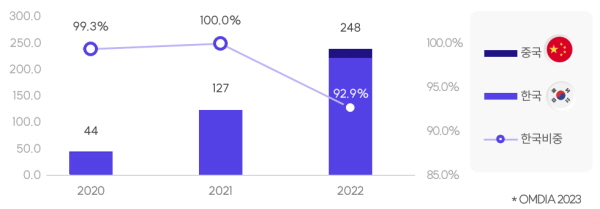
On the other hand, OLED is expected to be released in 2022In the entire market of 250 million dollars as of the year, Korea has a share of about 93% with 230 million dollars, while China has a share of about 7% with 20 million dollars. Korea and China are the only two countries competing, but Korea has an overwhelming advantage in automotive OLED.

▲Vehicle display OLED size by country (million dollars)

However, China, which is increasing its market penetration rate by expanding OLED investment, is expected to increase its market share from 0% in 2021 to 7.1% in 2022, so it is worth paying attention to whether competition intensifies in the automotive OLED market in the future.

The automotive display market, which has been focused on LCDs and small and medium-sized displays for the past five years (2017-2022), has a compound annual growth rate (CAGR) of approximately 4.7%, but is expected to grow by an average of approximately 7.8% per year to reach USD 12.6 billion in 2027 due to the trend toward larger displays.

By technology, automotive LCDs accounted for approximately 97.2% of the market in 2022, but are expected to decline due to increasing demand for large and high-definition displays, while OLEDs are expected to gradually increase in share from 2.8% in 2022 to 17.2% in 2027.

As of 2023, conditional driving automation (Level 3), the highest level of autonomous driving among cars released so far, is being installed, and the display requirements of the automotive industry are also changing due to changes in the usability of the vehicle's interior space.

In particular, the automotive industry requires a brightness level that exceeds the reflection of sunlight while driving (500 to 1,000 nits) and extreme temperature changes (-30 to 70℃) without affecting operation. They are demanding displays that are not affected by design changes or high-definition implementation.

As OLED is currently the most suitable display to meet these requirements, the automobile industry is expanding the adoption of OLED, focusing on premium lines.

By type of vehicle display, OLED is focused on entertainment applications. The OLED share of Center Stack Display based on sales was only 0.6% in 2020, but it is expected to grow to 8.0% in 2023, and Passenger Display used by passengers in vehicles is expected to account for 46.3% in 2023.

In addition, as the automobile industry increases its demand to display not only driving information but also content such as movies on a single screen, vehicle displays are bound to become larger. From the display industry’s perspective, larger displays are expected to lead to increased profitability, which will also have a positive effect on expanding the marketability of vehicle displays.

For the Center Stack Display and Cluster, panels larger than 10 inches are rapidly increasing by 13.3% and 17.2% year-on-year, respectively, due to the enhancement of information delivery and entertainment functions, such as driving information, various attractions, and vehicle status information.

Along with this trend toward larger displays, domestic display manufacturers LGD and Samsung D have overcome the limitations of OLED's short lifespan through hybrid OLED panel manufacturing and two-stack tandem technology. These technological improvements are expected to accelerate the expansion of OLED applications and secure high profits.

Vice Chairman Lee Dong-wook of the Korea Display Industry Association said, “The global automobile industry is expanding its differentiating factors to include electrical components, and the importance of display technology in electrical components is receiving increasing attention.”

He also said, “Just as we experienced delays in automobile production last year due to a shortage of semiconductors, expanding cooperation between the automobile-display industries is not an option but a necessity in terms of stable supply of premium displays such as OLED going forward.” He added, “It is more important than anything to establish a stable supply chain ecosystem strategy to support exports and investments in the rapidly growing automotive display market.”