Easy LPCAMM replacement and upgrade, increased manufacturing flexibility and user convenience
Validation planned for major customers and next-generation systems, commercialization planned for 2024
Samsung Electronics is developing a removable LPDDR memory that is mainly installed directly on the main board, and it is expected that the replacement and upgrade of low-power DRAM will become easier.
Samsung Electronics announced on the 26th that it has developed the industry's first 7.5Gbps LPCAMM (Low Power Compression Attached Memory Module) based on LPDDR DRAM that will change the landscape of the PC and laptop DRAM market.
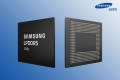
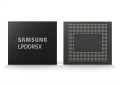
LPDDR (Low Power Double Data Rate) is a low-power DRAM used in mobile devices such as smartphones, tablets, and laptops.
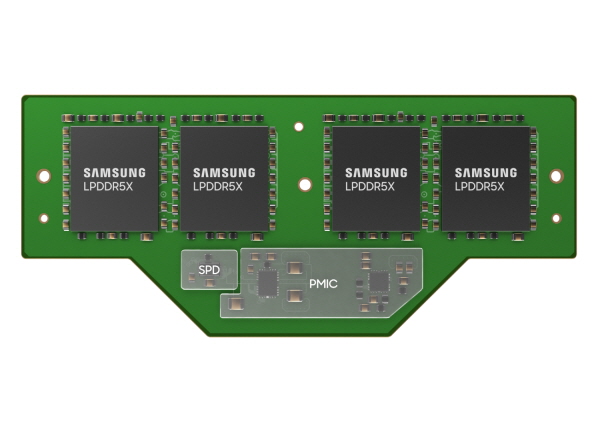
LPCAMM is a module product based on the LPDDR package, and is expected to present a new form factor paradigm to the next-generation PC and laptop market by achieving technological innovation in terms of performance, low power, and design efficiency compared to existing DDR-based So-DIMMs.
So-DIMM (Small Outline Dual In-line Memory Module) is a module with DRAM mounted on both sides of the PCB board. It is smaller than a typical DIMM and is widely used in small systems such as laptops.
Existing PCs and laptops use the on-board method where the LPDDR package product is directly mounted on the main board. Alternatively, So-DIMMs in the form of DDR-based modules are used.
The onboard method has the advantages of miniaturization and low power consumption, but it is difficult to replace because it is directly mounted on the main board, and although So-DIMM can be detached in module form, there are physical development limitations in terms of transmission speed and space efficiency.
Samsung Electronics has implemented high performance and low power consumption by mounting LPDDR on a module, while making it detachable, thereby increasing manufacturing flexibility for manufacturers and convenience for users in terms of replacement and upgrades.
LPCAMM reduces the mounting area by up to 60% compared to So-DIMM, increasing the freedom of component configuration in PCs or laptops and enabling more efficient use of internal space, such as securing additional battery capacity.
In particular, LPCAMM is expected to expand its application areas to artificial intelligence (AI), high-performance computing (HPC), servers, and data centers by improving performance by up to 50% and power efficiency by up to 70% compared to So-DIMM.
Recently, data center customers are considering power operation and total cost of ownership (TCO) efficiency by considering LPDDR installation, but in the case of the onboard method, there is the difficulty of having to replace the entire motherboard in case of specification upgrade or problem.
On the other hand, when LPCAMM is applied to a server, it is possible to upgrade by replacing the product with the desired performance, and it can also bring about cost savings from the perspective of power operation.
“As the demand for high performance, low power, and manufacturing flexibility increases across various fields, LPCAMM is expected to find more applications in PCs, laptops, and data centers,” said Bae Yong-cheol, Vice President of Product Planning Team, Memory Business Division, Samsung Electronics. “Samsung Electronics will continue to expand the LPCAMM solution market in the future.” “We will actively explore opportunities to open up new markets and lead the memory industry,” he said.
“LPCAMM’s energy efficiency and ease of replacement and repairability make this new form factor a game changer for today’s PC market,” said Dimitrios Ziakas, vice president of Memory & IO Technologies at Intel. “We are excited to participate in this new standard that will fuel the client PC ecosystem and drive innovation across a broader range of market applications.”
Samsung Electronics has completed verification of 7.5Gbps LPCAMM operation on the Intel platform and plans to verify it in next-generation systems with major customers, including Intel, within the year for commercialization in 2024.