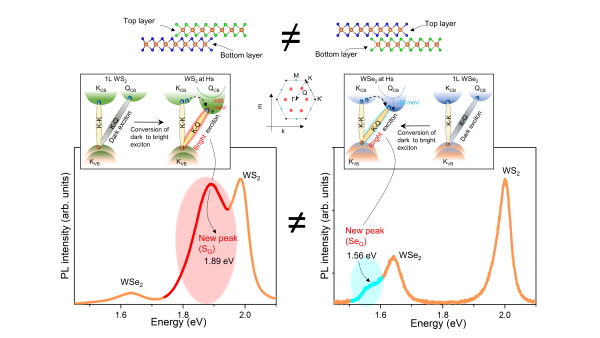
▲Schematic diagram of dark excitons and excitons generated when two single-layer semiconductor materials are stacked
IBS detects 'dark excitons' for the first time in layered devices
Next-generation semiconductors that utilize quasi-particles called 'excitons' instead of electrons are expected to be developed.
The research team of Director Lee Young-hee of the Center for Nanostructure Physics at the Institute for Basic Science (IBS, President Noh Do-young) and Professor Emeritus of HCR at Sungkyunkwan University announced on the 12th that they have detected 'dark excitons' for the first time in a device that stacks different semiconductor materials through joint research with the research teams of Fellow Yoon Seok-joon of Oak Ridge National Laboratory in the U.S. and Professor Ermin Malik of Philips-Marburg University in Germany.
Semiconductor materials have two bands where electrons can exist. The lower band, which is filled with electrons, is called the 'valence band', and the upper band, which is empty of electrons, is called the 'conduction band'. When external energy is applied, electrons in the valence band are excited to the conduction band, and the empty space where electrons disappear is called a hole. A hole pairs with an electron that has moved up to the conduction band to form a quasiparticle called an exciton.
Excitons are divided into two types: 'bright excitons' and 'dark excitons'. Bright excitons are already being used in quantum dot displays (QLEDs) due to their characteristic of being easily detected by absorbing light.
On the other hand, dark excitons have the advantage of being longer-lived and more stable than bright excitons, making them advantageous for use as semiconductors, but they are difficult to detect because they absorb little light. So far, only the operating principle in a single material has been elucidated, and it has not been clearly revealed how it is expressed in a heterojunction device with multiple materials stacked similar to the actual semiconductor device environment.
To this end, the research team first confirmed the behavior of excitons by irradiating laser light onto a TMD heterojunction device in which a different type of TMD was stacked on top of a single sheet of transition metal disulfide compound (TMD).
As a result, we were able to discover a phenomenon in which dark excitons appear or disappear depending on the stacking order of the TMD materials, and in particular, we were able to confirm that dark excitons are always expressed regardless of the stacking order in the case of the upper TMD material.
Furthermore, it was revealed that dark excitons become brighter when the intensity of the applied light decreases, making it possible to control the intensity of dark excitons according to the intensity of light.
This opens up the possibility of improving the efficiency of broadband solar cells by utilizing dark excitons in 'energy filters' that distinguish energy or color and 'power filters' that control the intensity of light.
“With the discovery of dark excitons for the first time in heterojunction materials, we anticipate next-generation optical semiconductor applications with power and energy filtering functions expected in the next generation,” said Director Younghee Lee, who led the research.
The research results were published on September 8th in the renowned international academic journal ‘Nature Communications (IF 17.694)’.