KITECH Webinar_~7.22
Physical AI HBM Smart Factory SDV AIoT Power Semicon 특수 가스 정정·반론보도 모음 e4ds plus

[PCB Trends-Part 1] Domestic PCB Growth of 6% This Year, Flexible Leaping Back to Lead the Market

Google 우선 소스 기사입력2017.06.12 06:39

The PCB market in the four major countries will turn to growth due to automotive electronics and IoT
Fan-out Wafer-level Package Technology Mass Production Application, Influence Gradually Expanding


This year, the domestic electronic circuit board market is expected to grow by 6.0% to reach 9.5 trillion won.

The domestic market has grown to KRW 8.96 trillion in 2016, growing at an average annual rate of 10.2% based on production value since 1998, but has recorded negative growth for the past three consecutive years. The global electronic circuit board (PCB) market is expected to record a growth rate of approximately 3% by 2020.

According to the Electronic Circuit Board Industry Status Report published by the Korea Electronics Circuit Industry Association, the growth rate of the four countries (Korea, China, Japan, and Taiwan) that account for 81.6% of the world's electronic circuit board production has slowed down. Prices have fallen due to the slump in the smartphone and computer markets and supply outpacing demand. On the other hand, this year, the average annual growth rate (CAGR) is expected to be 2.8% due to the growth of the automotive electronics and IoT markets and the upward standardization of smartphones.
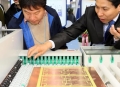
Competitive PCB (Source: Samsung Electronics website)

Taiwan and Japan have seen their overseas production exceed their domestic production, and our country is expected to increase its share of overseas production starting this year. Among them, the production share in Vietnam is expected to increase.

Looking at substrate production by product (2016), rigid substrates accounted for 51%, flexible substrates 20.3%, HDI substrates 14.4%, and IC-Substrates 14.3%. Among rigid substrates, 4- to 6-layer substrates accounted for 23.9% of the total. As fan-out wafer-level package (FO-WLP) technology was mass-produced, the performance of companies with flip-chip chip-scale package (FC-CSP) technology used in smartphone APs decreased. It is expected that the influence of FO-WLP technology will gradually expand after 2017.

2016 Market, 8.96 trillion won, down 1.5% from the previous year
Growth expected as it is adopted in FPCB for OLED displays

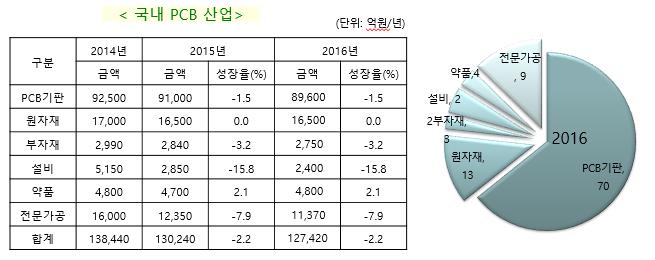
In 2016, the domestic production of electronic circuit boards recorded KRW 8.96 trillion, down 1.5% from the previous year. Although it slowed down due to the stagnation of the premium phone market, it is expected to grow by 6.0% to KRW 9.5 trillion in 2017. This is due to domestic smartphone manufacturers releasing new products and domestic companies using FPCB for OLED displays in products of overseas global companies. In addition, the flexible sector is expected to lead growth as it makes a comeback.

By substrate, rigid substrates (including HDI substrates) accounted for 51.0%, IC-Substrate 26.6%, and flexible substrates 22.4%. It is expected that high-density/fine pattern PKG substrates, build-up substrates (HDI), and high-layer substrates for servers and supercomputers for realizing multi-functionality and high functionality of electronic devices for IoT and IoE will lead production. Rigid substrates are expected to grow by 0.7% to KRW 4.6 trillion, while flexible substrates are expected to stop negative growth and grow significantly by 24.4% to KRW 2.5 trillion. PKG substrates are expected to fluctuate depending on FC-CSP performance, and are expected to grow by 0.8% to KRW 2.4 trillion.

Raw materials, down 0.6% year-on-year to KRW 164 billion
Recovery expected due to increased demand for materials for flexible substrates

In 2016, among the downstream industries, raw materials decreased by 0.6% year-on-year to KRW 1.64 trillion. In particular, materials for flexible substrates decreased by 2.0%, but the decrease was smaller. In 2017, it is expected to recover to KRW 1.755 trillion due to increased demand for materials for flexible substrates, and those for rigid substrates are expected to reach KRW 1.06 trillion, similar to the previous year. As demand for copper foil stagnated and prices fell, the production ratio decreased, and the production ratio of copper foil for high value-added electric fields increased, resulting in an imbalance in supply and demand, which is expected to continue this year as well as last year.

Domestic PCB Industry (Source: KPCA)

The production of auxiliary materials recorded KRW 280 billion, down 1.4% from the previous year, with Solder Resist (PSR) accounting for 32.1% at KRW 90 billion. This year, the production is expected to increase by 5.7% from last year to KRW 296 billion, and PSR is expected to reach KRW 95 billion. Bit production is being pushed out by China, which has high price competitiveness, as manufacturing technology is standardized. CNC Drill Bit and Router Bit are expected to show the same performance as the previous year, and Dry Film is expected to show a size of KRW 112 billion, up 6.7%.

Pharmaceutical production decreased by 3.2% to 34.55 trillion won, with gold plating and copper plating drugs accounting for 62.6% of the total. This year, gold plating is expected to grow by 3.9% and copper plating by 5.9%, with the total market growing by 4.8% to 477 billion won. Gold plating and copper plating are increasing their market share, but high value-added drugs such as copper plating and PKG drugs are still dominated by foreign companies.

Domestic production of pharmaceuticals reduces costs and creates opportunities for latecomers to enter the market

According to the industry status report, “It is difficult for latecomers to enter the market due to the need for testing on mass production lines to ensure final consumer approval of drugs and reliability,” and “Recently, there are opportunities for participation as costs are reduced through local production through cooperation with domestic substrate manufacturers.”

The equipment market showed a 15.8% decrease year-on-year to KRW 240 billion, with equipment for plating/surface treatment processes decreasing by 28.6%. New investments are expected to be minimal this year, but new investment demand for flexible substrates, overseas plants, and investment in the rationalization sector are expected to continue.

The report explained, “Although domestic demand has decreased significantly, we are strengthening our global competitiveness by advancing into the Chinese market and Southeast Asia based on our technological prowess.”
김지혜 기자
기사 전체보기