반도체 AI 인더스트리 4.0 SDV 스마트 IoT 컴퓨터 통신 특수 가스 소재 및 장비 e4ds plus

Teledyne LeCroy Launches 16-Bit Arbitrary Waveform Generator

기사입력2018.11.16 09:04

Up to ±24V output voltage range
Provides 16-bit vertical voltage resolution
For use with 12-bit oscilloscopes

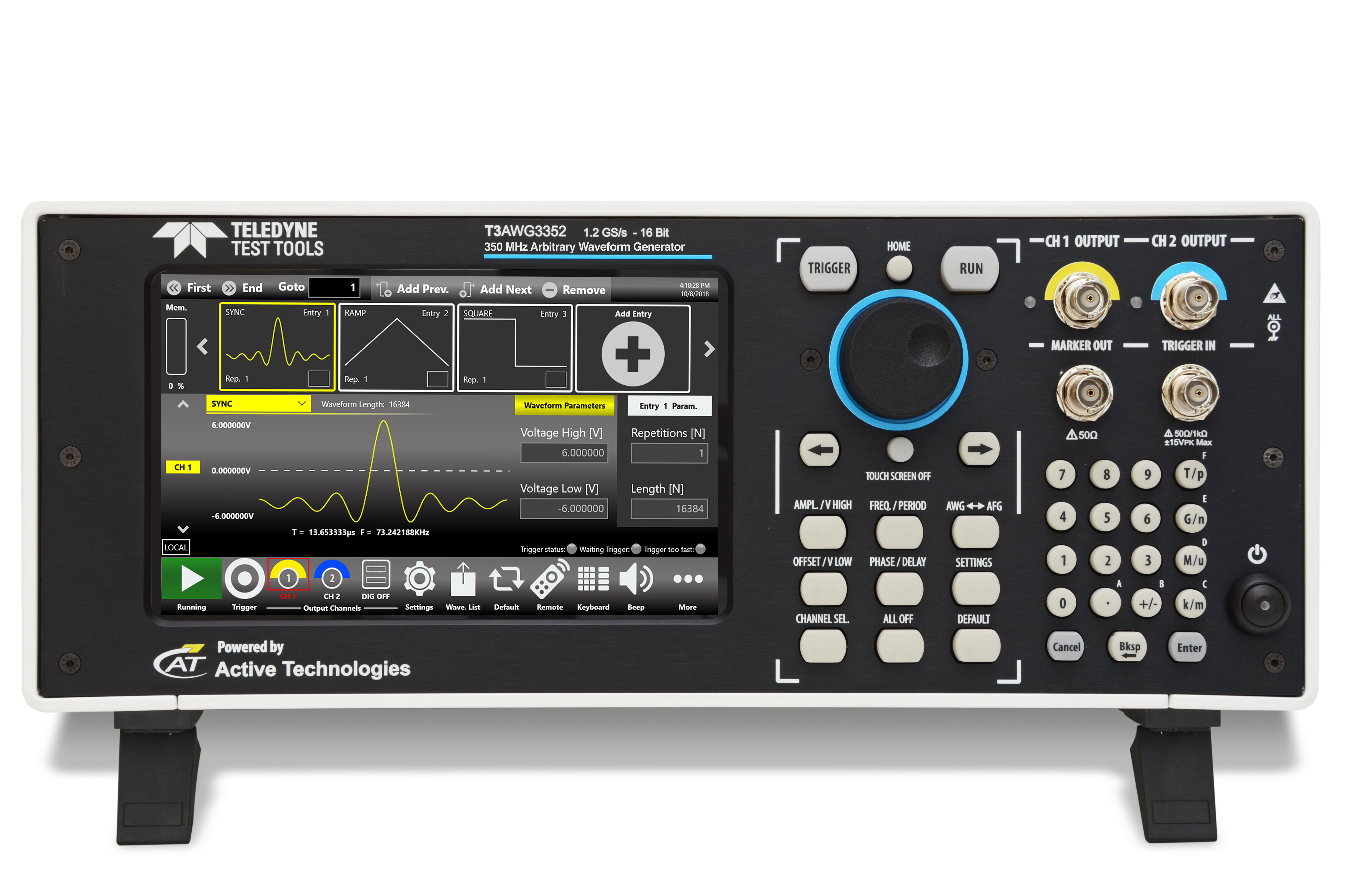
Teledyne LeCroy T3AWG3352

Teledyne LeCroy today introduced 16-bit arbitrary waveform generators (AWGs). The T3AWG3252 (250 MHz) and T3AWG3352 (350 MHz) dual-channel arbitrary waveform generators provide an output voltage range of up to ±24 V and 16-bit vertical voltage resolution.

In addition to arbitrary waveform generators, Teledyne Test Tools (T3) also offer function generator or digital pattern generator capabilities. These instruments can be used with Teledyne LeCroy's high-resolution 12-bit oscilloscopes in automotive, component/semiconductor test, aerospace/defense, physics, research and university labs for stress testing and response testing of specific signals.

Waveform generators with high signal accuracy and precise waveform details are key to designing high-quality finished products with short design cycles. The new T3 AWG produces the industry’s highest accuracy waveforms with clean, crisp details thanks to its high-definition 16-bit vertical voltage resolution. Therefore, users can secure test efficiency and increase confidence in the reliability of the results.

Teledyne LeCroy's 16-bit AWG provides a clean stimulus waveform to the DUT so that the DUT's response behavior is not affected by distortion. It also stores previously acquired real-world signals in memory and replays the stored waveforms in the AWG. The AWG emulates problematic or corner case inputs to the DUT and emulates expected interference signals as outputs to test the DUT's response behavior.

The new AWG provides a voltage output range of ±12 Vpk-pk (50Ω output into 50Ω input) and has an adjustable offset of up to ±6 V to extend the output range. Setting the output impedance to high impedance at 50Ω widens the output range to ±24 V or 48 V.

T3AWG3252/3352 AWG has three functional modes.

First, it operates as an arbitrary function generator with a variety of waveform options, providing a wide range of modulation capabilities. It also operates as an AWG, providing complex and completely arbitrary waveforms along with the ability to sequence analog/digital patterns using an intuitive user interface. Finally, in digital pattern generator (DPG) mode, users can generate completely arbitrary differential or single-ended digital patterns up to eight parallel bits. Users can combine the instrument’s eight digital outputs and synchronize them with the two analog output signals for use in debugging and verifying digital designs.
이수민 기자
기사 전체보기