With the development of artificial intelligence, virtual reality, etc., the amount of data to be processed is increasing, but the limits of integrated circuits are approaching. So instead of gates made of transistors, quantum computers that use quantum as their operational rules are emerging as an alternative. What exactly is quantum, and what can be done with it as an alternative? A reporter who has no connection with science takes a close look at everything from quantum to quantum computers, which are a recent issue, with a learning heart. When asked what he would say if he could leave only one thing for future generations when all civilization on Earth was destroyed, physicist Richard Feynman answered, "Everything is made of atoms!" He is right. Everything around us, including us, is made of atoms. And quantum mechanics is the study of the movement of atoms. So, in order to understand quantum mechanics, it would be natural to learn about atoms.
Atom, the smallest entity Around the 5th century BC, the ancient Greek philosopher Democritus proposed the atomic theory, which states that all matter is made up of indivisible small particles. However, because it was not possible to prove it at the time, it was only discussed philosophically among philosophers. Afterwards, during the Middle Ages, the atomic theory sank below the surface.
The atomic theory was brought back to the surface by the British chemist and physicist John Dalton. In 1803, Dalton used the atomic theory in his book, The Chemical System, to explain why the law of conservation of mass and the law of definite proportions hold. According to his atomic theory, atoms were the smallest fundamental particles of elements that had properties and could not be divided further. Many scientists at the time used Dalton's atomic theory as a useful hypothesis, but they did not think that atoms actually existed. The one who bucked this trend was Germany's Ludwig Boltzmann.
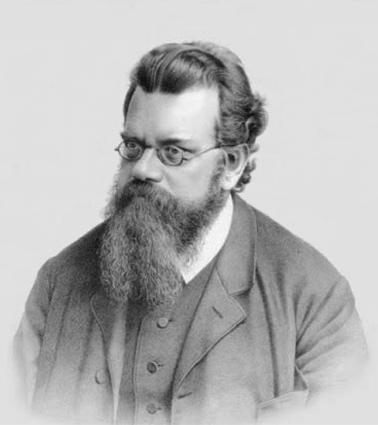
Recognized atom At the end of the 19th century, Boltzmann was convinced of the existence of atoms and argued for the kinetic molecular theory of gases based on atomism, not atomic theory. He also laid the foundation for statistical mechanics, which statistically deals with atoms and molecules. However, Boltzmann's argument, which started from the belief that matter exists discontinuously in space, was severely criticized by scientists who had an empirical belief that matter exists continuously in space. In particular, Ernst Mach, a physicist and philosopher who argued that only what can be measured empirically is science, openly said to Boltzmann, "I do not believe in atomism." Boltzmann even studied philosophy to refute the trend, but committed suicide in 1906 due to depression.

Ludwig Boltzmann "Why Me..." Coincidentally, a year before Boltzmann committed suicide, a paper supporting Boltzmann's claim was published. A patent examiner who majored in physics in Bern, Switzerland, proved that atoms must exist to explain the phenomenon of 'Brownian motion', which is the irregular movement of particles in a fluid. That examiner was none other than Einstein. Later, Jean-Baptiste Perrin of France experimentally verified this, and the existence of atoms was empirically proven.
Things smaller than atoms While some scientists were denying the existence of atoms, those studying atoms discovered even smaller things. Joseph John Thomson discovered the electron in 1897 while studying cathode rays. Ordinary gases and liquids do not carry electricity. In other words, atoms are electrically neutral. However, the electrons that Thomson discovered had a negative charge. Then, wouldn't there be a positive charge somewhere in the atom that cancels out the negative charge of the atom? In 1906, Thomson proposed an atomic model in which electrons with a charge equal to the total amount of positive charge are evenly distributed in a positively charged substance.
Thomson's disciple Ernest Rutherford began the gold leaf experiment in 1909 to investigate the internal structure of atoms. He created a 1/20,000 cm piece of gold leaf and fired alpha particles (stable particles made up of two protons and two neutrons) from radioactive elements at the gold leaf at a speed of about 16,000 km per second. He did not create a separate launching device. He simply opened a container containing radioactive elements toward the gold leaf. In any case, Rutherford thought that if Thomson's atomic model was correct, shooting alpha particles at the gold leaf would be like throwing a baseball at a pile of ping-pong balls. As expected, most alpha particles passed through the gold leaf. However, some alpha particles bounced off at a large angle, and some alpha particles bounced completely backward.

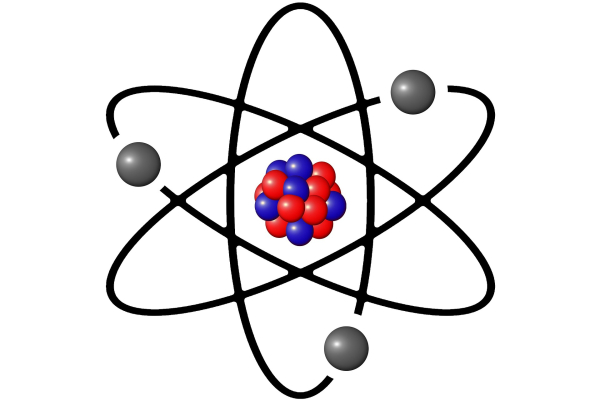
Rutherford's atomic model Rutherford discovered that the inside of an atom is almost empty, but there is something very small and solid that bounces off alpha particles. Rutherford named that solid thing the nucleus and created a new atomic model. It is an atomic model that resembles the orbits of planets that we are familiar with. According to Rutherford's atomic model, electrons orbit the nucleus, but the distance between them is very far. Dalton's conjecture that atoms were like stones and Thomson's atomic model that atoms were like bread with raisins were completely discarded.
The atom doesn't break down As we have seen before, atoms are made up of a nucleus and electrons. The nucleus is 1/100,000th the size of an atom, and electrons are 1/1000th the size of a nucleus. Usually, the orbit of electrons is considered to be the size of an atom. When an atom is magnified 1000000000000000 times, the nucleus and electrons are 100 km apart. And the rest of the space is all empty. Therefore, this question may arise.

The scene where Ant-Man shrinks "I need Pym Particles, I need Pym Particles!" Why don't atoms collapse when the empty space inside them is so vast? And why do all things made of atoms collide with each other instead of passing through each other?
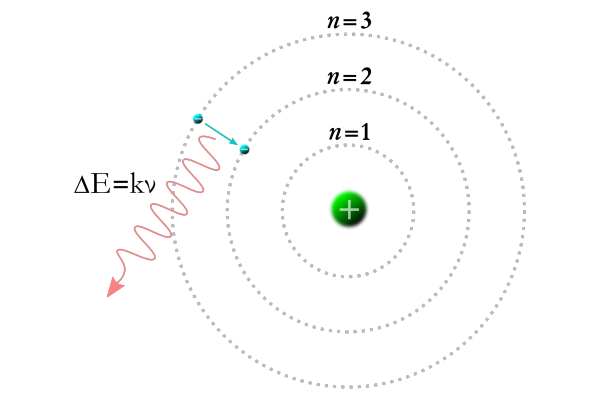
To find the answer, we must first look at the atomic model proposed by Niels Bohr in 1913. Bohr observed the discontinuous spectrum of the hydrogen atom and created a model based on it. Electrons move in circular orbits, and each orbit is not continuous but rather spaced apart. However, even if there is a set orbit, the probability that atoms will not collide is still high.

Bohr's atomic model
Werner Heisenberg gives up orbits here. The position of an electron is uncertain, and it can appear in several places at the same time. If you observe it directly, you can know where the electron is, but if you don't observe it, it can exist in many places. The electrons are scattered here and there like a cloud. The probability of atoms colliding with each other is higher than if the electrons were just orbiting. However, according to Heisenberg's theory, even if the atoms collide with each other, it is not guaranteed that they will bounce off. This is because the cloud is not solid.
Wolfgang Pauli made atoms rigid with the exclusion principle. An electron cannot take the place of an electron that is already occupied. For example, there is only one electron around the hydrogen nucleus. No other electron can enter. There is only one electron in a cloud at one point, and two electrons cannot exist. Electrons hate electrons. Atoms have no choice but to collide. However, the nucleus wants to pair with an electron. That is why electrons do not leave the nucleus. That is why atoms do not suddenly collapse or explode.
We've learned a little about atoms. In the next article, we'll look at how quantum mechanics began.
Reference book: "The World's Easiest Quantum Mechanics Class, Li Miao (Go Bo-hye), The Forest"
그렇군요.