Equipped with PQC technology to prepare for the era of quantum computing
Development of USB-type security token, Q-PUF USB
Strengthening security in areas close to actual users Post-Quantum Cryptography (PQC) is an encryption method that uses a complex mathematical algorithm that would take billions of years to break even with a quantum computer. It is being proposed as an alternative to the currently used RSA encryption method, which can be easily broken by a quantum computer.
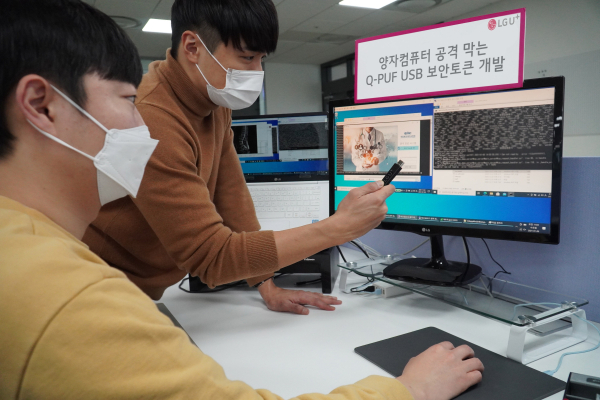
LG Uplus announced on the 19th that it has developed a 'Q-PUF USB' security token that embeds PQC technology in a USB, and has applied it to the Digital New Deal project to strengthen security in remote control and medical care.

▲ LG Uplus and ICTK Holdings develop Q-PUF USB
[Photo = LG Uplus]
PQC can be applied to key security elements such as △encryption key exchange, △data encryption/decryption, and △integrity authentication, and can be implemented only with software without separate equipment. Therefore, it can be flexibly applied to small devices to provide end-to-end security in all areas of wired and wireless communication networks.
Additionally, in the era of quantum computing, authentication technology that recognizes the subject of encrypted communication and verifies that the data has not been tampered with is important. LG Uplus and ICTK Holdings have developed a USB-type security token, Q-PUF USB, by upgrading the quantum-resistant algorithm to resolve security threats during authentication.
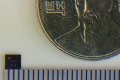
Q-PUF USB is a USB-type security token that combines ICTK Holdings' hardware security technology, Physically Unclonable Function (PUF) and Quantum Random Number Generator (QRNG). It generates encryption keys used in application services using the quantum random number of QRNG and protects them using PUF, providing high security.
While existing security tokens were a method in which the administrator injected a key or certificate, Q-PUF USB issues a certificate with its own hardware and stores the issued private key in internal secure storage. It is highly secure because there is no concern about it being leaked to the outside. In addition, it can provide unique verification and ownership-based authentication functions using the so-called 'inborn ID', a semiconductor fingerprint that cannot be duplicated or altered.
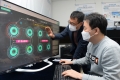
LG Uplus is introducing Q-PUF USB to its digital new deal project. Last year, it installed PQC modules in the dedicated lines of LG Innotek’s factory (640km section from Pyeongtaek to Busan) and Eulji University Hospital (207km section from Seoul Nowon to Daejeon). This time, it plans to apply Q-PUF USB to applications used in industrial and medical settings to strengthen security even in sections close to actual users.