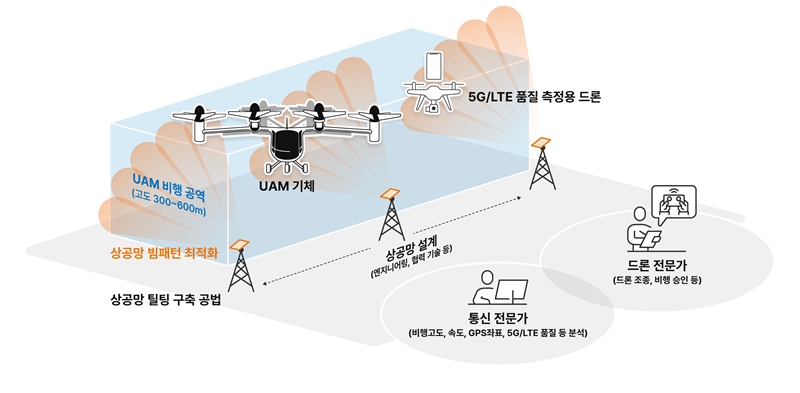
▲ Infographics on the construction of the Goheung Testbed 5G commercial network
SKT-Hangwooyeon, UAM demonstration flight route 5G communication support
Step-by-step development of technology and systems for stable 5G construction
SK Telecom, together with the Korea Aerospace Research Institute (KARI), the main organization for the Ministry of Land, Infrastructure and Transport's 'K-UAM Grand Challenge' demonstration project, will begin building the 5G airspace network necessary for K-UAM demonstration and support stable UAM communications.
SK Telecom announced that it operated a communication quality measurement drone near the Goheung National Comprehensive Flight Test Center as a pilot test related to the 5G airspace network and checked service quality based on communication altitude and distance. As a result, it was announced on the 4th that stable communication quality was confirmed at an altitude of 300-600m, which is the UAM operating altitude.
Based on the test results, SKT decided to build a 5G airspace network on some sections of the demonstration flight route of the first phase of the Goheung K-UAM Grand Challenge within the year.
SKT will provide support not only to the SKT consortium but also to other consortia and institutions participating in the verification, so that even consortia that do not have their own networks can conduct research with the goal of commercializing UAM in 2025.
In addition, in preparation for the urban verification of Phase 2 of the K-UAM Grand Challenge in the future, the company announced that it has built a pilot 5G commercial network infrastructure in some areas of the metropolitan area and has also prepared a plan to provide optimal commercial network quality in an urban environment in collaboration with relevant organizations.
The 5G airspace network is expected to bring about significant changes compared to the existing ground-centered network infrastructure construction and operation methods, and must be supported by a system that can efficiently manage communication quality in a wide range of airspace areas.
SKT said that in order to stably provide 5G commercial communications networks, it will gradually develop cell design technology, interference avoidance technology, beamforming technology, and cell cooperation technology, and will conduct technology exchanges with the government, academia, and research institutes.
Meanwhile, in the US and EU, UAM communications using commercial 5G and LTE networks, in addition to existing voice-based aviation communications, have not yet been fully implemented.
SKT has revealed its ambition to lead the construction of a 5G airspace network using SKT infrastructure and to lead demonstrations related to airspace networks through collaboration with Joby Aviation, a global UAM aircraft company.
Ha Min-yong, Chief Development Officer (CDO) of SKT, said, “In order to provide stable UAM services, it is essential to build a high-quality 5G airspace network,” and added,ot;We will continue our efforts to advance communications encompassing both ground and air in the 6G era and lead the future mobility era,” he said.