인피니언 HV GaN
반도체 AI 인더스트리 4.0 SDV 스마트 IoT 컴퓨터 통신 특수 가스 소재 및 장비 e4ds plus

“UAM New Market Development, Nationally Led Research and Development Is Essential”

기사입력2022.07.27 14:38


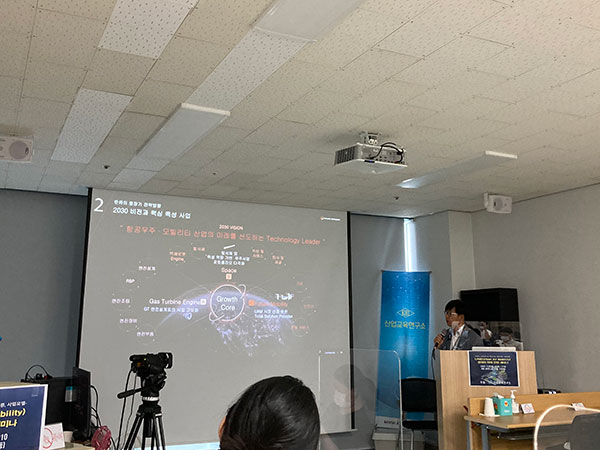
▲Kim Myeong-hyo, Managing Director of Hanwha Aerospace, giving a lecture


“UAM New Market Development, Nationally Led Research and Development Is Essential”

Sangyoyeon ‘UAM Outlook Seminar’… Presenting UAM Trends and Directions
Securing eTVOL maker status, aviation certification and minimum safety verification required
Establishing a certification policy linked to the development of UAM core technologies... Leading the global market

A forum was created to examine the current status of the domestic UAM industry and discuss institutional arrangements and business directions from various perspectives, including development technology, certification, and business models.

The UAM industry is a huge market with great potential due to its connections to various fields, and experts agree that state-led and joint research and development by industry, academia, and research institutes is essential to pioneer the new UAM market.

On the 22nd, KIEI Industrial Education Research Institute held a ‘UAM Present and Future Outlook Seminar’ at its headquarters in Guro-dong.

This seminar was attended by △CKO Kim Myeong-jip (Pablo Aviation), △Team Leader Shin Bok-gyun (Korea Aerospace Research Association), △Vice President Hwang Chang-jeon (Korea Aerospace Research Institute UAM Research Department), △Principal Researcher Namgung Pyeong (Aviation Safety Technology Institute), △Executive Director Kim Myeong-hyo (Hanwha Aerospace), △Team Leader Shin Sang-hoon (SK Telecom), △Director Jang Jeong-hoon (Moasoft Future Business Division)) covered UAM trends, infrastructure, core technologies, aviation certification, business models, etc.

UAM is a transportation system based on electric vertical takeoff and landing (eVTOL) aircraft, and is attracting attention as a next-generation transportation system due to its features such as vertical takeoff and landing, low noise, stable flight, and linkage with various ground transportation methods.

Kim Myung-jip, CKO of Pablo Aviation, said that as urbanization accelerated after the Industrial Revolution in the 18th century and carbon dioxide concentrations continued to increase, electrification in the field of e-mobility emerged as a megatrend due to eco-friendly policies.

Kim CKO added, “As urban congestion has made the transition to smart cities more important, operators need to select eVTOLs of an appropriate size based on urban air traffic demand,” and “In order to achieve Mobility As A Service (Maas), it is important to build various security, infrastructure, and partnerships.”


■ Government-led K-UAM, aviation certification strategy must be established

In his presentation on the development trend of the ‘UAM industrial operation aircraft AAV,’ Team Leader Shin Bok-gyun of the Korea Aerospace Research Association asserted that overseas market development through global joint development is necessary to take the lead in the AAV market.

Aviation certification is the process of judging and evaluating the suitability of aircraft for flight safety requirements throughout the entire process, including design, production, and operation, to ensure the safety of aircraft navigation. For example, when manufacturing an aircraft, FFA type certification approval is required, and automobile manufacturers cannot produce aircraft parts without approval even if they produce automobile parts.

Team leader Shin said, “Korea’s aviation technology level can be said to be close to that of advanced countries in areas such as airframe structure,” through strategies such as ▲participation in global international joint development ▲development of military and official AAV airframes and development of civilian-military AAV core systems. He also said, “We need to establish strategies and achieve goals for developing our own airframes domestically.”

In his presentation on 'UAM eVTOL Core Technologies and Development Issues,' Hwang Chang-jeon, Director of the Korea Aerospace Research Institute, argued that in order to activate the K-UAM industry ecosystem, the government needs to take the lead in research and development for certification, safe operation systems, and technology introduction.

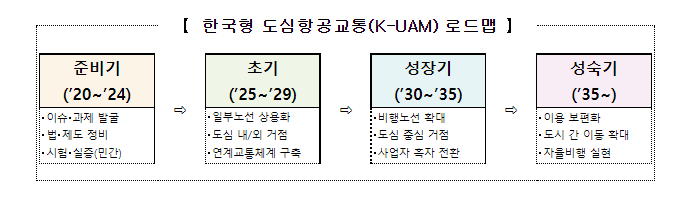
In particular, the Ministry of Land, Infrastructure and Transport and the Ministry of Trade, Industry and Energy have been conducting a project to develop prototypes for verifying future air vehicles (OPPAVs, remotely controlled or automatic autonomous flight, or manned and unmanned personal aircraft that can be piloted by a pilot on board) since 2019, as well as to certify and develop safe operation technologies. In addition, the Ministry of Land, Infrastructure and Transport's Grand Challenge (demonstration project) was launched to verify the operation of Korean UAM with the goal of commercializing UAM in 25 years.

In his presentation on ‘UAM International Aviation Certification Trends and Certification System Development Plans,’ Namgung Pyeong, a senior researcher at the Korea Aviation Safety Technology Institute, argued that rather than unconditionally imposing regulations, the government should activate the system based on securing optimized safety.

Researcher Nam said, “The key issues in the UAM industry are establishing a system for promoting the aviation industry, such as UAM certification and operation, and safety certification. The key is the level of safety to be achieved.”

Additionally, “our country has plans to revise existing laws or create new ones. “We are creating standards that can reassure the public through the first enactment and revision in 2023 and the second in 2025,” he said.

■ Status of domestic and international partnerships for UAM commercialization


Kim Myeong-hyo, Managing Director of Hanwha Aerospace, asserted in his presentation on ‘Hanwha’s Future Mobility Business Progress,’ that the future aviation business is expected to see fierce competition among companies, and that technological differentiation is important to take the lead in the market.

Hanwha Aerospace is leading the aircraft engine and parts business, including the Nuriho engine, and is also promoting UAM business with various domestic and international partners, including Hanwha Systems-Overair (airframe system integration), Hanwha Solutions (composite materials suitable for mass production of aircraft), Kymeta (UAM traffic management system), Korea Airports Corporation (landing and takeoff field construction), Kakao Mobility, and SKT (ground mobility), in addition to developing UAM eco-friendly powertrains.

“We formed a consortium in January of this year, and early this year, Hanwha Systems and Hanwha Aerospace invested 150 billion won in Overair,” said Executive Director Kim. “Together with Hanwha Group and its partners, we will grow into a leading global aerospace company.”

SKT T3K Future R&D Team Leader Sang-Hoon Shin emphasized the importance of establishing a system for UAM commercialization in his presentation on 'K-UAM Components and SKT Business Promotion Status' and asserted that safety and public accessibility must be secured for commercialization.

SKT sees UAM business as a future business 10 years from now We are currently pursuing a UAM airspace network design and construction project to secure selection, partnerships, and capabilities.

Team leader Shin said, “SKT secured the aircraft through a strategic partnership with Joby, a U.S. company with the most advanced technology, and completed the submission of a proposal through a consortium in February to participate in the Ministry of Land, Infrastructure and Transport’s demonstration project, and is currently in full-scale preparation.”

Lastly, in his presentation on ‘UAM-equipped software development and verification plan,’ Jang Jeong-hun, CEO of Moasoft, presented a plan to solve problems that arise in proportion to the increasing amount of software installed in UAM, and argued that securing development personnel is important.

Director Jang said, “UAM software design and testing must follow the DO-178C standard. Starting this year, the number of companies applying the MBD development method is increasing. When applying this method, the effort is reduced by 59% based on the DAL C standard compared to the manual development methodology,” adding, “Europe and the US have already adopted the MBD process as a solution, and Korea is also transitioning.”