Ensuring security that can withstand quantum computer hacking
Research on chips and SW dedicated to homomorphic encryption accelerators is gaining momentum
The Electronics and Telecommunications Research Institute (ETRI) has succeeded in developing a dedicated processing device technology that can safely send and receive encrypted data and perform high-speed calculations without a re-identification procedure, rather than encrypting and sending existing data and decrypting and calculating it again when using the data. Expectations are high that this will allow data to be applied to various convergence services in the defense, public, medical, and financial sectors in an encrypted state in the future.
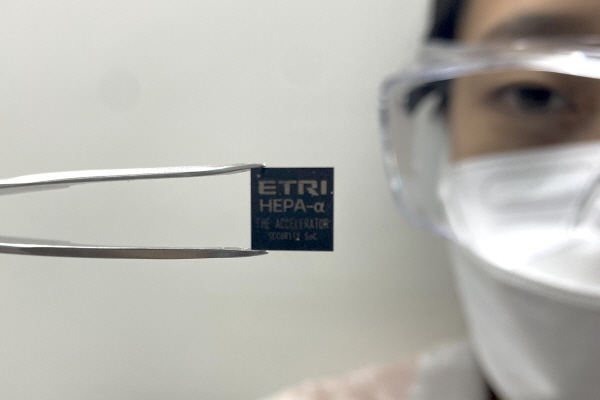
ETRI announced on the 6th that it has developed a fully homomorphic encryption accelerator chip that can be applied to machine learning and other fields while ensuring privacy by encrypting data and has the performance to withstand quantum computer hacking.
The research team reports that if this technology is commercialized, it can be installed in cloud data center servers and used in artificial intelligence semiconductors (SoCs) that can guarantee personal information.
The development of this technology is expected to provide momentum to future research on chips and software development platforms dedicated to homomorphic encryption accelerators.
This will enable data to be directly applied to various convergence services in an encrypted state in areas such as national defense, public, medical, financial, and industrial areas where security, statistics, and artificial intelligence applications are required simultaneously.
Existing encryption technologies cannot perform operations directly on encrypted data.
Decrypt data using your private keyThe reconciliation had to be converted to the original information and then re-encrypted and transmitted.
The core technology of the fully homomorphic encryption hardware operation accelerator chip developed by ETRI is a dedicated hardware operation processing device suitable for the unique characteristics of homomorphic encryption, in which the ciphertext is expressed as polynomials of tens of thousands of degrees or more with coefficients of thousands of bits when information is encrypted.
Therefore, it quickly processes operations such as addition, subtraction, multiplication, and division between high-order polynomials while the data is encrypted.
Data privacy is ensured as no one can see the original data.
The research team plans to implement a homomorphic encryption-only system-on-chip (SoC) based on the core chip technology developed this time and put it into practical use.
In addition, we plan to continue research to satisfy conditions such as providing compatibility with various homomorphic encryption algorithms while being able to adjust the desired encryption strength.
In addition, we decided to implement an HPU chip with a PIM structure that can flexibly perform high-speed calculations on a single chip through simple settings even when the size of the arithmetic operation word of the ciphertext and the degree of the polynomial are different, and that supports compatibility with various algorithms and variable words and degrees.
In the future, we plan to develop a platform that can expand the homomorphic encryption SoC to a fully homomorphic encryption hardware accelerator that can infer a homomorphic encryption-applied video using a homomorphic encryption-applied AI model in real time.
ETRI Security SoC Convergence Research Lab Director Park Seong-cheon said, “It is very meaningful that we have created an opportunity to advance the commercialization of homomorphic encryption by studying the core technology of high-speed homomorphic encryption chips, which are considered promising technologies. We will work even harder to develop and commercialize world-class performance with this technology so that Korea can lead the way in new security technologies.”