인피니언 3월24일부터
Physical AI HBM Smart Factory SDV AIoT Power Semicon 특수 가스 정정·반론보도 모음 e4ds plus

5G AI emergency medical system secures golden time for emergency patients

기사입력2020.12.18 09:15

AI emergency medical system, real-time collection of patient information
Linking the equipment in the ambulance with the emergency room terminal
Optimal management of the entire process of emergency patient transport and treatment


On the 17th, the Ministry of Science and ICT and the National IT Industry Promotion Agency (NIPA) held an R&D performance report meeting for the '5G Mobile Communication-based AI Emergency Medical System Development' project, in which 14 ICT companies, including Yonsei Medical Center, 7 medical institutions, KT, and Kakao Mobility, participated.
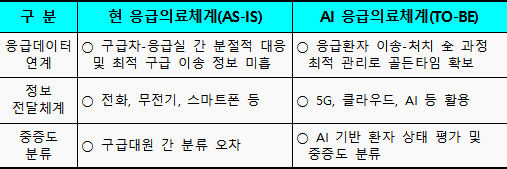
▲ Comparison before and after the introduction of the AI emergency medical system [Table = Ministry of Science and ICT]

This project, promoted by the Ministry of Science and ICT, the Ministry of Health and Welfare, and the National Fire Agency, aims to establish a rapid and consistent management system from the occurrence of emergency patients to treatment. The government will invest 18 billion won over three years from 2019 to 2021 to develop core technologies for the first two years and distribute and expand them to two regions for the remaining year.

The government expects that this project will contribute to increasing the survival rate of emergency patients by securing timely treatment time, the so-called golden time, through customized emergency treatment and rapid emergency room transfer for the four major domestic emergency patients, including cardiovascular, cerebrovascular, severe trauma, and cardiac arrest.

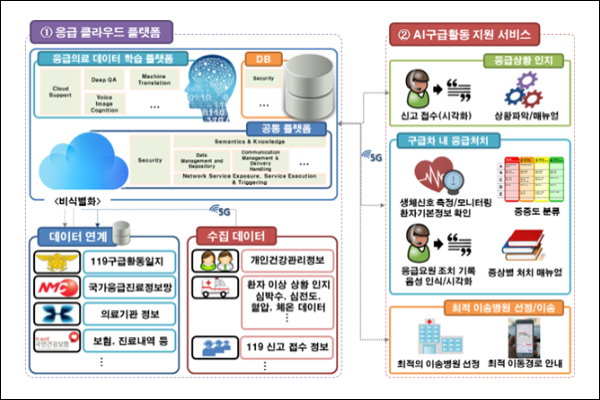
The AI emergency medical system consists of equipment in ambulances and an emergency data integration and analysis platform that can collect various information about emergency patients, such as voice, video, and bio-signals, in real time and transmit them to an integrated platform via a 5G network, and additionally supports emergency room terminals in medical institutions.
img src="/news_thumb/X0HEIM3K6A6B6SH6GH1Y.jpg" />
▲ Key systems of intelligent emergency medical services [Image = Ministry of Science and ICT]

The intelligent emergency medical service analyzes emergency data transmitted to the integrated platform and provides the following to paramedics in the ambulance: △providing standard emergency treatment methods, △supporting the creation of emergency activity logs, △providing the optimal transport hospital route, etc., and to emergency room specialists. By transmitting the situation in real time, it helps to prepare for optimal treatment before the emergency patient arrives.

At the performance report meeting, an actual emergency situation was assumed so that participants could experience the intelligent emergency medical service in person, and a demonstration was given of paramedics and medical staff utilizing the intelligent service step by step from patient occurrence to optimal hospital transfer, and this was relayed to the attendees.

An event was also held where the emergency patient data collection devices installed inside the ambulance were introduced at the 119 ambulance displayed outside the event venue, and the results of emergency patient data measurement and analysis were directly confirmed.

Jang Seok-young, Second Vice Minister of Science and ICT, expressed his expectations, saying, “This is the result of the world’s best medical staff and ICT capabilities,” and “I hope that 5G and AI technologies will play an important role in saving the lives of emergency patients.”

In his presentation on the project’s progress, Jang Hyuk-jae, head of the Yonsei Medical Center project division in charge of this project, said, “We will achieve results that overcome the limitations of emergency situations through continuous service advancement.”
이수민 기자
기사 전체보기