인피니언(5월21일부터)
Physical AI HBM Smart Factory SDV AIoT Power Semicon 특수 가스 정정·반론보도 모음 e4ds plus

Four AI semiconductors will be developed this year and two will be commercialized

Google 우선 소스 기사입력2021.01.13 10:25

The global AI semiconductor market is still in its early stages, so there are opportunities.
Ministry of Science and ICT invests 125.3 billion won in AI semiconductors
4 developments, 2 verifications, 270 professional personnel trained


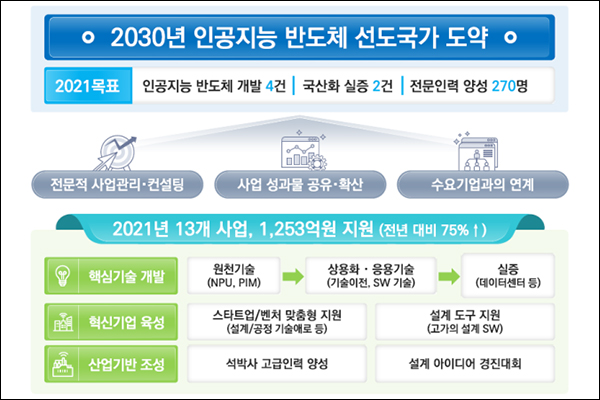
The Ministry of Science and ICT announced on the 13th that it will begin full-scale AI semiconductor support projects as a follow-up measure to the 'Artificial Intelligence (AI) Semiconductor Development Strategy' jointly announced by related ministries in October 2020. The scale of this year's support projects, with a total investment of 125.3 billion won in 13 projects, has increased by approximately 75% compared to last year (9 projects, 71.8 billion won).
▲ Overall business structure [Image = Ministry of Science and ICT]

AI semiconductors, also called neural processing units (NPUs), are high-performance, low-power system semiconductors specialized for AI implementation, such as learning and inference. The government has been pursuing policy efforts since last year with the goal of achieving a 20% share of the global AI semiconductor market by 2030.

This year's support project consists of 13 projects in 3 major areas: ▲support for core technology development ▲fostering innovative companies ▲establishing industrial infrastructure, and 4 new projects are being promoted: ▲development of PIM (Processing In Memory) semiconductors, ▲strengthening software capabilities, ▲support for domestic semiconductor verification, and ▲fostering innovative companies.


Nearly 2 trillion invested in developing NPU and PIM semiconductors
The Ministry of Science and ICT and the Ministry of Trade, Industry and Energy plan to invest 1.096 trillion won in the development of next-generation intelligent semiconductor technology from 2020 to 2029. Last year, 36.4 billion won was invested in 37 projects, and this year, 58.6 billion won will be invested in 56 projects. The areas of investment are design, component, process innovation, and NPU development.

The R&D project to take the lead in PIM semiconductor technology, which integrates storage (memory) and computation (processor), by utilizing the world's No. 1 memory semiconductor capabilities, will also be promoted in two stages.

First, the development of PIM semiconductor leading technology with high commercialization potential in conjunction with existing domestic processes will be newly established, and 11.5 billion won will be invested in five projects this year alone. Next, a 1 trillion won inter-ministerial mid- to long-term feasibility study project is planned for the development of PIM semiconductors based on next-generation memory device processes such as PRAM and MRAM.

In order to enable early commercialization of fabless products, support for AI semiconductor application technology development through industry-academia-research cooperation, including technology transfer and human resource support for R&D source technologies such as patents held by research institutes and universities, will be expanded from 2 projects worth 1.9 billion won in 2020 to 7 projects worth 7.1 billion won.

We will also pursue support projects (5 projects, 7.5 billion won) to enhance the capabilities of domestic companies in the vulnerable software sectors, such as compilers and libraries, and to develop design tools. We will also pursue demonstration projects (2 projects, 2.8 billion won) to support the creation of initial market demand by introducing domestically developed AI semiconductor technologies and products to △public/private data centers, △digital new deal projects, etc.


Fostering innovative companies and creating an industrial base
In order to foster AI semiconductor companies, the 'AI Semiconductor Innovation Company Intensive Support Project' (8 tasks, 5.5 billion won) will be newly established to select 8 startups and small and medium-sized venture fabless companies and resolve technological difficulties through customized intensive support such as conversion to fine processes, development and utilization of new design assets (IP), and software optimization.

In addition, we plan to gradually expand the design tools that support the joint use of expensive design tools for early fabless companies and provide specialized training.

The project to foster advanced human resources such as AI semiconductor design personnel will also continue. Two centers for fostering specialized human resources in system semiconductor convergence and one university ICT research center (ITRC) in the AI semiconductor field will be added within domestic universities. Previously, there were three and two locations respectively.

We will also promote the attraction of top talents such as overseas PhD holders and the opening of AI semiconductor-related courses in AI graduate schools (10 in 2021). In addition, AI semiconductor design competitions will continue to be held to promote the implementation of ideas by college students and entrepreneurs and the influx of human resources into the AI semiconductor field.


4 AI semiconductor developments, 2 demonstrations, 270 professional personnel training
The Ministry of Science and ICT plans to provide professional business and technology consulting in cooperation with the 'Next Generation Intelligent Semiconductor Business Division' and the 'AI Semiconductor Forum' launched last year to systematically manage and improve the performance of the large-scale projects being promoted this time.

In order to spread business results, we plan to promote performance announcements and investment consultations, support for technology transfer and utilization, and connections with demand companies. In addition, we will enhance solidarity and cooperation between design companies, foundries, and demand companies, focusing on AI semiconductors, and discover and support policy tasks necessary for the development of the technology and industrial ecosystem.

Last year, the Electronics and Telecommunications Research Institute (ETRI) and SK Telecom achieved the first domestic development results for AI semiconductors. The Ministry of Science and ICT expects that this year's project will produce more specific results, such as the development of four additional AI semiconductors, support and verification of the commercialization of two, and the training of 270 specialized personnel.

Minister of Science and ICT Choi Ki-young said, “Last year was a year to lay the foundation for the development of the AI semiconductor industry,” and added, “This year, we will implement various policies established last year, such as large-scale R&D, fostering companies and human resources, and creating early markets in conjunction with the Digital New Deal, to realize a comprehensive semiconductor powerhouse by 2030.”
이수민 기자
기사 전체보기