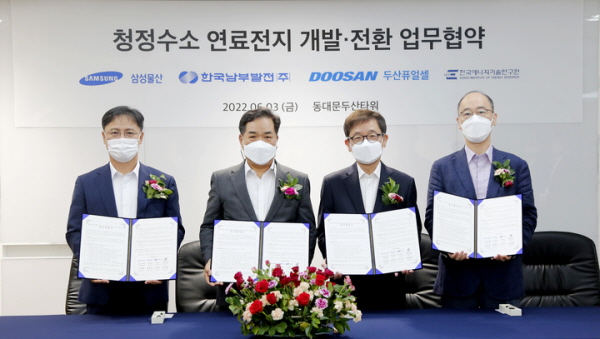
▲From left: Lee Byeong-su, Vice President of Samsung C&T Construction Division, Shim Jae-won, Head of Business Division at Korea Southern Power, Je Hu-seok, Vice President of Doosan Fuel Cell, and Park Young-cheol, Head of Research Group at Korea Institute of Energy Research. (Photo courtesy of Doosan)
MOU signed with Korea Southern Power, Samsung C&T, and Energy Research Institute
CCU Technology Development and Acceleration of Clean Hydrogen Fuel Cell Conversion Doosan Fuel Cell has set out to secure ultra-gap technological competitiveness for the transition to clean hydrogen fuel cells.
On the 3rd, Doosan Fuel Cell signed a business agreement (MOU) for 'clean hydrogen fuel cell development and conversion' with Korea Southern Power, Samsung C&T Construction Division, and Korea Institute of Energy Research (hereinafter referred to as the Energy Research Institute) at Doosan Tower in Dongdaemun, Seoul.
This agreement was prepared to respond to domestic hydrogen economy activation policies such as the Clean Hydrogen Certification System and the Clean Hydrogen Power Generation Mandatory System (CHPS).
△The main contents include development of carbon dioxide capture and utilization (CCU) technology linked to fuel cells, △conversion of existing hydrogen fuel cells to blue and green hydrogen fuel cells, and △joint cooperation and commercialization of ammonia fuel cell demonstration projects.
Depending on the production method, hydrogen is largely divided into gray hydrogen, blue hydrogen, and green hydrogen.
Gray hydrogen accounts for approximately 96% of the hydrogen currently produced and is mainly produced by reforming natural gas.
Byproduct hydrogen generated by petrochemical companies is also gray hydrogen, and when CCU technology is applied to it, it is recognized as blue hydrogen.
As the production cost of green hydrogen, which is produced by electrolyzing water using electricity from renewable energy sources such as solar energy, is high, blue hydrogen, which emits almost no carbon dioxide and can be produced at a reasonable cost, is attracting attention.
Doosan Fuel Cell is jointly developing CCU technology linked to the Energy Research Institute and fuel cell, and is conducting a demonstration of a blue hydrogen fuel cell using the technology with Korea Southern Power. Proceed.
Once the verification is complete, we plan to lead the transition to clean hydrogen by replacing the existing hydrogen fuel cells with blue hydrogen fuel cells in cooperation with Korea Southern Power Co.
Doosan Fuel Cell is also participating in the ammonia fuel cell demonstration project.
Ammonia can be liquefied at -33 degrees Celsius and has a smaller volume than hydrogen, allowing it to be transported in 1.5 times greater quantities. Ammonia also has a high energy density, making it more efficient and economical than liquefied hydrogen.
Doosan Fuel Cell is developing ammonia fuel cells, and Samsung C&T Construction Division is importing ammonia from overseas. Korea Southern Power is providing support such as providing a site for ammonia fuel cell demonstration.
Jeong Hyeong-rak, CEO of Doosan Fuel Cell, emphasized, “Through this MOU, we will actively respond to the government’s clean hydrogen policy and secure ultra-gap technological competitiveness, thereby accelerating the transition to clean hydrogen fuel cells.”