▲AI beef cattle meat yield and body condition index prediction system
12 focused support including 5 life-related and 7 social problem-solving
The Ministry of Science and ICT and the National IT Industry Promotion Agency are establishing a core foundation for leading the digital transformation by discovering killer services using new technologies of the Intelligent Internet of Things (AIoT), thereby improving the quality of life of the people.
Artificial Intelligence of Things (AIoT) is a term that combines artificial intelligence (AI) and the Internet of Things (IoT), the core technologies leading the 4th Industrial Revolution. This is a technology that collects large amounts of data in real time from various fields using IoT technology, and creates an algorithm that classifies and analyzes the data and makes predictions through AI thinking, learning, and self-development with human intelligence.
The Ministry of Science and ICT announced on the 21st that it will focus on providing a total of 8.55 billion won in support to 12 projects in the fields of smart home, disaster safety, agriculture, forestry, livestock, and fisheries to discover AIoT projects with high public perception outcomes this year.
Through this project competition, we received applications from 55 consortia involving over 200 companies (organizations), and the final support projects were selected by considering the subject matter, support areas, and applicability/diffusion potential.
■ Lifestyle (5)
- Personal sleep management system: Controls the sleep environment so that individuals can sleep comfortably, and helps solve problems such as insomnia and lack of sleep. Sensors collect sleep data, and AI analyzes information such as individual heart rate, breathing, and sleep depth.
- Child Nutrition Intake Intelligent Management System: Provides customized healthcare services such as proper eating habits education and health management by checking individual child nutritional intake rates, etc. The food scanner intelligently analyzes the type and amount of food consumed by comparing the food status before and after a meal.
- Voice recognition unmanned store kiosk for the digitally vulnerable: Provides convenience so that it can be widely used by the digitally vulnerable, such as the elderly who have difficulty using kiosks. Unmanned store kiosks respond to customers in a conversational manner through voice recognition and chatbot AI, and help with ordering and payment guidance.
- AI-based kiosk for the disabled: AI supports Braille output, sign language, and voice recognition for the disabled visiting the hospital.
- User-based music creation system: AI creates music based on user preferences and automatically controls robotic instruments to play it.
■ Social problem solving type (7)
- Hazardous Chemical Substance Industrial Facility Disaster Safety Prediction System: Supports disaster response for rapid blocking and containment measures in the event of a hazardous substance leak. Sensors monitor hazardous substances in industrial facilities, and artificial intelligence provides prediction results for the spread of hazardous substances and fires based on indoor and outdoor environmental variables such as weather.
- Elevator Smart Maintenance Service: Minimizes elevator failure rates and prevents safety accidents for elevator users in advance. AI measures vibration and noise of elevator parts to predict signs of failure and remaining lifespan for each part, and provides emergency dispatch notifications to elevator inspectors when predicted.
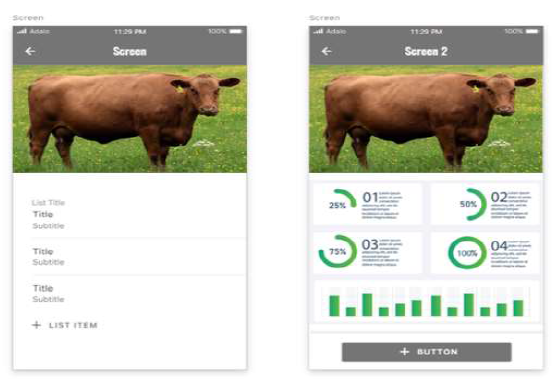
- AI Beef Cattle Meat Yield and Body Condition Index Prediction System: Provides information on the optimal slaughter time to help farmers make profits, thereby improving livestock economy productivity. It is expected to solve the problems of existing lack of professional manpower and high-priced products making it difficult for farmers to actually use the system. Through the app, AI analyzes the photographed images and predicts the beef yield grade of the cattle, etc.
- Integrated safety control for shared electric kickboards: Reduces electric kickboard safety accidents and resolves inconvenience caused by indiscriminate abandonment of kickboards on the road. The video AI installed in the kickboard automatically slows down and stops in dangerous situations such as the possibility of colliding with a pedestrian, and recommends parking in designated parking areas.
- AI public/official vehicle management service: Analyzes usage patterns such as main usage time and usage cycle of public/official vehicle users to optimize dispatch reservations and support efficient management.
- Healthy living care for the elderly living alone: Through an easily attachable touch sensor, the behavior of the elderly living alone, such as the frequency of going out, number of calls, and TV viewing time, is analyzed to provide care for depression and health.
- Support for guidance and crackdown on electric vehicle charging stations: Video AI recognizes parking of internal combustion engine vehicles at electric vehicle charging stations, long-term parking exceeding the charging time, etc., and supports guidance and crackdown.
Kim Jeong-sam, the director of the Ministry of Science and ICT’s Information Protection Network Policy Bureau, said, “The Intelligent Internet of Things is becoming a key foundation for driving digital transformation by converging digital objects, artificial intelligence, and ultra-high-speed network technologies,” and “Through these support projects, we expect that the Intelligent Internet of Things will create meaningful results that can protect our safety and health and improve the quality of our daily lives.”