2026 Physical AI Conference
반도체 AI 보안 인더스트리 4.0 SDV 스마트 IoT 컴퓨터 통신 특수 가스 소재 및 장비 유통 e4ds plus

KETI, Japan-France Joint Research on Sympathetic AI

기사입력2023.09.20 10:44

AI aims to naturally empathize and cooperate with specific people and situations

The Korea Electronics Technology Institute (KETI, President Shin Hee-dong) has joined hands with research institutes in France and Japan for joint research on interactive AI.

KETI announced on the 20th that it will pursue the development of artificial intelligence (AI) technology that can give human individuality together with the French National Institute for Digital Science and Technology (INRIA) and Japan's Seikei University.


'Persona AI' technology, which displays different personalities depending on the situation, target, and time, is expected to be utilized not only in social robots or chatbots that interact with people, but also in robots that care for the elderly and disabled, and counseling robots that manage mental health, to form and evolve individual relationships with the target.

On the other hand, although many generative AI services based on giant language models (LLMs) are being developed worldwide, there has been a limitation in that there is a lack of specific data sets on conflict situations and coping methods and complex intelligence technology reflecting them in the case of AI agents with different personalities depending on their social roles.

Accordingly, the KETI Human IT Convergence Research Center has been promoting the development of agent platform technology capable of individuality by participating in the Ministry of Science and ICT's 'Development of Core Source Technologies for Human-Centered Artificial Intelligence' project since 2022, and Korea University, Sungkyunkwan University, Seoul National University of Science and Technology, Acryl Co., Ltd., and BMS Works Co., Ltd. are participating in the research.

KETIThrough this study, we aim to form a dataset for AI learning, develop AI modeling theory, and develop a matrix to evaluate interactions between users and AI, with the goal of presenting AI agents that naturally empathize and cooperate with specific people and situations in the future.

Meanwhile, according to KETI Senior Researcher Hye-dong Jeong (PhD), who is leading the technology development, domestic research is currently not active in the fields of human-AI relationships, AI sociality, and empathy formation, so KETI began joint research with France's INRIA, a leading research institute in the field of complex intelligence, last year, and conducted joint research with leading researchers from Seikei University in Japan this year.

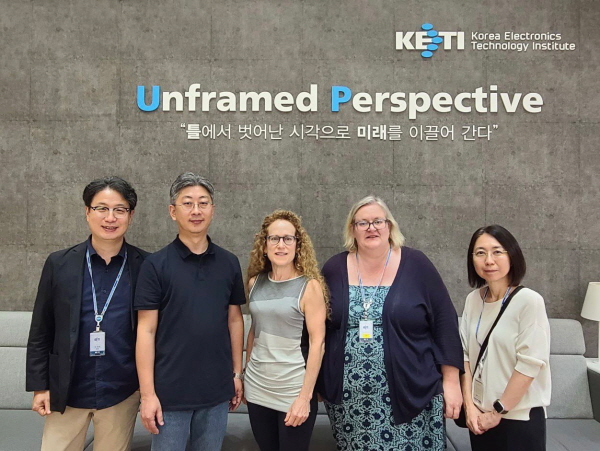
This international joint research was participated by Professor Justine Cassell of Carnegie Mellon University (CMU) and INRIA Research Director, a leading authority in the field of Human Computer Interaction (HCI), and Professor Yukiko Nakano of Seikei University in Japan. In addition, Dr. Noh Gyu-sik, a domestic psychiatrist, also contributed to the research to increase understanding of human psychology.

At an international workshop held at KETI Seongnam headquarters for three days from the 18th, researchers from each country specifically discussed the direction of building a dataset necessary for research on the formation of individuality in artificial intelligence, and agreed on R&D cooperation and personnel exchange to study AI models that reflect cultural differences by country in the future.

“Through this international joint research, we were able to confirm the possibility of artificial intelligence being able to express different personalities depending on various situations,” said Senior Researcher Jeong Hye-dong, who oversaw the research. “The research team will lead research in the field of sympathetic AI so that it can form and evolve mutual relationships between AI and people.”