Smart work platform, translation web, app, and realistic content development
Leading the way in popularizing recorded cultural heritage… 92% recognition accuracy
A domestic research team is developing a platform that will support the translation work of experts translating ancient books written in Chinese characters for the first time in Korea. This will likely be an opportunity for our country's documentary cultural heritage to come one step closer to the people.
The Electronics and Telecommunications Research Institute (ETRI) announced that it is developing a platform to assist professional translators in translating old books.
The research team's technology is expected to be very effective in helping translators save time and serve as a support tool when translating ancient books in the future.
Chinese classic book translation experts go through a arduous process of inputting the original text of a classic book one by one, transcribing it into letters, checking it, and then changing it into Korean several times before finally completing a single translated book.

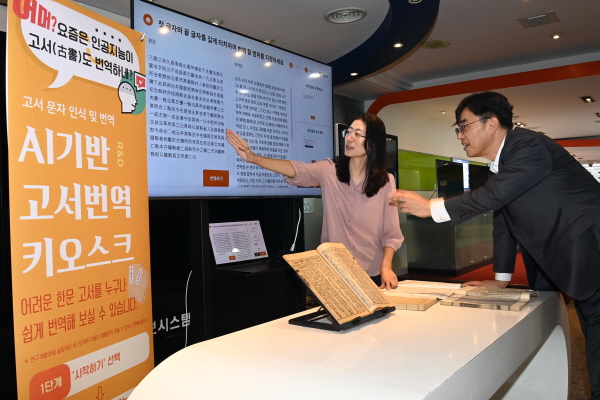
▲ETRI Senior Researcher Min Ki-hyun (left) and Korea Classics Translation Institute Senior Researcher Kwon Kyung-yeol (right) are discussing AI-based ancient book translation technology.
ETRI announced that it is developing Chinese character recognition and translation technology for ancient texts with a recognition accuracy of 92% and a translation accuracy of 85 points to improve the work of ancient text translation experts.
The main functions of the 'Smart Work Platform' developed by the research team include: △Support for comparing different versions for standardization, △Character recognition verification support, △Vocabulary dictionary, and △Translation pattern/special term sharing function.
Through this, translators will be able to provide services that enable open collaborative translation and interpretation work.
The research team plans to provide a smart work environment foundation for translators and improve the work efficiency of ancient book translation experts, thereby accelerating the translation of approximately 30,000 ancient books and hundreds of thousands of ancient documents.
It is expected that this will increase public accessibility to our country's precious and proud documentary cultural heritage.
ETRI also provides easy access to Hanmungo books for the general public. It also provides technology that can access Chinese character recognition and translation.
We are developing a service to recognize/translate Chinese characters in ancient books using artificial intelligence, and will provide a mobile web and app by the end of the year that allows the general public to easily experience ancient book translation.
Since September, the research team has been providing Chinese character recognition and translation verification services to the general public by installing kiosks in 11 libraries and cultural centers across the country, including the National Assembly Library, Daejeon Hanbat Library, Jeju Special Self-Governing Province Halla Library, Gwangju Metropolitan City Mudeung Library, and the National Library of Korea.
Through this, we expect to increase the public's accessibility to classical Chinese books, and greatly increase the base and usability of recorded cultural heritage of classical books in private collections along with classical books stored in libraries.
ETRI researchers are also developing realistic interactive content using translated books.
This is a service where you can experience the story of a translated book through media art and motion sensors.
It is expected that this will stimulate the general public's interest in ancient books.
ETRI Honam Research Center Director Kang Hyeon-seo said, “The work environment for translation experts has been burdensome due to labor-intensive work, but we expect that the digital transformation will simplify the work environment and make it easier for ordinary people who do not know Chinese characters to access old books, which will serve as an opportunity to take an interest in old books, which are part of our country’s cultural heritage.”
Kwon Kyung-yeol, a senior researcher at the Classical Literature Translation Lab at the Institute of Korean Classical Translation, also said, “Translation experts have been experiencing many difficulties in handling the pre-translation process, and I believe that this technological development will be of great help.”
The research team will further improve the technological perfection of the smart work platform currently under development through verification and enhance convenience and accessibility so that the general public can take greater interest in our country's recorded cultural heritage.We plan to promote technology development.
The smart work platform and realistic interactive content developed through the research will be utilized as core elements of the Jeonran Overseas Study Promotion Institute to be established in the future, and the project is being carried out with research support from Jeonbuk Province.
ETRI has completed the patent application for this technology, received an excellent paper award through an academic conference paper presentation, and plans to commercialize the technology through future transfer.
This study is being conducted through the 'Development of AI-based Open-source Chinese Classical Text Translation and Interpretation Support Technology' project supported by the Ministry of Culture, Sports and Tourism and the Korea Creative Content Agency.
We are conducting joint research with the Korean Classical Translation Institute, Jeonju University, ABC Co., Ltd., and Jeonbuk Content Convergence Promotion Agency.