2026 Physical AI Conference
반도체 AI 보안 인더스트리 4.0 SDV 스마트 IoT 컴퓨터 통신 특수 가스 소재 및 장비 유통 e4ds plus

Congatec, low-power SMARC module AI and graphics performance greatly improved

기사입력2025.01.13 09:43


Intel Core 3 Processor-Based SMARC Module Launched

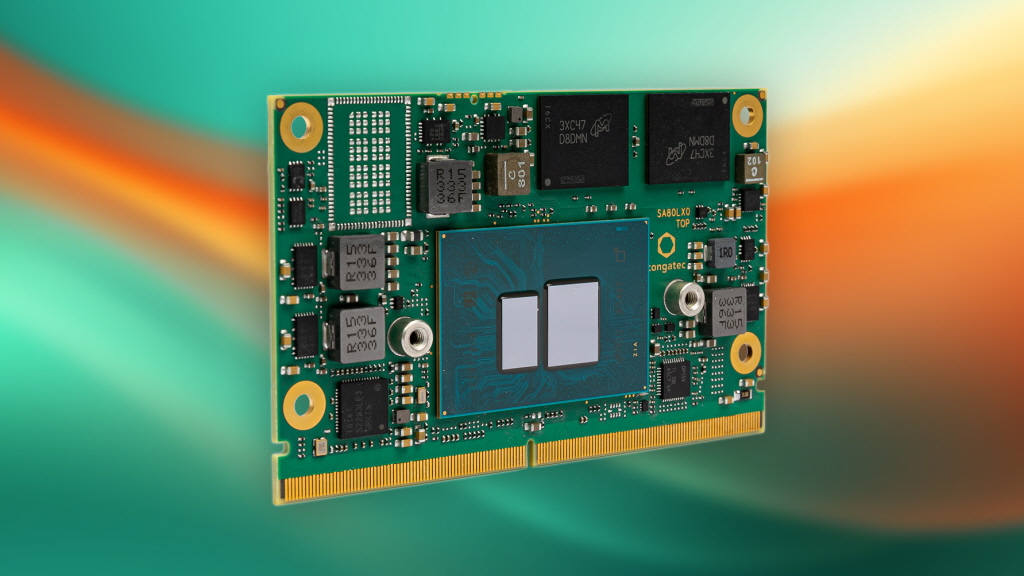
congatec, a leader in embedded and edge computing technologies, has launched a new low-power SMARC module featuring Intel Core 3 processors that significantly improves AI and graphics performance.

congatec announced today that it is upgrading its conga-SA8 SMARC module and launching a low-power Computer-on-Module (COM) featuring the latest Intel Core 3 processor.

The new CPU technology significantly improves performance, making energy-efficient, credit-card-sized SMARC modules ideal solutions for high-performance edge applications and low-power system integration.

Any edge computing application that operates across a wider temperature range from 0 to +60 degrees Celsius can now achieve higher performance and improved energy efficiency with the conga-SA8 SMARC module.

Operating at a maximum clock speed of 3.9 GHz, the module offers a configurable TDP (thermal design power) range from 9 W to 15 W and supports the same AI instruction set as its predecessor, Intel AVX2 (Advanced Vector Extensions 2) and VNNI (Vector Neural Network Instructions), to accelerate deep learning inference tasks.

Additionally, the integrated Intel graphics support 8-bit (INT8)-based inference processing with up to 32 execution units (EUs), and significantly improved object recognition and graphics processing compared to the previous generation. Provides performance.

This enables users to improve application efficiency and productivity through AI-accelerated workloads and system integration.

“The ‘virtualization-ready’ modules with firmware-integrated hypervisor enable the consolidation of multiple application-specific workloads that would otherwise run independently on the conga-SA8,” says Florian Drittenthaler, Product Line Manager at congatec. “The low-power SMARC modules with up to eight cores enable the consolidation of a wide range of applications that previously required multiple dedicated systems. This enables users to significantly reduce the number of devices and further enhance the reliability, cost-efficiency and sustainability of their solutions.”