Industrial Edge AI Solution Challenge 2026
반도체 AI 인더스트리 4.0 SDV 스마트 IoT 컴퓨터 통신 특수 가스 소재 및 장비 e4ds plus

[Planning] Display outlook for the second half of the year - 'OLED' in the second half of 2021

기사입력2021.06.08 14:02

[Editor's Note] Display exports have turned upward again in the second quarter of 2021. In April, they increased 43.5% year-on-year to $1.428 billion, and in May, they increased 38.6% year-on-year to $1.523 billion. In the past 10 years, display exports have continued to show structural negative growth due to stagnation in the TV and smartphone markets and intensifying competition in the LCD panel market, but recently, OLED smartphone shipments have increased, and LCD unit prices have also increased due to increased demand for laptops, monitors, and TVs, showing a steep growth rate due to an overall increase in display shipments. In particular, since the second half of the year is the seasonal peak season for displays, the industry expects that annual display exports this year will rebound for the first time in four years. Accordingly, our magazine has prepared a forum to look into the display market in the second half of the year.


Second Half of 2021, ‘OLED’ Led

Smartphone OLED demand reaches 750 million units, up 46.2% YoY
Samsung OLED TV launch possible, large OLED expansion in full swing


■ Demand and prices continue to increase in the second half of 2021

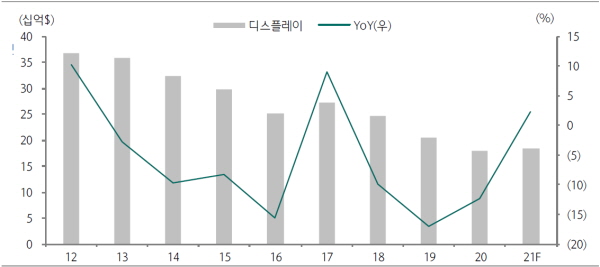
Since 2010, display exports have been in negative growth every year except 2012 and 2017. Annual display exports peaked at $36.9 billion in 2012 and then fell to $18 billion in 2020, a 51% decrease over eight years. The average annual growth rate of display exports over the past three years has also continued to show negative growth: -10% in 2018, -17% in 2019, and -12% in 2020.

This trend began to rebound in the second half of 2020. In the first half of 2020, global LCD TV sales decreased by 7.3% to 91 million units compared to the first half of 2019 due to the decrease in demand due to COVID-19. However, in the second half of 2020, advanced countries such as the United States expanded various subsidies, and consumers' leisure time increased. As LCD TV sales in the third quarter of 2020 surged by 37.4% to 61.93 million units compared to 45.06 million units in the second quarter of 2020, LCD TV panel prices began to rebound. The price of a 32-inch LCD TV open cell soared by 167% from $33 in May 2020 to $88 in May 2021. This is the largest price increase in the history of LCD.


▲Trends and outlook for Korean display exports (Source: Hana Financial Investment)


Demand for OLED TVs is also continuing to increase.

Unlike overall display exports, OLED exports grew 137% over eight years, from $4.6 billion in 2012 to $6.9 billion in 2016 and $10.9 billion in 2020. The proportion of OLED in display exports also increased from 12% in 2012 to 27% in 2016 and 61% in 2020.

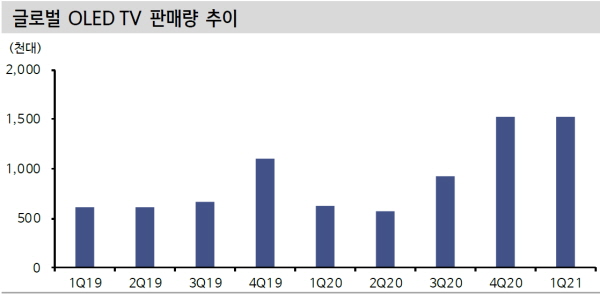
In particular, OLED shipments in the first quarter of 2021 are continuing to increase in line with this trend. According to UBI Research, small OLED shipments in the first quarter of 2021 were 140 million units, down 135.5% quarter-on-quarter, but up 32.4% year-on-year. Mid-to-large OLED sales in the first quarter amounted to $1.46 billion, up 16.9% quarter-on-quarter and 156.3% year-on-year. OLED panel sales for TVs reached a record high of 1.6 million units.

This steep growth rate is analyzed to be due to the increase in OLED penetration in the mobile market, the expansion of the OLED TV market, the expansion of new OLED demand sources such as laptops, and the increase in the operating rates of Chinese panel makers.

■ LCD panel supply shortage, 3Q price increase, 4Q price slowdown

Since July 2020, LCD panel prices have continued to rise due to increased demand for IT panels, driven by demand for TVs, remote work, and online education. As of the end of May 2021, the price of a 55-inch global LCD panel was $223, up 117% year-on-year.

In the second half of last year, following DDI, the shortage of glass substrate supply has become more severe, and since the beginning of this year, with the continued strong demand for TV/IT and the deepening shortage of DDI supply, LCD panel prices have remained strong.

This trend is expected to continue in the second half of this year, with the average annual LCD capacity increasing by 9% in 2021, but the supply shortage issue of key components such as DDI, glass substrates, and PMIC is expected to persist.

In particular, Chinese LCD companies are taking a detour with a strategy of focusing on securing profitability after domestic companies closed their LCD lines.

China's BOE, the world's largest LCD manufacturer, is expected to undergo regular LCD maintenance for three months starting in June, which will likely reduce BOE's LCD panel production in the third quarter of 2021 to a certain extent. Taiwan's AUO also implemented regular maintenance on some lines in the second quarter of 2021.

Accordingly, LCD prices are expected to continue rising until the third quarter of 2021.

On the other hand, a slight decline in the fourth quarter of 2021 is expected compared to the previous quarter, as the shortage of medium and large-sized DDI supply is alleviated, Corning begins ramping up its new 10.5-generation glass substrate plant in Wuhan, and the new Guangzhou plant is scheduled to start operation in September.

■ OLED display market growth begins in earnest

The display market in the second half of this year is expected to be led by OLED.

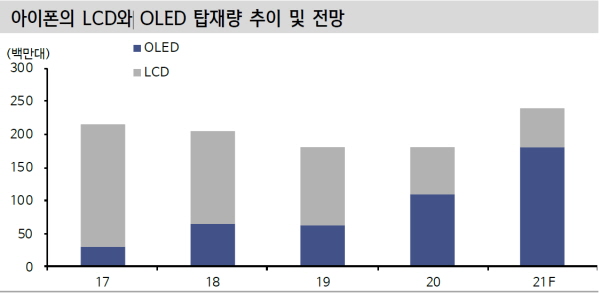
All four iPhone 13 models this year are expected to be equipped with OLED, and shipments of 5G smartphones, most of which are equipped with OLED, are expected to increase 125.9% year-on-year to 610 million units, and demand for OLED panels for smartphones this year is expected to increase 46.2% year-on-year to 750 million units.


▲Trends and outlook for LCD and OLED installations on iPhones (Source: Shinhan Financial Investment)


Also, Samsung's OLED laptop and Apple's OLED-equipped iPad in 2022 are plus factors.

In April 2021, Samsung Electronics unveiled the 'Galaxy Book Pro' notebook equipped with OLED, and in 2021, Samsung Display plans to expand its OLED notebook lineup to more than 10 models from 13.3 inches to 16 inches, thereby fully expanding its production of OLED panels for notebooks. The production volume of OLED panels for laptops is expected to grow significantly every year: 12,000 units in 2019, 165,000 units in 2020, and 1 million units in 2021.


▲Global OLED TV sales trends (Source: omdia, Shinhan Financial Investment)


In the midst of this, Samsung Electronics' OLED TV launch is attracting attention. Samsung Electronics, the world's No. 1 TV market leader, has not released an OLED TV. Currently, there are about 16 OLED TV sellers, and LG Electronics has a 56% share in terms of sales volume, Sony has a 22% share, and Panasonic has a 9% share.

According to recent market sentiment, Samsung Electronics is also considering entering the OLED TV market, and it is analyzed that Samsung Electronics' participation in the OLED TV market is likely to strengthen its position in the premium market.

In particular, Samsung Electronics is known to be launching QD-OLED TVs in 2022 together with Samsung Display, and to this end, Samsung Display is known to begin mass production of its first Q1 at a monthly capacity of 25,000 sheets starting in the fourth quarter of 2021. However, additional expansion seems difficult due to reasons such as Samsung Display's lack of space, and it is estimated that only about 1 million OLED TV panels can be produced through the Q1 line in 2022 and 2023.

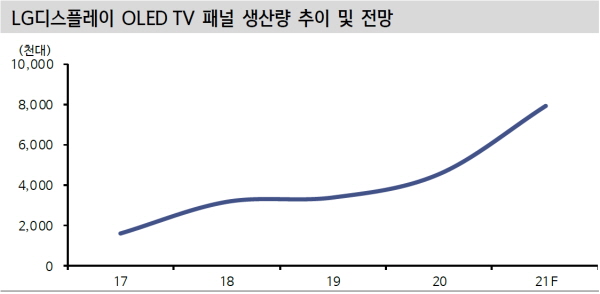
Meanwhile, LG Display's operating profit is expected to turn to a surplus in the third quarter of 2021 as its OLED TV line in Guangzhou, China, begins full operation in 2021.


▲LG Display OLED TV panel production trend and outlook (Source: omdia, Shinhan Financial Investment)


It is expected that LG Display's OLED TV panel production volume in 2022 will increase to around 10 million units, maintaining a structural operating profit surplus.

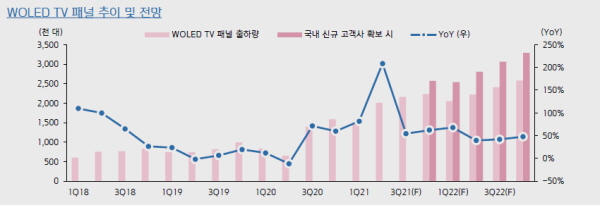
Currently, LG Display's WOLED TV panel capacity is about 150,000 sheets per month, which can produce about 8 to 10 million units. In particular, in order to enter the WOLED TV panel market, the stabilization of oxide TFT technology for large panels must come first, and BOE is known to be planning to develop oxide TFT technology for large panels through its recent acquisition of CEC Panda. It is expected that Chinese companies such as BOE will enter the WOLED TV panel market after 2025.


▲WOLED TV panel trends and outlook (Source: Kiwoom Securities)


LG Display's POLED capacity is currently 45,000 sheets per month, which is lower than that of competitors. Accordingly, it is expected to increase by 15,000 sheets per month in April 2021 to expand shipments to North American customers and supply POKED IT panels, and it is reported that operation will begin in the second quarter of 2022.
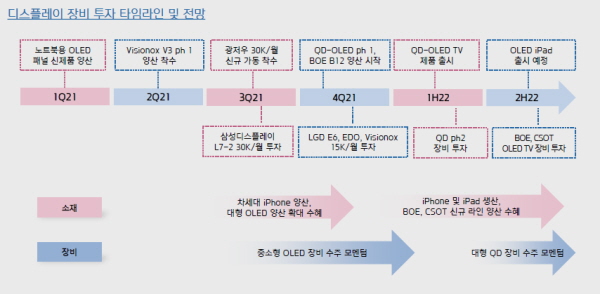
Chinese panel manufacturers such as BOE and CSOT are all said to be focusing on equipment setup and yield stabilization rather than new investments this year. Investment in OLED TV panels is possible in the second quarter of 2022, but mass production is expected to take place after 2025 at the latest.


▲Display equipment investment timeline and outlook (Source: Kiwoom Securities)


■ Strengthening dominance in the Chinese market

China's dominance in the LCD market is expected to continue to strengthen.

This is because new LCD expansions are only taking place in China, while China's LCD production capacity has already far surpassed that of competing countries (Korea, Taiwan, and Japan).

Accordingly, the use of Chinese LCDs is expected to expand significantly in the future, and the proportion of Chinese LCD panels adopted by Korean set (TV) manufacturers is understood to be continuously increasing.

Competition in the small and medium-sized OLED panel market is also intensifying. Currently, China's BOE and Visionox are supplying OLED panels (for smartphones) to set manufacturers outside China. In particular, BOE is known to be investing in LTPO at its B12 facility to supply OLED panels for Apple.

Annual OLED panel shipments by major Chinese companies are expected to increase from 324,000 units in 2019 to 512,000 units in 2020 and 915,000 units in 2021.


▲Samsung Display and LG Display 7th generation, 8.5th generation mid-to-large capacity status and outlook (Data: Omdia, Hi Investment & Securities)