Microchip _ Nov 25
반도체 AI 보안 인더스트리 4.0 SDV 스마트 IoT 컴퓨터 통신 특수 가스 소재 및 장비 유통 e4ds plus

Machinery Research Institute Opens Era of Mass Production of 100-inch Nano-Transparent Screens

기사입력2024.07.04 15:48


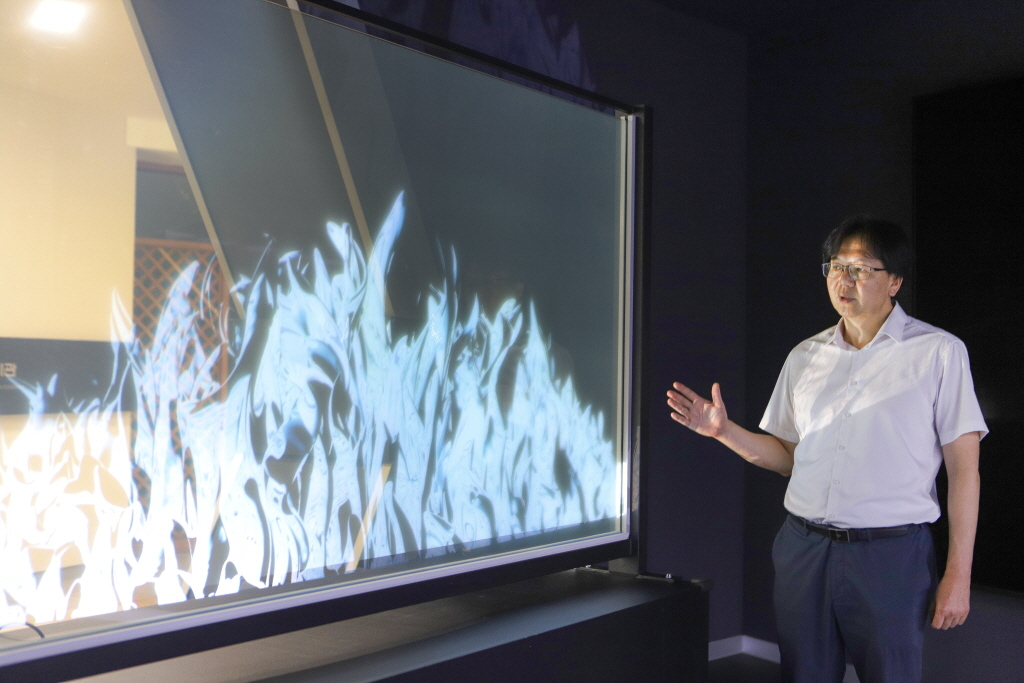
▲Junho Jeong, a senior researcher at the Korea Institute of Machinery and Materials, explains the nano-transparent screen.

10% price reduction compared to transparent OLED
Clear image implementation without resolution loss

The world's first ultra-large nano-transparent screen measuring over 100 inches that can freely adjust transparency depending on the surrounding environment and can be mass-produced at low cost has been developed and commercialized. It appears that the popularization of large transparent screens, which were difficult to utilize due to their high cost, will accelerate.

The research team of Senior Researcher Jeong Jun-ho of the Nanolithography Research Center at the Korea Institute of Machinery and Materials (President Ryu Seok-hyun) under the Ministry of Science and ICT and Metatupeople Co., Ltd. (CEO Ahn Jun-won) succeeded in commercializing a 100-inch large nano transparent screen that can freely adjust transparency according to ambient light and image information.

The nano transparent screen was installed in the outdoor space of the Youth Mall in Chungju last June, and is scheduled to be unveiled at the 'Nano Korea 2024' nanotechnology exhibition, the largest exhibition in Korea, held at KINTEX in Ilsan from July 3 to 5.

The nano transparent screen developed by the Korea Institute of Machinery and Materials is composed of a film made as thin as a strand of hair by evenly dispersing titanium dioxide (TiO2) nanoparticles with a diameter of 100 nanometers inside the film.

When a beam projector shines light on a nano transparent screen, the viewing angle is very wide at 170 degrees, and you can see clear images and the scenery beyond the transparent screen at the same time, so you can watch the images from any angle.

In addition, the nano-transparent screen developed by the research team can be overlapped with a PDLC (Polymer Dispersed Liquid Crystal) film, and when the brightness of the surrounding light or detailed image implementation is required, the transparency of the PDLC can be lowered to implement clearer images.

In the case of the existing 100-inch transparent OLED (Organic Light-Emitting Diode), the high cost of over 100 million won made it difficult for general consumers to use, and the low resolution of transparent LED (Light-Emitting Diode) made it difficult to popularize.

Nano transparent screens can be mass-produced through a continuous roll process, so they can be supplied to the market at a much lower price, at around 10% of the price of transparent OLEDs. Even when using the highest resolution projector, you can achieve clear images without any loss of resolution.

In addition, since the characteristics of light hardly change in high and low temperature environments, it is possible to produce a large transparent screen of 100 inches or more in the form of a light and flexible film. It is not affected by adverse weather conditions such as extreme cold and heat waves, so it is very suitable for installation both indoors and outdoors.

Jeong Jun-ho, a senior researcher at the Korea Institute of Machinery and Materials, said, “Nano-transparent screen technology is a cutting-edge innovative technology created by combining nanomaterials and nano-manufacturing technology with existing IT technology.” He added, “We will continue to conduct research and development to improve the quality of nano-transparent screens in the future and strive to lead the popularization of transparent screens.”

Ryu Seok-hyun, the president of KIMM, said, “This research result is very significant in that it was commercialized jointly with a research institute company established by KIMM through investment of original patented technology,” and added, “We will continue to do our best to develop technology that can greatly contribute to the development of national strategic technologies and revitalization of the regional economy.”