| Smartphone market shrinks by 3.2% in 2019
| No innovation, no new products, no upgrades
| 5G smartphones to grow 46% by 2023 Forecasts for global device shipments in 2019 have been released.
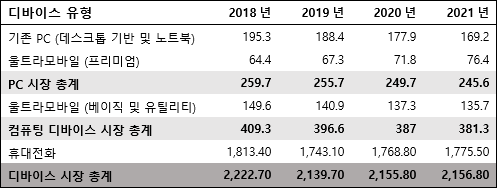
According to Gartner, global shipments of devices including PCs, tablets and mobile phones are expected to decline 3.7% in 2019 compared to the previous year.
Premium smartphones now last for more than two years Gartner estimates that there are more than 5 billion mobile phones in use worldwide. After years of growth, the smartphone market has reached a turning point. Smartphone sales are expected to decline by 3.2% in 2019, the weakest performance among device segments.
“This is because users are holding onto their phones longer as new technologies do not attract much attention,” said Ranjit Atwal, research director at Gartner.
The replacement cycle for premium smartphones is expected to continue to increase in 2019. Today's users see the quality and technology of premium smartphones as valuable enough to last for more than two years.

▲ Global device shipments by type, 2018~21
(Unit: Millions of Units) (Source: Gartner, September 2019)
In addition, users’ ability to use new technologies and applications has reached its limit. “Users will not upgrade their smartphones unless they are provided with completely new usability, efficiency, and experiences,” said Atwal, a senior researcher.
5G phones on the rise The share of 5G phones is expected to increase from 10% in 2020 to 56% in 2023.
Major mobile phone market players are exploring the introduction of 5G connectivity technology to encourage replacement of existing LTE phones. However, less than half of telecom operators worldwide are expected to commercialize 5G networks within the next five years.
More than a dozen mobile service providers have now launched commercial 5G services in some markets. To revive smartphone sales, handset makers will need to highlight 5G’s advanced capabilities, including faster speeds, improved network availability and security.
Once these companies have established their initial requirements and concrete plans for 5G, 5G phones will account for more than half of all mobile phone sales by 2023. The smartphone market is expected to grow by about 2.9% in 2020 due to the impact of 5G.
5G is expected to impact more than just mobile phones. According to Gartner, the 5G endpoint installed base is expected to grow 14-fold from 3.5 million units in 2020 to 48.6 million units in 2023. While 5G will account for only 2.1% of all IoT endpoints, the total installed base is expected to reach 324.1 million units by 2028.
“When 5G technology is applied to premium ultramobile devices in 2020, ultramobile devices will become more attractive to consumers,” said Atwal, senior research fellow.
PC Device Trends in 2019 Global PC shipments in the second quarter of 2019 totaled 63 million units, up 1.5% year-over-year, but uncertainty remains due to uncertain economic conditions. PC shipments in 2019 are expected to drop 1.5% to 256 million units compared to 2018.
The consumer PC market is expected to decline by 9.8% in 2019, dropping its share of the overall market to less than 40%. As consumer PC lifespans increase across the board, device replacements are expected to fall by about 10 million units by 2023. As the Windows 10 migration reaches its peak, business PCs are expected to decline 3.9% in 2020 after three years of growth.
“There is no doubt that the landscape of the PC market is changing,” said Atwal, senior research fellow. “The consumer PC market is demanding high-value products that can perform specific functions that consumers want, such as gaming.”
“PC companies will have to deal with uncertainty from the potential imposition of tariffs or the destructive power of Brexit,” he continued. “Companies will need to shift their business models from those based on peaks and troughs in capital expenditure to those based on annual service revenue.”