Completion of 200,000-ton Synthetic Gas Production Plant with 170 Billion Investments
Hanwha Solutions is entering the synthetic gas supply market monopolized by foreign companies in the Yeosu Industrial Complex. It plans to apply ‘Carbon Capture and Utilization (CCU)’ technology to its synthetic gas production facilities and strengthen ESG (environment, society, and governance) management.
Hanwha Solutions announced on the 15th that it has completed construction of a 200,000-ton synthesis gas production plant in which it invested 170 billion won and has begun commercial production.
Syngas is a mixture of hydrogen (H2) and carbon monoxide (CO) produced by reforming liquefied natural gas (LNG), etc., and is used in the manufacturing of Hanwha Solutions’ main products, such as TDI, a polyurethane material. Hanwha Solutions expects to achieve cost savings of up to KRW 23 billion per year through its own production and supply of synthesis gas.
Hanwha Solutions’ new synthetic gas production is expected to contribute to the smooth supply of raw materials for companies in the Yeosu Industrial Complex. This is because the facilities of foreign companies that have monopolized synthetic gas for over 20 years are aging, which may lead to situations where synthetic gas is not supplied on time. With Hanwha Solutions producing synthetic gas, companies in the industrial complex that use it as a raw material will be free from concerns about supply disruptions.
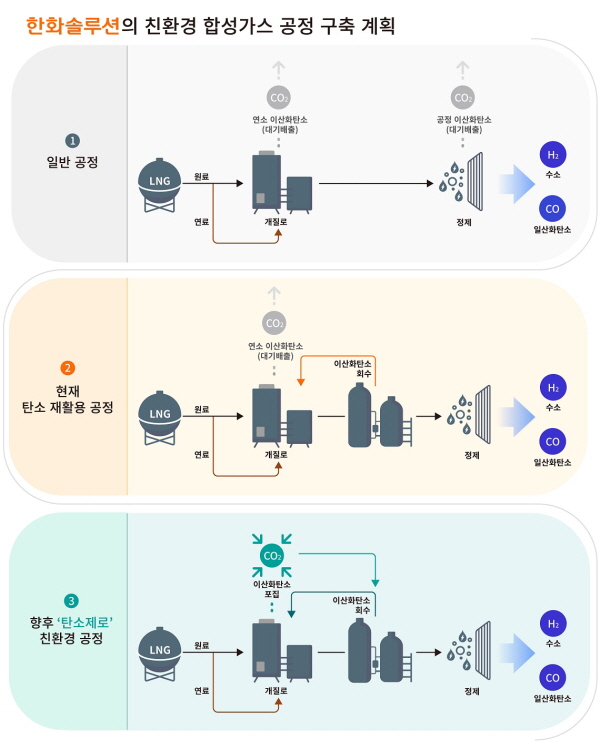
Hanwha Solutions has introduced carbon capture and storage technology that repeatedly reuses carbon dioxide (CO2) in a new synthesis gas facility. The synthesis gas production process emits carbon dioxide during the process of applying high heat to separate and purify the gas. Hanwha Solutions’ CCU technology, which recovers all of the carbon dioxide generated and reintroduces it into gas production, can reduce carbon emissions by 100,000 tons, which is equivalent to the amount absorbed by approximately 36 million trees per year.
Hanwha Solutions’ Executive Director of Environment and Safety, Jang Sang-moo, said, “We are reviewing the establishment of an eco-friendly ‘carbon zero’ process that will not only reuse the carbon dioxide generated during the process, but also capture all residual carbon dioxide generated during the combustion of gas within the process by 2024.”