반도체 AI 인더스트리 4.0 SDV 스마트 IoT 컴퓨터 통신 특수 가스 소재 및 장비 e4ds plus

Air Products also failed to secure a P5 contract and the sale fell through. Is it possible to sell DIG Air Gas, which failed to supply on-site to Samsung Electronics?

기사입력2025.01.13 16:36


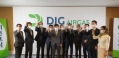
▲CEO Oh Gyu-seok (center) and executives are taking a commemorative photo at the CI declaration ceremony held after changing the company name from Daesung Industrial Gases to DIGE Air Gas Co., Ltd. in 2021.

Samsung Electronics P5 Delay Causes Sale of Last Year's Largest Fish AP to Fail, P5 Construction Expected to Be Difficult
DIG, which was unable to supply on-site to Samsung Electronics, may have difficulty considering semiconductor supply

DIG Airgas is up for sale. The estimated sale price is said to be in the range of 5 trillion won, but it is expected that sale negotiations will be difficult due to the slump in the forward-looking industry and difficulties in supplying semiconductors.

According to the investment banking (IB) industry on the 12th, private equity fund (PEF) management company Macquarie Asset Management is selling its 100% stake in DIG Air Gas (formerly Daesung Industrial Gases).

According to the industry, it is reported that a request for proposal (RFP) for selecting a sales manager will be sent to global investment banks (IBs) this week.

The estimated sale price of DIG Airgas is said to be in the range of 5 trillion won, and there are also reports that Macquarie Asset Management will complete the sale in the first half of this year.

DIG Air Gas is an industrial gas company that produces and supplies oxygen (O2), nitrogen (N2), argon (Ar), etc. It supplies industrial gases through on-site production and large-scale bulk supply through bulk lorries of its own produced industrial gases.

It was established as a subsidiary of Daesung Industrial in 1979, and was sold to MBK Partners for KRW 1.8 trillion in 2017 due to Daesung Industrial's management difficulties, and was acquired by Macquarie Asset Management for KRW 2.5 trillion two years later.

In terms of business performance, sales in 2023 were KRW 731.2 billion, a 1.9% decrease from the previous year, and operating profit was KRW 133.6 billion, a 16.1% decrease from the previous year. Net income increased 4.3% year-on-year to KRW 122.7 billion.

Nitrogen is supplied to LG Display and the semiconductor industry as major customers, and oxygen is supplied to steel mills and petrochemicals.

■ No experience in supplying Samsung Electronics on-site

The industrial gas market has been active in M&A through financial investors for the past decade or so, so the corporate value evaluation by PE is still high, and interest was high despite the large number of unlisted companies.

In particular, when Air Products Korea (AP), a global industrial gas company, recently announced that it would sell 100% of its shares, interest was high to the point that 5 trillion won was mentioned as the sale price.

In particular, in the case of AP, despite the fact that nitrogen was supplied on-site to Samsung Electronics' Hwaseong plant as well as its Pyeongtaek plant, the sale recently fell through.

It is reported that the reason for the sale failure is that the contract for Samsung Electronics' Pyeongtaek plant P5 was not completed.

It is known that currently, 50% of Samsung Electronics' P5 supply is to be supplied by Linde Korea, and the remaining 50% is to be supplied by AP.

It is also reported that 50% of the Samsung Electronics P6 will be supplied by AP, with the remaining 50% to be selected at a later date.

However, it is unknown whether an actual contract has been drawn up, and it is reported that the construction of Samsung Electronics P5 is delayed, making supply uncertain.

When constructing a semiconductor plant, the industrial gas ASU is built first because piping and purging are important, but in the case of P5, no company has yet built an ASU, leading to speculation that the construction of P5 is still far away.

The reason why Samsung Electronics' supply has such a significant impact on the sale is that, other than steel mills, there are no other customers in Korea with such a high demand for industrial gases.

Accordingly, DIG Airgas has made many efforts to supply to Samsung Electronics on-site after being acquired by Macquarie Asset Management, but has failed time and time again, and the industry predicts that it will be difficult to supply to Samsung Electronics.

This goes back to the days of Daesung Industrial Gases, and even during the Daesung Industrial Gases days, it supplied to LG Display and others, but never supplied on-site to Samsung Electronics.

Samsung Electronics has also received on-site supplies from AP, Linde, Airfirst, etc., but has never received on-site supplies from Daesung Industrial Gases. The reason is unknown.

Accordingly, it appears that the supply of semiconductors to Samsung Electronics will be cited as a weakness in the sale of DIG Air Gas. However, with the exception of oxygen and nitrogen, we have experience supplying some special gases for semiconductors, such as helium (He), to Samsung Electronics.

In the case of SK Hynix, there is experience in supplying nitrogen on-site through the Cheongju plant.

■ Uncertainty in the forward-looking industry, industrial gas business is also not easy

Industrial gases are produced and supplied domestically as materials that cannot be exported or imported, so they are significantly affected by the domestic economy.

The main demand sources for industrial gases can be categorized into petrochemical, semiconductor, secondary battery, steel, display, oil refining, and other industries.

In the case of petrochemicals, the situation is difficult as some plants have recently been shut down, and in the case of steel, it is also expected to be difficult due to factors such as the slump in the construction industry.

In the case of semiconductors, sales are increasing due to the expansion of high value-added products such as HBM, but there are currently no new investments and production volumes are not increasing, so there are no signs of increased demand for the time being.

Accordingly, the industrial gas business is also not in an easy situation, and some are concerned about a decline in operating rates.

In the case of DIG Air Gas, it produces 1.2 million ㎥ of nitrogen per hour and 500,000 ㎥ of oxygen per hour, ranking third in industrial gas production in Korea after Linde Korea and AP.

Accordingly, future demand from forward-looking industries may become an important factor in sales.