반도체 AI 인더스트리 4.0 SDV 스마트 IoT 컴퓨터 통신 특수 가스 소재 및 장비 e4ds plus

Materials Research Institute Develops Corona Antiviral Verification Mask

기사입력2021.05.11 17:04


▲Senior Researcher Jeong Seong-hun and Senior Researcher Lee Seung-hun (from left) who led this research


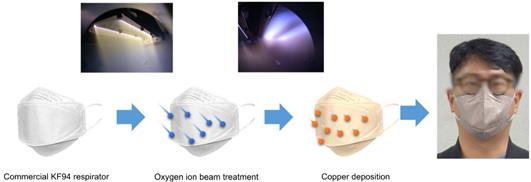
Vacuum deposition of 20 nm copper film after ion beam treatment
Preventing adverse effects caused by copper nanoparticles penetrating the respiratory tract

The Korea Institute of Materials Science (KIMS, President Lee Jeong-hwan) has completed the development of a mask with proven antiviral performance against COVID-19, raising expectations that it will contribute to the prevention of COVID-19 infection.

The Korea Institute of Materials Science announced on the 11th that the research team led by Dr. Seong-Hoon Jeong and Dr. Seung-Hoon Lee of the Nano-Bio Convergence Laboratory recently succeeded in developing a COVID-19 antiviral mask coated with a copper nano-film using ion beam technology.

The technology developed this time is a technology that solves the toxicity problem of copper nanoparticles by firmly attaching a copper nano-film to the KF94 mask polypropylene filter without damage.

Until now, mask and filter products have used polymer fibers containing copper nanoparticles. However, copper in particle form can easily separate from the fiber surface and be inhaled by humans, so there is a possibility that copper nanoparticles may cause human toxicity problems.

The research team predicted that if they manufacture a filter fabric coated with a copper nano-film using plasma/ion beam surface treatment technology utilizing vacuum roll-to-roll equipment, it will be possible to develop a KF94 mask and HEPA filter capable of inactivating the COVID-19 virus.

In addition, we plan to conduct a performance verification using the actual COVID-19 virus with the National Masan Hospital, which is conducting joint research on materials and quarantine materials.

The research team treated polypropylene filter fibers with an ion beam and then vacuum-deposited a 20-nanometer copper film. The surface modification layer generated by the ion beam process prevented the exfoliation of the copper nano-film, thereby preventing adverse effects caused by the respiratory tract penetration of copper nanoparticles.

The particle capture efficiency of the KF94 mask to which this technology was applied was similar to that of the existing KF94 mask because there was no damage to the filter fibers.

Additionally, the research team confirmed that the currently prevalent actual coronavirus (SARS-CoV-2) was inactivated by over 99.9% when it was placed in contact with the mask surface for one hour.

Senior Researcher Lee Seung-hoon, the principal investigator, said, “While the development of various quarantine materials is important, there is also a lack of empirical research utilizing highly pathogenic pathogens.” He added, “It is urgent to standardize K-quarantine material components by establishing an infrastructure and related certification system that can secure empirical results utilizing high-risk pathogens, such as the COVID-19 virus evaluation conducted in this study.”

This research was conducted as a project titled 'Development of Materials and Systems for Pathogen Removal Using Low-Temperature Plasma', a major project of the Korea Institute of Materials Science supported by the Ministry of Science and ICT, and the results of the research were published in the April 22nd issue of Polymers, an academic journal in the field of polymers.

▲Production process and finished mask