Resource Recycling, Responding to Resource Depletion and Environmental Pollution
The Korean Society of Resource Recycling Holds 54th Academic Conference
Society President Lee Man-seung: We Must Respond to the Weaponization of Resources with Recycling In 2019, Japan's export restrictions against South Korea instilled anxiety within the country that resources could become weapons. As the measures had a negative impact on the economy, diplomacy, and security, the government rolled out policies related to the materials, parts, and equipment (SoBuJang) sector. Companies also actively pursued self-reliance in SoBuJang, particularly in materials, to resolve business uncertainties.
The movement toward material self-sufficiency is the only positive development brought about by the incident. However, Korea is fundamentally a country lacking mineral resources (hereinafter referred to as resources). Even if we possess the technology to produce materials, it is all for naught if we lack the resources to do so. As of 2019, Korea imports 42% of the rare earth elements used in advanced industries from China.
Resource recycling has long been recognized as a means to overcome the limitations of scarce resources. The goal is to address resource depletion and environmental pollution by collecting and utilizing reusable resources—that is, secondary resources—containing the ever-accumulating industrial waste and urban waste.
In 2010, the Samsung Economic Research Institute estimated that the total value of rare earth elements in industrial waste and municipal waste amounted to 33 trillion won. In addition, it is known that about 400g of gold, 3kg of silver, and 100kg of copper can be extracted from 1 ton of mobile phone waste.

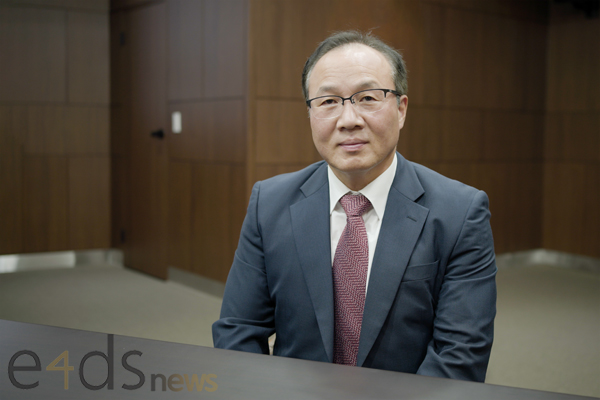
▲ Lee Man-seung, President of the Korean Society of Resource Recycling [Photo by Reporter Lee Su-min]
The 2021 Spring Extraordinary General Meeting and the 54th Academic Conference of the Korean Society of Resource Recycling were held from Thursday, the 13th, to Friday, the 14th, at the Utop Marina Hotel & Resort in Yeosu, Jeonnam. We had the opportunity to meet with Professor Lee Man-seung of Mokpo University, who leads the Korean Society of Resource Recycling as its president, to hear his assessment of the domestic recycling industry and the goals of the Society.
Q. It is a pleasure to meet you. What kind of society is the Korean Society of Resource Recycling? A. Our society was founded on June 18, 1992, by our current Honorary President, Professor Jae-Hyun Oh of Yonsei University. As the name suggests, the purpose of our society is research on 'resource recycling.' Industry, academia, and research institutes are currently joining forces to recover and utilize inorganic substances contained in secondary resources generated from our daily lives and industrial sites, rather than raw ore.
Q. What are the domestic resource recycling base technologies and target materials? A. There are two main methods for recovering inorganic substances from the periodic table. The first is the method of smelting raw ore. The second is the method of recovery from secondary resources, or so-called urban mines, which is the objective of our society. The two methods are similar yet different.
Mining raw ore is crucial. Secondary resources are those that have already been mined, and our society is carefully considering ways to process them efficiently. Secondary resource processing technologies broadly include resource processing, dry smelting, and wet smelting, and also include materialization technologies for refined resources. Our society is composed of related companies and researchers.
Q. It is no exaggeration to say that the development of future industries depends on securing resources. Why is resource recycling important for the development of the domestic materials industry? A. I believe that resources and food should be regarded as the same concept.
In the case of rice, even though it could be imported at a low price from overseas, we do not do so to protect the livelihoods of domestic farmers. Furthermore, this is to prevent rice exporting countries from using rice as a weapon to affect our people. The same applies to resources. The reason Japan cannot take decisive action in the dispute over the Senkaku (Diaoyu) Islands between Japan and China is that China possesses large quantities of rare metals, commonly known as rare earth elements, which could be weaponized.
The domestic secondary resource environment is highly diverse but has low productivity. For this reason, domestic companies are hesitant to engage in resource recycling businesses. There are also environmental concerns. However, it is evident that the importance of rare earth metals will continue to grow.
Q. Please tell us what the current difficulties are facing the domestic resource recycling industry and what policies you believe are necessary to improve them.
A. It is essential to be able to produce a certain amount of rare metals domestically. Currently, there are no domestic materials companies operating on a trillion-won scale. Even the largest companies are only in the 100 to 200 billion won range, making it difficult to survive when iron and copper ore prices fluctuate severely, as they do these days.
Therefore, just as with rice, the government should provide financial support to companies capable of producing rare metals so that they can devote themselves to developing related technologies.
Furthermore, most of the current rare earth metals industry is focused on material utilization. However, from a national perspective, securing resources is far more important. Material utilization is entirely possible. But if the resources themselves are not secured, materialization is impossible.
The government treats secondary resources solely from an environmental perspective. Of course, the environment is important. However, for the sake of the future, it is necessary to expand the direction of policy to include resource securing.
As explained earlier, resource recycling consists of “resource processing – dry smelting – wet smelting – materialization.” While resource processing is widely covered in resource engineering, dry and wet smelting are not as common. Although examples of integrating the two technologies are increasing, there are fewer than 20 graduate students majoring in wet smelting in Korea.
I once visited Central South University in Hunan Province, China. It is the birthplace of China's dry and wet smelting technology, where one professor was leading a research team of 20 specialists who were pursuing doctoral or postdoctoral studies. If master's degree programs are included, this number increases to about 40 to 50 people.
The smelting industry is a key national industry, but our country is in a position where it must follow China's lead. Therefore, urgent policy considerations are needed to foster the workforce for dry and wet smelting.
Q. What are the future plans of the Korean Society of Resource Recycling? A. We are currently aiming to secure 1,000 members and over 50 member companies. While the focus is currently on related companies, government-funded institutions, and academia, we will encourage the participation of large corporations to expand the recycling industry and government agencies to serve as a channel for conveying the industry's challenges.