Interbattery 2021, 229 companies, 500 booths, looking into the future of secondary batteries
Introducing innovative technologies such as quaternary cathode materials, silicon anode materials, and NCM8
Major domestic battery finished product, material, equipment, and testing companies, including LG Energy Solution, Samsung SDI, SK Innovation, POSCO Chemical, and Wonik P&E, introduced next-generation batteries, showed off the latest material and equipment technologies, and revealed the future of battery technology.
'InterBattery 2021' was held at COEX Hall A from June 9th to 11th.
The InterBattery exhibition, now in its 9th year, has set up its largest-ever scale with 229 companies and 500 booths, reflecting the recent growth of the secondary battery industry and people's interest.
This exhibition provided comprehensive information on the latest products and technologies in the industry with the participation of companies in various fields including secondary battery manufacturing, small and medium-sized enterprises, and recycling, and delivered the views of domestic and international experts on the present and future of the secondary battery industry through online and offline international conferences.
At the opening ceremony held on June 9, Minister of Trade, Industry and Energy Moon Seung-wook and Chairman of the Korea Battery Industry Association Jeon Young-hyun (currently President of Samsung SDI) attended and cut the ribbon to announce the opening. After that, they visited the exhibition hall to encourage Korean companies that are contributing to the growth of the secondary battery industry and asked for their continued efforts.
Various side events were held at the exhibition, including The Battery Conference, Battery Job Fair, and Online Export Consultation.
'The Battery Conference 2021', which celebrates its 10th anniversary this year, invites the world's leading battery industry experts to discuss the future of the battery industry. We have created an opportunity to discuss vision and development strategies and understand industry trends.
On the first day, June 9, there was also time to explore various aspects of the battery market, from keynote speeches by the three domestic battery companies, Samsung SDI, LG Energy Solution, and SK Innovation, to battery simulation software technology.
On the second day, June 10th, the Ministry of Environment and BMW provided keynote speeches on electric vehicle distribution and future electric vehicles, along with various information on overseas electric vehicle markets.
The 'Battery Job Fair' provided a 1:1 consultation opportunity between HR managers and job seekers for participating companies willing to hire, and the 'Overseas Buyer 1:1 Online Export Consultation' helped connect domestic battery companies with local companies by recruiting overseas buyers of the participating companies' choice.
In addition, this exhibition was held concurrently with ‘xEV TREND KOREA,’ Korea’s representative electric vehicle exhibition.
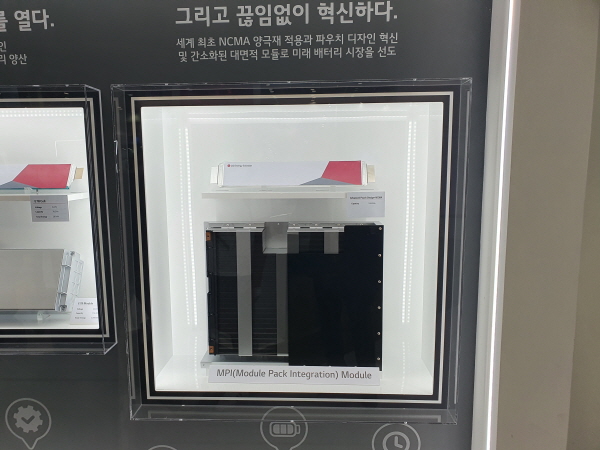
■ LG Energy Solution LG Energy Solution introduced its unrivaled product technologies ranging from ultra-small cells to the world's largest ESS packs, as well as innovative material technologies such as the industry's first 'quaternary cathode material' and 'silicon anode material'.
The 'Reuse ESS Zone' will display the 'Reuse Battery Project', an electric vehicle charging station built at the Ochang factory, in the exhibition zone to promote battery recovery & middot; introduced actual cases of reuse and recycling construction.
The 'Next Generation Zone' showcased next-generation battery products, including all-solid-state batteries for improved safety and lightweight lithium-sulfur batteries with high energy density.
At the 'Core Technology Zone', the company exhibited core technologies that can maximize the performance and safety of batteries, such as differentiated material innovations such as 'NCMA', the industry's first quaternary battery with added aluminum, 'silicon oxide (silicon oxide) cathode material', and 'safety-enhanced separator (SRS®)', as well as process innovations including 'Lami & Stack' and Long Cell Design.
■ SK Innovation SK Innovation displayed Hyundai Motor Company’s strategic model, the Ioniq 5, on the front right side of its booth. This vehicle uses NCM8 batteries, which have the industry’s highest nickel content among high-nickel batteries.
At the center of the front of the booth, a Ford F-150 vehicle was on display. SK Innovation supplies the vehicle with the 'NCM9', which is considered the most powerful lithium-ion battery available. NCM9 is a battery that has increased the proportion of nickel, the mineral that has the greatest effect on the battery's driving range, to about 90%. Because it has high energy, it is difficult to manufacture without ensuring safety.
The 'Safer than EVer' zone introduced the separator technology, which is the secret to ensuring safety while manufacturing high-performance batteries, the Z-folding company, and the battery pack technology with heat diffusion suppression capability.
In addition, they introduced recycling technology that extracts metals from waste batteries and BaaS (Battery as a Service), a battery circular economy model.
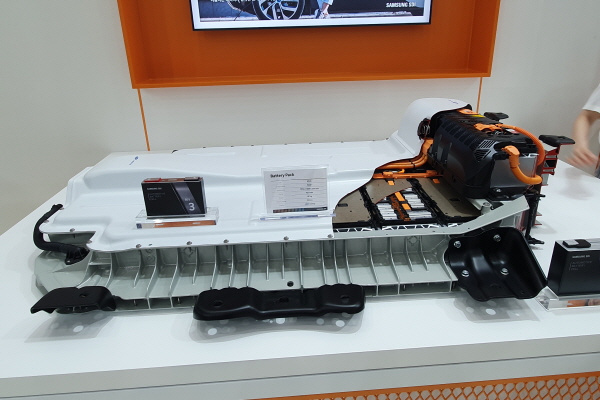
■ Samsung SDI Samsung SDI presented four zones with different characteristics and products, ranging from electric vehicle batteries to batteries for IT and power, batteries for ESS, and batteries for E-mobility.
In the electric vehicle battery zone, the 5th generation battery was exhibited, featuring high-nickel technology with a nickel content of over 88%, enabling a driving range of over 600 km on a single charge. In addition, the battery zone for IT and power showcased batteries applicable to foldable phones, wireless earphones, and power tools, as well as batteries for ESS, batteries for e-scooters, and charging stations.
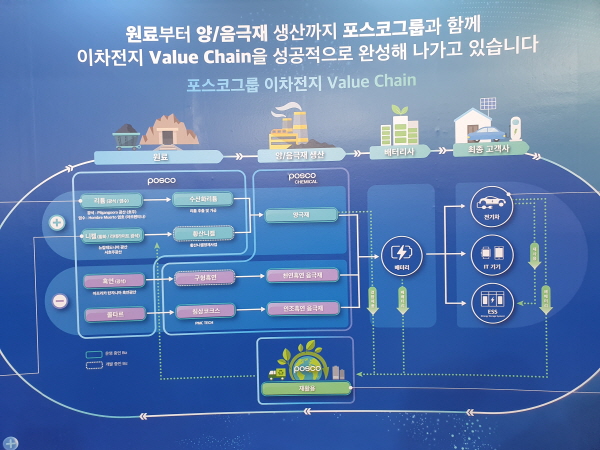
■ POSCO CHEMICAL POSCO Chemical introduced battery materials such as cathode and positive electrode materials, the value chain from raw materials to material production, the next-generation R&D roadmap, and the group's eco-friendly mobility integrated brand, e Autopos.
They introduced high-capacity, high-nickel NCM/NCMA cathode materials to increase the driving range of electric vehicles, and natural graphite/artificial graphite/low-expansion cathode materials that help improve the lifespan and charging speed of batteries, and emphasized their differentiated technological prowess.
In particular, POSCO Chemical also disclosed the status of development of next-generation battery cathode and anode materials as an R&D roadmap. POSCO Chemical is developing nickel content-enhancing technology to increase the driving range of electric vehicles and Co-Free cathode materials. It is also pursuing the development of high-nickel cathode material platform technology to quickly mass-produce customized materials for various electric vehicle specifications. In cathode materials, we are developing silicon cathode materials with high storage capacity and lithium metal cathode materials for all-solid-state batteries.
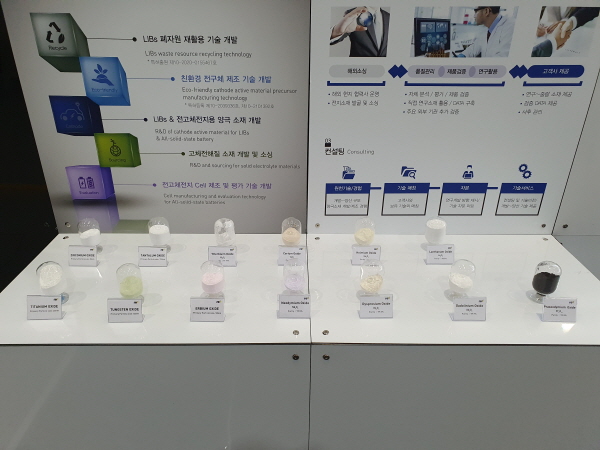
■ Robe Lobe Co., Ltd., a next-generation battery material research and development and distribution company, introduced cathode materials, anode materials, all-solid-state electrolytes, and nano-oxides.
Robe Co., Ltd. develops and sources various materials suitable for the domestic secondary battery and high-functionality material industries and supplies materials that match the research and development direction of customers.
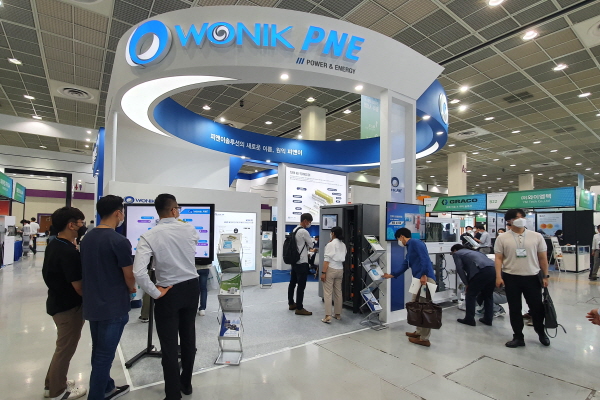
■ Wonik P&I Wonik P&I showcased battery charging and discharging systems and testing equipment.
Wonik P&I's WEMS is a remote integrated monitoring system that can comprehensively monitor each piece of equipment and test data, and has solutions specialized in centralizing and unifying management. In addition to checking the operating status of each piece of equipment, it is possible to monitor various issues and check process and test results in real time.
OPC UA, an industrial automation protocol, is applied, and each operational data and test information is designed to be stored through a legacy or cloud server and monitored through various devices such as PCs, tablet PCs, and smartphones.
In particular, the design has been designed to enhance user convenience, allowing remote updates or control of the operating software of each device, and provides a powerful management solution by sending real-time emails and text messages to registered users regarding any issues that may arise during testing.
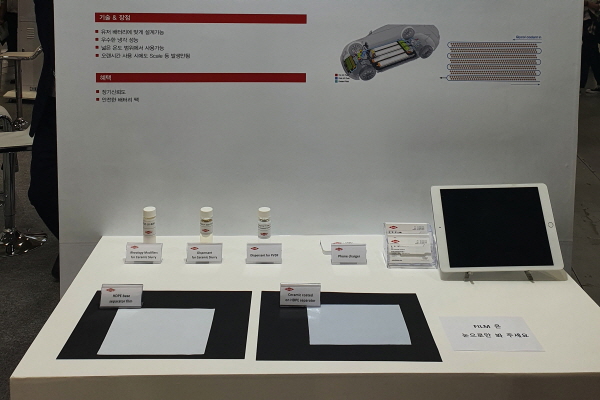
■ Dow Chemical Korea Dow Chemical Korea introduced additives for separators for EV batteries and battery pack coolants.
Various types of additives applicable to the manufacturing of each material in LIB are available. △ Dispersants for ceramic slurry are used for high efficiency, increased adhesion, moisture prevention, and heat shrinkage relief. △ Rheology modifiers for ceramic slurry are excellent in controlling material viscosity, reducing mixing time, excellent bonding, and coating uniformity. Dispersants for PVDF slurry have the effects of high efficiency, improved wettability, and improved slurry stability.
Coolant for temperature control within the LIB pack can be designed to suit the user's battery, has excellent cooling performance, can be used in a wide temperature range, and does not cause scale, etc. even when used for a long time.