“Nano-Fusion 2020 Project, Small Business R&D Success Milestone”
Technology commercialization, thorough market analysis and fierce competition are inevitable
2020 Plus in progress, new R&D methodology expected for 2030 project
[Editor's Note] The 'Nano-Convergence 2020 Project' is a project in which the Ministry of Trade, Industry and Energy and the Ministry of Science and ICT jointly established a single project group to connect the public sector's nanotechnology achievements with new product ideas from the industry and support early commercialization. From 2012 to 2020, 143.7 billion won was invested, and the project achieved results such as 705 billion won in commercialization sales (490% of the government investment), 51 successful commercialization companies, 85 commercialized products, 426 patent applications, 191 patent registrations, and 740 jobs created. The Nano-Convergence 2020 Project, which achieved these results, officially ended at the end of last year, and follow-up projects are currently in progress. On June 8, the 'Final Performance Report' was held to successfully conclude the 'Nano-Convergence 2020 Project'. Accordingly, this magazine arranged an interview with Park Jong-gu, head of the Nano Convergence 2020 Project Group, who has led the Nano Convergence 2020 Project for the past nine years, to hear about the achievements and impressions so far.
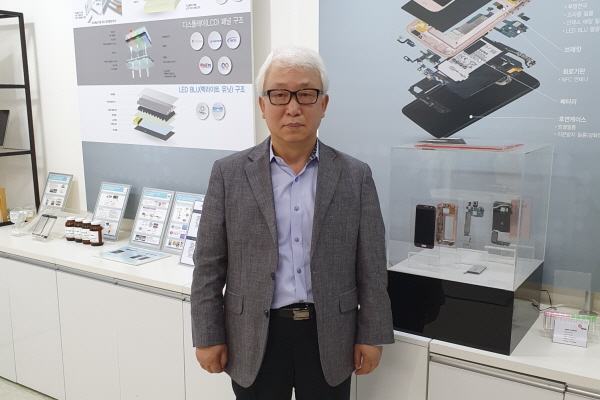
▲Park Jong-gu, Head of Nano Convergence 2020 Project Group ■ Recently, the 'Final Performance Report', which is the successful conclusion of the Nano Convergence 2020 project, was completed. What are your thoughts on the matter? I realized once again that nine years pass quickly.
As I was finishing it, I started to think about how much I knew about technology commercialization when I started commercialization nine years ago.
Even during the preliminary planning of the 2020 project, we thought that if we just filled in the missing parts in the research sector, it would be commercialized, and if we just had good technology, it would be commercialized.
After 9 years of commercialization, I realized that it is not always like that and that market movements are actually important.
First of all, we realized that technology commercialization is different from what we had imagined when we first started, because there are many areas where technology that companies can use right now is important rather than excellent technology. In the process, I think I now have a grasp of what technology commercialization is.
I felt that way and thought about it a lot.
■ The Nano Convergence 2020 project generated high results, such as achieving commercialization sales of KRW 705 billion, which is 490% of the investment amount, with KRW 143.7 billion invested. It is particularly highly regarded for linking government R&D projects to actual commercialization. Please briefly explain your achievements to date.
Since our business is focused on technology commercialization, we cannot avoid talking about money, but if we only look at the amount, we can see that it is a decent result.
But what I am more interested in is that when the government invests in new technologies, whether nanotechnology or biotechnology, the ultimate goal is to commercialize them and create wealth.
What I was more interested in was finding out how these new technologies could be commercialized through certain processes.
Proof that you've found a way is that sales have been generated.
If we look at the composition of the sales revenue of 705 billion won that we generated by investing 143.7 billion won, some projects made a lot of money, and some projects are currently generating revenue.
Since the nature of all such development products and commercialization products is different, at some point in time, a product may generate huge sales, and as time passes, sales of this product decrease while sales of another product increase, so it seems very difficult to judge the performance of national R&D at a specific point in time.
As we wrap up the performance, I feel like we have come to realize that at least some of the technologies in the cutting-edge field of nano can be commercialized if they follow the successful model of the 2020 business.
■ Several achievements have been made over the past 10 years. Please introduce some of your representative achievements.
It is difficult to say which one is particularly important, as each one is an important business.
Among them, there was a product that generated sales of 300 billion won just from our business alone.
The product was a fusion of NT and IT. The IT business has high sales but its life cycle is very short.
While there are such businesses, sales in areas such as materials are very slow.
Even though our sales volume is small right now, we can make predictions.
“In the case of this product, it can generate greater sales after 5 years than IT products whose lifespan ends within 5 years.” We are seeing products like this.
What we give meaning to is that nano is included in the laws related to small and medium-sized businesses, so each industry has its own meaning. It is a commercialization task, but we do not place much significance on sales.
■ There are some successful projects, but I think there are many failed projects. What do you think is the cause of the failure, and if there is a project that you regret the most, please tell us about it. It's all regrettable. Everything is regrettable, but the part that I particularly regretted compared to what I paid attention to was the equipment part.
These days, many people talk about small business owners, but in nano, because we deal with very small parts, measurement and analysis are extremely important.
We have also been investing in equipment even before the issue of small business owners became a thing, and we have developed two pieces of equipment that are very useful in nano.
However, it failed to generate sales. Although some sales were made, the reason it is disappointing is because good performance does not lead to commercialization.
In particular, since equipment such as measurement and analysis equipment is already dominated by global companies, we have to break through the strongholds of these companies. However, when we tried to break into the market for our products, these companies had formed a value chain, and when a competing product appeared, they would bundle it and lower the price significantly, leaving no room for us to enter.
Those are different from what we thought. We thought we could definitely compete because the performance and such were good, but it was unfortunate that the market was not opening well due to other factors, especially the equipment part.
■ What is the future schedule of the Nano Convergence 2020 Project Group? Our business officially ended at the end of 2020, as the performance report was concluded.
Currently, the 2020 Plus Project is underway, which means extending the 2020 Project a little further.
In addition, the Ministry of Science and ICT and the Ministry of Trade, Industry and Energy, which supported the 2020 project, are planning a follow-up project for the 2030 project.
I hope that since we have learned a lot from the 2020 project, if we supplement this a bit more, we will be able to create a model for commercializing new technologies. As 2030 progresses, if we find new methodologies for the areas that were not included in 2020, a model will be created that connects basic research results to commercialization. Since both ministries are interested in this, I think that follow-up projects will be carried out once the preliminary feasibility study is passed.
■ Please give us a word for the development of our country’s materials and components. As I said before, using taxes The reason for investing in research and development is not simply to accumulate knowledge, but to commercialize the accumulated knowledge and ultimately receive it back in the form of taxes.
Our country's R&D is increasing at a rapid pace, and if we master the methodology of the 2020 project, we can start from the original technology and commercialize it quickly, especially in today's fast-paced world.
If we are a little late, the market will already be gone, so if we can find a more effective way to do these things, it will be good for the taxpayers and good for the companies that need to make money through new products.
Also, especially from the researchers' perspective, if they see that the technology they have developed does not end in a paper but is actually turned into a product and this is converted into wealth, I think that research will become even more active, and I hope that through this, R&D in our country will become even more active.
thank you