반도체 AI 인더스트리 4.0 SDV 스마트 IoT 컴퓨터 통신 특수 가스 소재 및 장비 e4ds plus

SK Materials Invests 850 Billion Won in Silicon Anode Materials

기사입력2021.09.15 08:26


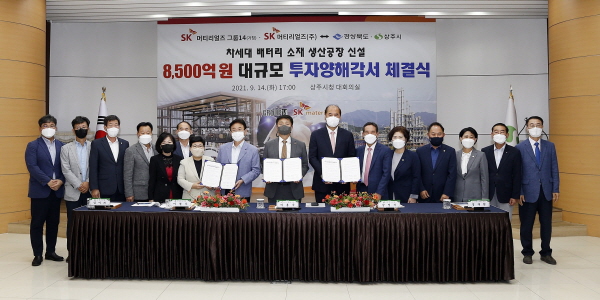
▲(From the eighth person on the left in the photo) Gyeongbuk Governor Lee Cheol-woo, SK Materials President Lee Yong-wook, Sangju Mayor Kang Young-seok and other officials are taking a commemorative photo.

2022 commercial production target, including 300 billion won investment in raw material SiH4

SK Materials (CEO Lee Yong-wook) is investing 850 billion won in the silicon cathode business, which is expected to be a next-generation battery cathode material.

SK Materials Group 14 (tentative name, hereinafter referred to as the joint venture) and SK Materials announced on the 14th that they signed a 'Memorandum of Understanding (MOU) on Investment Agreement' with Gyeongsangbuk-do and Sangju-si to take the lead in the next-generation battery materials industry and will push forward with the establishment of a silicon anode material and raw material production plant with a total scale of KRW 850 billion.

Through the MOU signed on this day, the joint venture will pursue the establishment of a next-generation silicon cathode battery material production plant at the Sangju Cheongni General Industrial Complex site.

The company plans to break ground on its first plant in October of this year, begin commercial production in 2022, and expand further through additional expansion. The total investment is expected to be 550 billion won.

In addition, SK Materials plans to invest a total of KRW 300 billion in the establishment of a plant and purchase of land to produce silane (SiH4), the main raw material for silicon cathode materials, in line with the expansion of the joint venture.

'Silicon cathode material' is currently used in electric vehicles It is receiving a lot of attention as a next-generation battery material because it has improved driving range and shortened charging time compared to the 'graphite anode material' mainly used in batteries.

It can also be used in IT devices such as mobile/tablets and small aircraft such as drones that require convenience and increased usage time due to their lightness and small volume.

In particular, the joint venture's product (SCC55™) solved the problem of reduced lifespan due to volume expansion, which was a problem with existing 'silicon anode materials', by minimizing volume expansion through silicon deposition within a porous carbon support.

Through this, the charge/discharge capacity, initial efficiency, and lifespan have been dramatically improved, and it is currently being evaluated by about 30 customers including not only battery manufacturers but also electric vehicle, home appliance, and IT companies, and discussions are underway for mass production supply after 2022.

According to market research firm SNE Research, silicon anode materials are an industry with very high growth potential, with market demand expected to grow by an average of about 70% per year until 2025 and demand expected to surge to over 200,000 tons by 2030. In particular, the proportion of electric vehicle batteries that require sufficient driving range is expected to increase significantly.

Meanwhile, the joint venture and SK Materials plan to do their utmost to ensure the safety of the local community and its citizens. To this end, SK Materials plans to apply its safety technology know-how, such as securing the best facility stability at each facility/operation stage and establishing a human error prevention system based on ICT solutions, to the established plant.

In the future, SK Materials plans to expand its battery material business area to include CNT (carbon nanotube) conductive materials, binders, and additives, which are high value-added cathode materials and high-functioning cathode auxiliary materials, in line with SK Corporation's battery business direction.

SK Materials President Lee Yong-wook said, “I would like to thank Gyeongsangbuk-do and Sangju-si for their support and warm hospitality that helped facilitate the establishment of this next-generation battery material production plant.” He added, “The joint venture and SK Materials will expand the industry to include not only silicon anode materials but also various battery materials through active investment and technological development, and raise the status of ‘K-battery’ materials in the global market.”

Meanwhile, the joint venture will have a total capital of 77.2 billion won, with SK Materials and Group14 Technologies holding 75% and 25% stakes, respectively, and is scheduled to be established within September. Group14 Technologies is a battery materials company with technology and patents related to silicon anode materials and is headquartered in Seattle, USA.

The signing ceremony held at Sangju City Hall on this day was attended by Gyeongsangbuk-do Governor Lee Cheol-woo, Sangju City Mayor Kang Young-seok, and SK Materials President Lee Yong-wook as representatives.