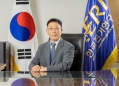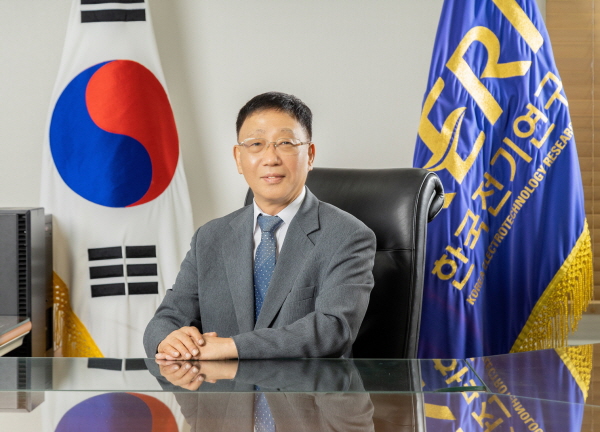
▲The late Myung-Ho Myeong, President of Korea Electrotechnology Research Institute
Aged 63, great achievement in research on countermeasures against electromagnetic waves in power facilities
Myung-Ho Myeong, the president of the Korea Electrotechnology Research Institute who made great achievements in research on countermeasures against electromagnetic waves in power facilities in Korea, has passed away.
The Korea Electrotechnology Research Institute (KERI) announced that President Myeong-Ho Myeong passed away from a cerebral hemorrhage on June 10. He was 63 years old.
Born in Gwangju, Director Myung graduated from Seoul National University's Department of Electrical Engineering in 1981 and received his master's (1983) and doctorate (1996) degrees from the same university.
He has been associated with the Korea Electrotechnology Research Institute since 1985, and has served in succession as the head of the Electric Environment Transmission Research Group, head of the Next-Generation Power Grid Research Center, head of the Future Strategy Office, head of the Research Department, and head of the Testing Department. He was appointed the 14th president of the Korea Electrotechnology Research Institute in August of last year.
Externally, he served as the Korean representative for the electrical environment sector of the International Conference on Large-Scale Electricity (CIGRE), a member of the KEPCO Open Management Committee, a director of Gyeongnam Technopark, a director of the Korea Energy Society, a member of the Korea Technical Standards Committee of the Korea Electrical Association, and an operating committee member of the Korea Electrical Industry Promotion Association.
President Myeong-Ho Myeong's major research and development achievements include 'Development of a program for analyzing and evaluating electromagnetic fields in power facilities.'
This is a technology that predicts the level of electromagnetic fields generated from power facilities such as transmission lines and substations and evaluates the effects they have on devices and the human body. It is evaluated that the quality and safety of domestic power facilities have been greatly improved as a result of localizing programs that had previously been dependent on overseas sources.
In addition to this, it has achieved major research results such as ▲development of commercialization technology for 765 kV ultra-high voltage transmission lines ▲development of electromagnetic wave countermeasure technology and safety assurance for 350 km/h Korean high-speed railways ▲development of core technology to protect national infrastructure from lightning and high-power electromagnetic waves (EMP).
Since 2014, he has been in charge of the management of the institution in earnest as the Vice President of Research, contributing to improving the operation system of major businesses, reorganizing the organization, and establishing the Role and Responsibility (R&R) of the Research Institute. During his tenure as the Vice President of Testing (2016-2018), he effectively led the successful completion of the 4000MVA high-power testing facility expansion project and the establishment of an integrated testing operation system, playing a significant role in strengthening the competitiveness of the domestic power equipment industry.
In August of last year, he was appointed as the 14th President of the Korea Electrotechnology Research Institute, and with the vision of “KERI, the Center of the Electrified World of the Future,” he has put a lot of effort into creating results that the public and businesses can feel.
Representative research achievements during his term include: △Establishment of a foundation for localization and mass production of SiC power semiconductors for electric vehicles, △Transfer of technology for silicon/graphene composite cathode materials for high-capacity lithium-ion batteries, △Domestic development of linear accelerator and magnetron technologies for cancer treatment, and △Transfer of technology for mass production of sulfide-based solid electrolytes for all-solid-state batteries.
In particular, Director Myung worked hard to promote regional development through electrical technology. △ Manufacturing innovation for local companies in Busan and Changwon through AI collaboration with the University of Waterloo in Canada △ Construction of the 'HVDC Power Equipment International Accredited Testing and Certification Center' to expand the export base of domestic power equipment companies △ Support for revitalization of the Changwon Gangseo Research and Development Special Zone in Gyeongnam △ Expansion of the 'Technology Startup Center' to revitalize local startups △ Construction of the 'e-Nano Material Chemical/Wet Process Platform' for self-reliance in electric new materials and components technology △ Construction of the 'Gwangju Redox Flow Battery Testing and Certification Center' to achieve carbon neutrality, etc. have played a major role in enhancing local industrial competitiveness.
Internally, the research institute has been working hard to build a new organizational culture, emphasizing “upward innovation” where everyone, regardless of rank, can express their opinions in an equal and fair manner and demonstrate collective intelligence. Director Myung, who has a reasonable and gentle personality, actively communicates with employees and has been greatly respected and loved.
He is survived by his wife, Shim Hyo-jeong, and two sons (Myeong Je-hak and Myeong Seung-hyeon). The funeral will be held on June 13 at the funeral hall of Korea University Anam Hospital, and the remains of the deceased will be cremated at Yeongsaengwon in Seongnam and buried at Bongandang Home in Bundang.