Up to 18 billion won in cost savings for 500 subway stations
A technology that can reduce ultrafine dust without a filter using static electricity has been developed for the first time in the world, which will save up to 18 billion won per year based on 500 subway stations.
The Korea Institute of Machinery and Materials (President Park Sang-jin) under the Ministry of Science and ICT announced on the 13th that it has succeeded in developing a filter-less air purification technology that can collect ultrafine dust using electrostatic force and clean it through the wind.
A demonstration project in a large-area indoor space, such as a subway station, is also underway at Daejeon Transportation Corporation’s Yuseong Hot Springs Station. Demonstrations are also planned in tunnels connecting to Seodaejeon Negeori Station, Oryong Station, and Jung-gu Office Station.
In addition, the 'Ultrafine Dust Zero Living Lab' has been installed and operated at Daejeon Station since early April, and this is the first case of a research-led living lab where Daejeon subway users can experience the technology.
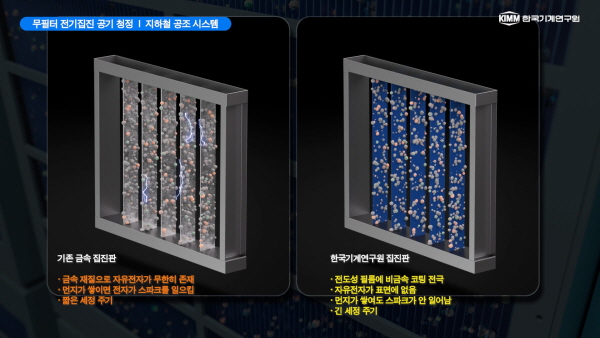
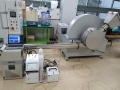
The research team led by Kim Hak-jun, a senior researcher at the Sustainable Environment Research Lab of the Environmentally Friendly Energy Conversion Research Department of the Korea Institute of Machinery and Materials, developed a low-pressure module using ultrafine fiber discharge electrodes and non-metallic carbon plates to develop a filter-free ultrafine dust reduction device. When a low current of several watts is passed through this module, it generates air ions that spread inside subway stations and meet suspended ultrafine dust, generating static electricity.
The ultrafine dust particles that are formed in this way and have ions attached to them are sucked into air conditioners and air purifiers and captured in the dust collector that attracts static electricity. When the capture accumulates and the purification ability decreases, a strong wind is generated in front of the dust collector to separate the ultrafine dust from the dust collector, and at the same time, the dust is sucked in with a vacuum cleaner at the back to dry clean it without using water.
The research team has now obtained research results showing that the concentration of ultrafine dust in the air entering through this technology can be reduced by up to 90% of the initial maximum. In platforms and waiting rooms that are continuously exposed to the outside, a reduction effect of 75% and 40%, respectively, was confirmed compared to the external ultrafine dust concentration.
Until now, the air purification technology using filters has been commonly used. When dust accumulates on the filter, it blocks the wind, causing a large pressure loss and consequently a large amount of electricity consumption. In addition, frequent replacement of filters has resulted in replacement costs of at least several billion won per year.
Air purifiers using the existing electrostatic collection method generate a lot of ozone while creating ions, and because the collection part must be washed with water during cleaning, it takes at least a day to dry, and there is also the disadvantage of having to consider the possibility of freezing of the cleaning water pipes in winter and the generation of waste water after cleaning.
If the technology developed by the Korea Institute of Machinery and Materials is applied this time, ozone is hardly generated when ions are generated, and since wind is used instead of water when cleaning the dust collector, there is no possibility of secondary pollution, and power usage can be reduced by 80%, making it much more economical than existing methods. If applied to 500 subway stations, annual maintenance costs can be expected to be reduced by 2 to 3 billion won and fan replacement costs by 15 billion won.
This technology has been transferred to a company specializing in ultrafine dust reduction technology and is being commercialized.
Kim Hak-jun, a senior researcher at the Korea Institute of Machinery and Materials, said, “The ultra-fine dust reduction technology using static electricity is the only technology that can quickly supply a large amount of clean air to large spaces such as subway stations without blocking the wind.” He added, “We will work to solve the problems of existing electrostatic technology with our filter-less electrostatic ultra-fine dust reduction technology and to apply it not only to subway stations but also to various spaces such as schools, offices, and buildings.”
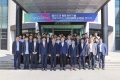
Park Sang-jin, the president of the Korea Institute of Machinery and Materials, said, “This is a significant case in which the technology developed by the institute is linked with the local community in Daejeon, allowing residents to experience the effects of the technology at all times.” He added, “We will continue to work hard to develop technologies that can contribute to the safety and welfare of all citizens.”
Meanwhile, this study was conducted with the support of the 'Development of ultra-clean mechanical technology for future power generation/power systems in response to fine dust and greenhouse gases' project of the Basic Project of the Korea Institute of Machinery and Materials and the 'Development of low-cost, environmentally friendly passive subway ultra-fine dust reduction technology' project of the Ministry of Science and ICT.