Development of high-capacity electrode technology with enhanced atmospheric stability
The Korea Electronics Technology Institute (KETI, President Shin Hee-dong) has secured the economic feasibility of the all-solid-state battery manufacturing process by developing high-capacity electrode technology that enhances atmospheric stability.
KETI announced on the 7th that it has developed a technology to improve the atmospheric stability of sulfide solid electrolytes, a key material for all-solid-state batteries, and that the related content was published in the latest issue of a renowned international academic journal.
All-solid-state batteries based on sulfide solid electrolytes are suitable for manufacturing large-area, high-capacity batteries for electric vehicles, and global companies are fiercely competing in R&D to commercialize the technology.
On the other hand, sulfide solid electrolytes are vulnerable to moisture in the air and have the disadvantage of generating hydrogen sulfide, a harmful gas. This can deteriorate battery performance, which has led to problematic situations where the process is carried out in expensive facilities such as dry rooms where moisture is extremely controlled.
The research team led by Dr. Woo-Seok Jo (Senior Researcher) at the KETI Next Generation Battery Research Center, through joint overseas research with the University of Wollongong, a research-oriented public university in Australia (Professor Jeong-Ho Kim's research team) and Kyung Hee University (Professor Min-Sik Park's research team), drastically reduced the amount of harmful gases emitted when exposed to the air by adding a small amount of special nanoparticles to a sulfide solid electrolyte.
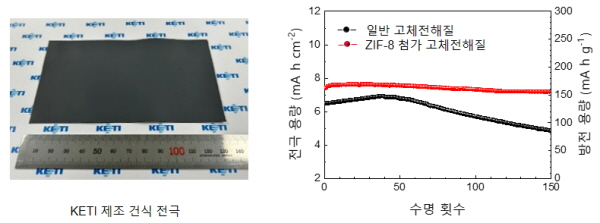
Specifically, the research team developed ZIF-8 (Zeolitic imidazolate framework), a type of metal-organic framework (MOF).By utilizing the property of ork-8) particles to simultaneously adsorb moisture and hydrogen sulfide gas, the amount of hydrogen sulfide gas generated from a sulfide solid electrolyte when exposed to the atmosphere was reduced by 90%, and the decrease in ionic conductivity was also suppressed to around 25%.
Furthermore, the research team manufactured a dry electrode with a loading of 40 mg/cm2 based on the ZIF-8 additive in a normal atmospheric environment rather than a special dry room, and conducted a 100-cycle charge/discharge test at room temperature on a battery with an electrode capacity of 7.3 mAh/cm2 (twice that of a lithium-ion battery), securing a lifespan maintenance rate of 98.4%, thereby maximizing the atmospheric stability of the solid electrolyte.
According to Dr. Cho Woo-seok, who led the research and development, the application of this technology has enabled electrode manufacturing in a general dry room or similar environment with low operating costs, and is expected to contribute to reducing future process costs and accelerate the commercialization of all-solid-state batteries.
The results of this study, which was supported by the Ministry of Trade, Industry and Energy and the Korea Institute of Industrial Technology Evaluation and Planning, were published in the latest issue of ACS Nano (IF=18.027), an international academic journal in the field of nanoscience, under the title “Dry electrode for all-solid-state batteries enhanced with moisture absorbents.”
KETI Next-Generation Battery Research Center Director Yoo Ji-sang said, “KETI is conducting a wide range of research in the next-generation battery field, including not only all-solid-state battery materials and electrode element technologies, but also battery manufacturing technologies,” and “As a key domestic research institute in the all-solid-state battery field, we will do our best in research to commercialize next-generation batteries.”