반도체 AI 인더스트리 4.0 SDV 스마트 IoT 컴퓨터 통신 특수 가스 소재 및 장비 e4ds plus

Machinery Research Institute Develops Turbo-Brayton Cryogenic Cooling System

기사입력2023.09.21 08:59

10kW cooling performance, superconducting cable and LNG carrier possible

The full-cycle technology for the Turbo-Brayton cryogenic cooling system, which is the basis for cryogenic cooling plants including hydrogen liquefaction and LNG liquefaction plants, has been developed for the first time in Korea.

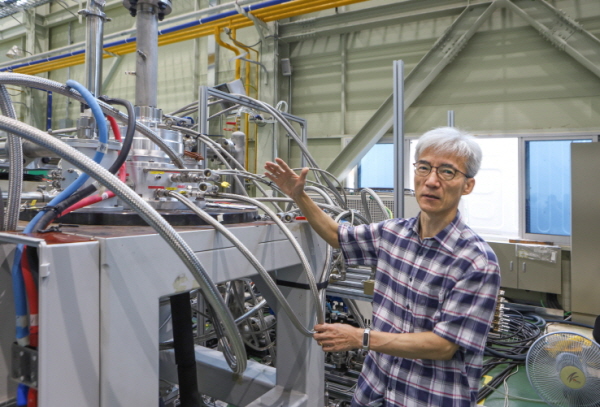
The research team led by Senior Researcher Yeom Han-gil of the Extreme Thermal Fluid Machinery Laboratory at the Korea Institute of Machinery and Materials (President Park Sang-jin, hereinafter referred to as KIMM) under the Ministry of Science and ICT has built a Turbo-Brayton cryogenic cooling system with a cooling performance of 10 kW at -196℃ and completed its operation test. This is the first time in Korea that the entire process technology from cooling system design to construction has been developed.

▲Korea Institute of Machinery and Materials’ Chief Researcher Yeom Han-gil explains the principles of the Turbo-Brayton cryogenic cooling system.


The Turbo-Brayton cryogenic cooling system is a core technology for cryogenic plants such as hydrogen liquefaction, LNG liquefaction, helium liquefaction, and superconducting power equipment cooling systems. Large-scale cryogenic cooling has been required in various industrial fields.

Centrifugal compressors and turbo expanders that rotate at ultra-high speeds at cryogenic operating temperatures are core components of cryogenic cooling systems, but due to a lack of domestic technology, they have been entirely dependent on imports.

The research team succeeded in domestically producing a centrifugal compressor and turbo expander, and through this development, secured all the technologies necessary for designing, manufacturing, constructing, operating, and controlling cryogenic cooling systems domestically. It is expected to be used in superconducting cables, a next-generation power technology, and domestic LNG carriers.

“The cooling system developed this time uses helium, neon, and nitrogen, which do not affect global warming, as refrigerants, and can provide large-capacity cooling over a wide temperature range of -40 to 250℃,” said Han-gil Yeom, a senior researcher at the Korea Institute of Machinery and Materials. “It is expected to provide eco-friendly cooling technology to industries where precise temperature control is important, such as semiconductors and gas industries.”

Meanwhile, this study was conducted with the support of the basic project of the Korea Institute of Machinery and Materials, ‘Development of an ultra-low temperature cooling system for future energy.’