Smart Factory, Intelligent Flexible Production System Needed
Advantages of 5G: Mobility, Ease of Deployment, Hyper-Connectivity
Developing solutions beyond the factory indirect area and beyond the direct area As the growth rate of 5G B2C subscribers slows, mobile carriers are gradually implementing plans to attract 5G B2B subscribers.
As various 5G-based BMs (Business Models), including extrasensory content, are being developed, smart factories are being cited as a representative B2B field where 5G can be applied.

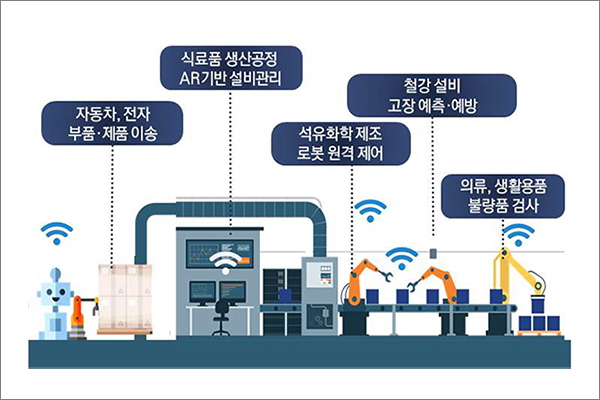
▲ Example of 5G used in smart factories (Image = Ministry of Science and ICT)
A smart factory is an intelligent factory that applies ICT technology combined with digital solutions to the production process to improve productivity, quality, and customer satisfaction. In other words, a smart factory is a factory with an intelligent and flexible production system for producing customer-tailored products.
5G clearly has the potential to advance smart factories. Let’s take a look at why.
Advantages of 5G over other communications in smart factories There are three advantages to 5G.
First, it is ultra-high speed. 5G is 20 times faster than LTE. The maximum transmission speed is 20 Gbps, and the typical speed is 10 Gbps. Next, ultra-low latency. 5G's transmission delay (1ms) is 10 times shorter than LTE (10ms). Lastly, it is hyperconnectivity. The maximum number of devices connected to 5G is 1 million per 1km2, which is 10 times more than LTE's 100,000.
These 5G advantages are the advantages of 5G over LTE. The biggest advantage that 5G can differentiate within a smart factory is that it is wireless communication itself. The advantages of wireless are mobility, variability, ease of construction, and hyper-connectivity.

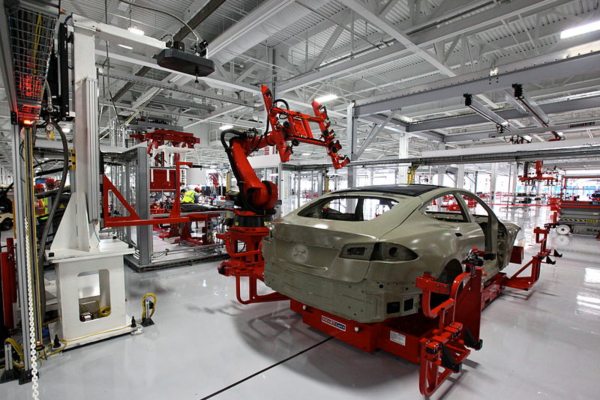
▲ Tesla's smart factory (Photo = Tesla)
There are four elements that make up a smart factory: △operating system △analysis platform △network infrastructure △field equipment. 5G has advantages over existing mobile and wired/wireless networks in terms of network infrastructure.
In terms of data transmission volume per facility, data transmission volume per factory, authentication, encryption, security, and the time it takes for data to arrive, 5G is close to the performance of wired communications such as Ethernet, and in terms of the number of facilities and sensors to be connected, ease and economy of construction and operation, and mobility support, it has an advantage because it is wireless.
Compared to existing mobile communications such as LTE and existing wireless communications such as Wi-Fi, it can be said to be superior in all aspects when optimization for each use is not considered.
Smart factory construction trend that increases 5G demand There are five steps a factory must go through to transform into a smart factory.
The first stage is a manual stage that improves the process based on experience. The second stage is a computerization stage that implements data management through the system. The third stage is an automation stage that implements standard/rule-based process control and efficiency. The fourth stage is an information stage that implements data-based analysis optimization. The last fifth stage is an intelligence stage that implements predictive control and autonomy/flexibility using AI.
Current automated factories only partially reflect customer needs in the process. The cycle of design-manufacturing-logistics-customer is still long. This is because automation was pursued for supplier-centered mass production. The line production system constructed in this way is vertical and closed.

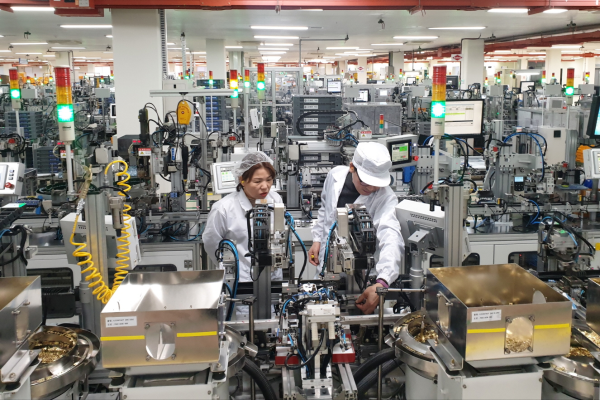
▲ LS Industrial Systems Cheongju Smart Factory (Photo = LS Industrial Systems)
On the other hand, smart factories pursuing 5-stage intelligence reflect increasingly diverse customer demands in their processes while also having a short cycle. They build a flexible production system while simultaneously pursuing automation and intelligence for demand-oriented, customer-tailored production.
To achieve this, △all types of equipment within the factory must be hyper-connected to collect, analyze, and control big data, and △free movement and change of equipment must be enabled. For such factory intelligence and flexible production systems, a high-quality wireless network is required, and 5G can play that role.
As mentioned earlier, 5G has higher performance than existing wireless networks. Accordingly, an era has arrived where wireless-specific mobility, variability, ease of deployment, and hyper-connectivity can be utilized.
Mobile communication from the indirect area to the direct area The number of mobile subscribers in our country has already exceeded 60 million in 2016. This is 10 million more than the total population. B2C is already saturated. Accordingly, mobile carriers plan to use the IoT industry through 5G as a new business engine.
LG Uplus, the third largest mobile carrier in Korea, has been commercializing IIoT solutions and services for smart factories based on LTE since 2016.
So far, the goal has been to cover the indirect areas (safety, environment, security, logistics) of large and complex factories that require wireless connectivity based on the advantages of mobile communications, such as wide coverage and mobility. Since 2018, as 5G technology matures, we are pursuing expansion into direct areas (facilities, quality, processes, and production).

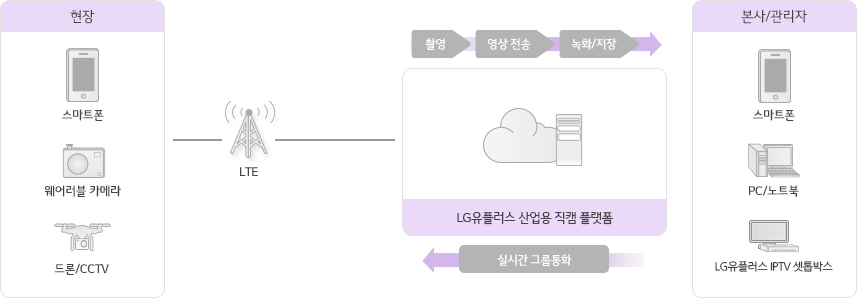
▲ U+ Industrial Cam Service Configuration Diagram (Image = LG U+)
In the indirect sector, LG U+ has already introduced LTE-based △(Safety) industrial direct cam, IoT helmet, IoT earthquake safety, IoT gas safety, worker safety management △(Environment) IoT flow management, IoT odor diagnosis △(Security) app-based radio △(Logistics) app-based location and route control, vehicle control solution that automatically creates driving logs, etc.
In addition, in the direct field, we are providing solutions for environment-based diagnosis and big data analysis through IoT motor diagnosis and IoT pump management in the facility field, and are currently exploring 5G-based smart factory solutions in the production, process, and quality fields.
Currently, LG Uplus is continuing research and verification on how 5G can be utilized in ▲operating systems such as ERP, MES, DCS, SCADA, ECS, and CPS ▲facility predictive maintenance solutions ▲quality prediction solutions ▲automatic vision inspection using AI deep learning ▲logistics mobile robots such as AGVs and AMRs ▲cloud-controlled robots ▲facility management and education and training using MR ▲intelligent CCTV ▲remote operation of facilities and inspections, etc.
Security, still a problem to be solved /> Security is an essential aspect to consider when applying 5G to smart factories. According to Penta Security’s column, 5G is structurally vulnerable to security. Unlike existing networks that are closed to each other by sector and purpose, 5G is designed to be open and applied in a distributed structure according to purpose.
This is a network slicing method that splits the bandwidth and applies it to various fields, dividing one network into virtual dedicated networks for communications, IoT, VR, autonomous driving, etc. Since it is the same network even after being separated, all types of data are exchanged even at general base stations.
If the network is closed by sector, even if equipment hacking occurs, the damage is limited to that sector, and it is easy to optimize and apply security measures for each sector. However, in a 5G environment, there is a risk of all types of data being touched through equipment hacking.
Therefore, security risk management is a more important business competitiveness than anything else in 5G and is also an important factor in maintaining the stability of smart factories.

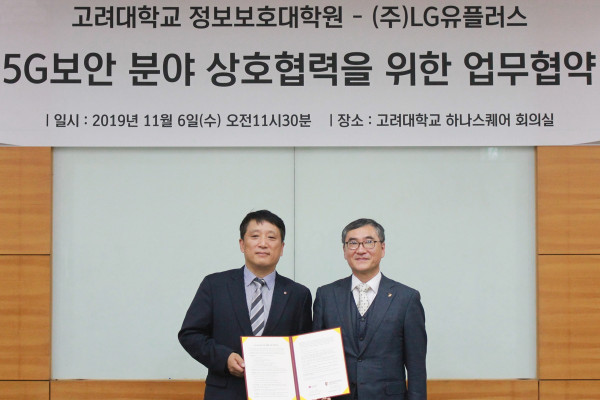
▲ In November last year, U+ signed an MOU with Korea University on 5G security.
signed (Photo = LG Uplus)
As a 5G security solution, KT is putting forward blockchain, and SK Telecom is putting forward quantum cryptography. LG Uplus signed an MOU with Korea University's Graduate School of Information Security to ensure 5G network security and stability, and the Ministry of Science and ICT also launched the 5G Security Council.
In summary 5G is not yet a widely used network in smart factories. This is because it is technologically immature compared to other wired and wireless networks used in existing industrial automation fields, and above all, its specific use is unclear.
However, attempts and research to introduce 5G to smart factories are continuing, with the government and mobile telecommunications companies being the most active.
Last October, the Ministry of Science and ICT and other related ministries jointly announced a 5G-based smart factory advancement strategy, and SKT and KT also formed a 5G MEC (Mobile Edge Computing) joint research group with global telecommunications companies to provide consumer-tailored services to smart factories.
“Industries or applications that can benefit greatly from using 5G while bearing the cost will adopt 5G,” said Choi Yoo-soon, team leader at Siemens Digital Industries. “5G will find its place in the industrial field,” said another industrial automation industry official.
At the Smart Manufacturing Best Practices Conference 2019 held in November last year, LG Uplus Advisor Park Jong-wook said, “5G is highly utilized in factories that require flexible wireless-based production process operation due to frequent changes in production models,” and “5G will become the core of the intelligence and flexibility of future smart factories.”
The benefits of 5G are clear, and they can help build a new level of smart factories by making them intelligent and flexible. However, to do so, it will be necessary to understand what is required in the actual production environment and provide appropriate solutions accordingly.