마이크로칩7월
Physical AI HBM Smart Factory SDV AIoT Power Semicon 특수 가스 정정·반론보도 모음 e4ds plus

[IT 인사이트] 2026, 5G market value '45 trillion won'

Google 우선 소스 기사입력2023.01.31 14:52


17 trillion in 2023… Metaverse demand ↑ in 2-3 years
Industrial manufacturing 32%, energy and utilities 18%, etc.
5G-IoT Market Expansion… Reaching 116 Million Units

It is projected that the 5G market value will reach 45 trillion won in 2026.

TrendForce announced on the 19th that the global 5G market size in 2023 will reach 14.5 billion USD (17 trillion KRW) through the activation of 5G private networks by enterprises, advancement of dedicated small cell equipment, and 5G FWA, and will reach 37 billion USD (45 trillion KRW) in 2026, with a CAGR of 11.0%. In addition, metaverse-related applications were mentioned as notable applications.

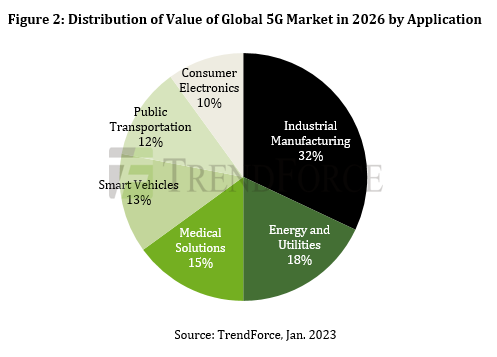
The key application areas of the 5G network market are industrial manufacturing, energy and utilities, healthcare solutions, smart vehicles, public transportation, and home appliances.

Industrial manufacturing will be the largest at 32%, followed by energy and utilities at 18%. Healthcare solutions will be 15%, with a focus on telemedicine, which has been particularly popular since the pandemic. Smart vehicles and public transportation are expected to account for a combined 25%.

Manufacturers are leveraging 5G in smart factories to make their production processes more intelligent, combining it with solutions for data visualization and analytics. In the energy sector, it is used to connect smart energy meters to the power grid or applied to energy equipment for power monitoring and preventive maintenance.

Automakers and auto parts suppliers are using low-latency 5G to improve advanced driver assistance systems (ADAS) and to apply them to Mobility as a Service (MaaS) platforms.

■ 5G-IoT connections to reach 116 million by 2026

The consumer electronics sector accounts for 10%, with 5G solutions embedded in smart appliances and devices, all interconnected.

The expansion of 5G infrastructure construction has contributed to the development of edge computing technology. Taiwanese company SERCOM has developed 5G small cells and 5G FWA equipment.

According to market research firm Juniper Research, the number of 5G-based IoT connections deployed on high-performance machines currently stands at 17 million, but is expected to reach 116 million worldwide by 2026.

This is only 17 million as of now, but it is expected to grow rapidly by 1,100% over the next three years, and the healthcare sector and urban services are expected to lead the adoption of 5G-based IoT solutions.

In particular, the healthcare and smart city markets are expected to account for more than 60% of 5G IoT devices.

More than 60 million of them will be created worldwide in the smart city sector, and their use as 'high-bandwidth gateways' is being urged. Monitoring of transportation networks, including road and rail networks, is expected to be a key service requiring 5G-enabled, high-bandwidth cellular connectivity.
■ It will take 2-3 years for the metaverse to see an increase in demand
 

Although demand for metaverse-related applications is still insufficient, it is expected to become active in three years.

The metaverse is a newly emerging concept, and companies dealing with related applications and services are still in the early exploration stage, so it is expected that more time will be needed for development.

Applications under the metaverse have greater interaction between parties than applications under cloud services. They also require high-speed, stable networks, such as creating a digital twin of the user, which requires 5G technology.

Core technologies such as AR/VR and control interfaces in the metaverse have individual applicability, and are mainly focused on social media, multiplayer games, educational services, simulation training, remote collaboration, and virtual meetings.

Meanwhile, Nokia, Ericsson, Huawei and others have announced that they have upgraded their network equipment to support related services and applications, which will enable them to handle the high-speed computing demands generated by large-scale and real-time virtual interactions occurring on the metaverse platform.