2026 Physical AI Conference
반도체 AI 인더스트리 4.0 SDV 스마트 IoT 컴퓨터 통신 특수 가스 소재 및 장비 e4ds plus

[IT 인사이트] “Korean IT service industry must secure cloud-based competitiveness”

기사입력2023.02.21 16:58


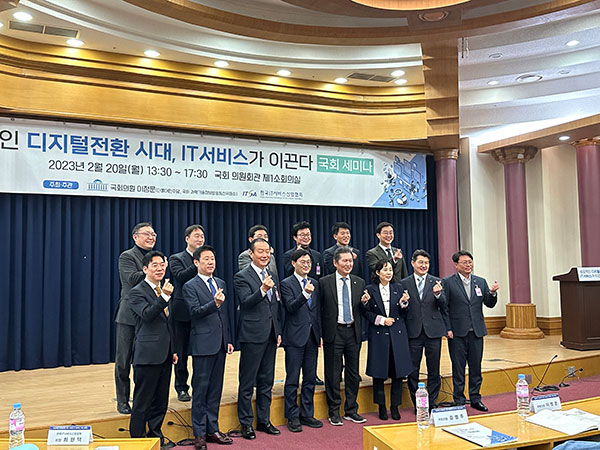
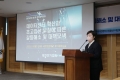
▲20th National Assembly Seminar on ‘Successful Digital Transformation Era, Led by IT Services’

Discussion on the development direction of IT service industry including IBM and Samsung SDS
Institutionalization and talent development to respond to diversified IT service needs

As the demand for infrastructure required for management has rapidly increased due to the development of IT technology, new application fields have increased, and the IT service industry has established itself as an important national industry, but it is facing a crisis due to its reputation as a low value-added industry.

There was a consensus that it is essential to introduce cloud computing for the development of the IT service industry, and that national efforts such as institutionalization and talent development are important.

On the 20th, the 1st Small Conference Room of the National Assembly hosted the event, “IT Services Lead the Way in the Era of Successful Digital Transformation,” which provided a forum for sharing business strategies on the direction in which the IT service industry should move forward in the era of digital transformation.

The IT service industry is an industry that supports all necessary utilization of information systemization, from customized consulting to system construction (SI), operation (SM), and IT system training, and grows human resources, companies, and countries.

In his opening speech, Rep. Lee Jeong-moon of the Democratic Party of Korea said, “The paradigm of our country’s IT service industry has changed significantly, and experts from academia, industry, and research must work together to innovate business models accordingly.” In his welcoming speech, Choi Hyun-taek, Chairman of the Korea IT Service Industry, said, “The purpose of the IT service industry should not end with digital transformation itself, and industry, academia, and research institutes should discuss together to contribute to maintaining and developing corporate competitiveness.”

■ IT Service Industry Crisis? “Change is Inevitable”

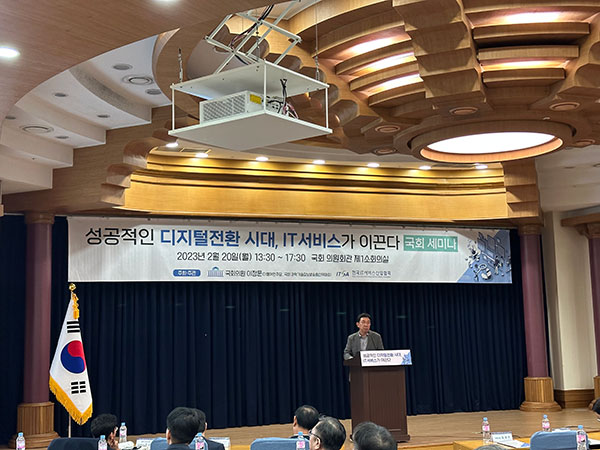
▲20th National Assembly Seminar on ‘Successful Digital Transformation Era, Led by IT Services’ (Professor Jo Moon-jeung, Gyeongsang National University)
 
In his presentation, Won Sung-sik, president of IBM Korea, claimed, “The current IT service industry has contributed to the formation of the market, but is experiencing problems such as a loss of human resources. By opening up the market and making it competitive, we can lead the upward development of the ecosystem.”

Founded in 1967, IBM Korea has been providing IT technology services since the 1990s, and now, AI cloud-related sales account for 50% of its new sales. President Won said, “IBM has gone through inevitable changes to accommodate market changes.”

CEO Won cited four areas that require development and investment in new service forms as they evolve into a cloud-based environment: △application modernization, △data and AI utilization, △security, and △operational automation. Within each area, IBM is developing automation solutions and working with various operators to provide solutions and services in a combined form.

Finally, CEO Won said, “IT services are a field that has considerable ripple effects, so in order to create a structure that generates profitability, we need to develop new technologies together with domestic service providers and open up closed markets.”

In his presentation, Professor Cho Moon-jeung of Gyeongsang National University said, “The customer-tailored IT service industry is continuously developing, and the development of cloud-based IT services is inevitable.” He argued, “In order to overcome the difficulties of the Korean IT service industry, the country must introduce and institutionalize new development methods at the national level and strive to foster key talent.”

The cloud is an innovation in IT procurement methods, enabling rapid response and leading to cost efficiency. Professor Cho said, “The change to the cloud is inevitable, and a change to a business structure that fits it is essential.”

Professor Cho asserted, “As users’ needs diversify, IT services must evolve in new directions.” To this end, he added, “We must gradually provide an atmosphere that tolerates failure and focus on nurturing talent.”

KRG Vice President Kim Chang-hoon also said, “They say our country is investing a lot in IT services, but compared to global companies, it is lacking,” and added, “It is important to recognize this as an urgent matter and lay a good foundation.”

The Korean big tech market is expected to grow by an average of 6.6% per year until 2027, and cloud spending is growing steadily by more than 25%. However, the digital IT spending ratio in Korea is only at 0.7-1%, which is low compared to the global level (4-5%).

Vice President Kim asserted, “The reason for the passive attitude of domestic companies is the complexity of the promotion process or decision-making process,” and “Ultimately, a change in awareness to improve obstacles is important for digital transformation.”

■ Samsung SDS, cloud adoption case introduction

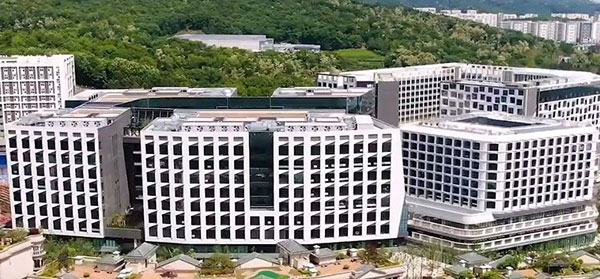
▲Samsung SDS Pangyo IT Campus
 
Samsung SDS Vice President Eun-Joo Lee introduced a case of innovation achieved through actual cloud adoption.

Since the early 2010s, the paradigm of IT services has changed, and platform-based businesses have emerged and become popular. In addition, new digital innovation cases have emerged through digital twin and my data technologies.

In particular, the transition to the cloud has accelerated due to the activation of non-face-to-face services caused by the Corona pandemic. There have been more cases such as the online non-face-to-face recruitment process (GSAT) and the Galaxy Unpacked online simultaneous live broadcast worldwide. Vice President Lee said, “Samsung SDS operates an eco-friendly, high-performance data center and is being applied in various ways, including to financial customers.”

Meanwhile, at the event that day, CJ OliveNetworks Center Director Han Kang-hee announced a plan to build a 5G-based infrastructure.

5G is a term for a 5G specialized network. It is a wireless network that can be introduced by demand companies in specific areas such as factories and buildings through the 5G characteristics of ultra-low latency, ultra-high speed, and ultra-connectivity, and can be utilized in fields such as logistics, manufacturing, medical care, and media.

One center director claimed, “Fast data communication is necessary for logistics robot control, non-face-to-face collaboration in manufacturing sites, etc., and through 5G communication, we can secure business competitiveness through service innovation in various fields.”